
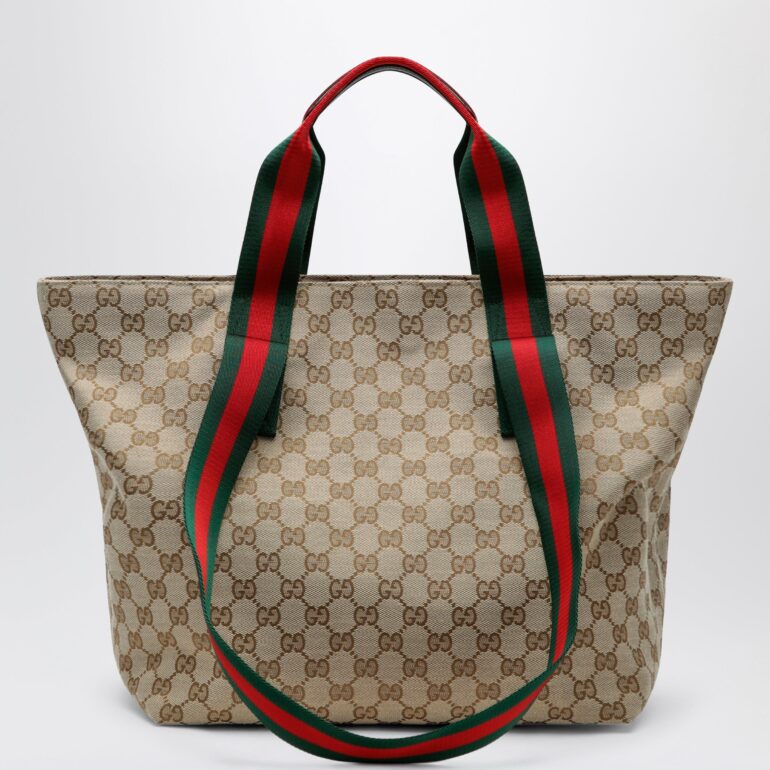
Forty thousand renminbi to spend, and in the end, a gold bracelet instead of a Gucci bag. As recounted by a consumer on Chinese social media, this choice obviously doesn’t tell the whole story about a market. Yet it raises the question that is currently troubling the luxury industry: what remains of a brand’s power when its customers begin to compare what they buy with what they think they can keep? In China, Gucci is cutting the prices of certain bags and clothing items. But there remains a considerable gap between a lower price tag and a renewed desire.
The Handbag Versus the Weight of Gold
Gucci’s most revealing competitor isn’t necessarily another fashion house. In several comments posted on Chinese social media, gold emerges as a more compelling destination for a budget allocated to luxury. This comparison shifts the debate. It is no longer a matter of preferring a silhouette, a pattern, or a signature, but of choosing between two ways of assigning value to an object.
A piece of gold jewelry can give its buyer the feeling of paying for a recognizable material, one that is built to last and likely to represent an inheritance. This perception is neither a promise of return nor a guarantee of resale value. Nevertheless, it offers a tangible point of reference compared to the price of a handbag, whose appeal depends more on embracing a fashion concept and a brand.
The anecdote about the 40,000 renminbi is interesting precisely because it does not depict a decision to forgo spending. The budget exists; it is simply being allocated elsewhere. For Gucci, the challenge is therefore not limited to making its products accessible to more customers. It also involves convincing those who can afford to buy that a bag is always worth the trade-off.
A price cut may encourage people to wait
This is the other paradox of this price adjustment: a lower price doesn’t necessarily trigger a faster purchase. It may suggest that it would be wise to wait. Following the price hikes in the luxury sector during the post-pandemic period, this reversal introduces a new layer of uncertainty. Is today’s price an opportunity to seize, or a stepping stone before the next reduction?
A survey conducted on Xiaohongshu illustrates this hesitation, albeit on a very small scale. Of fifteen participants, seven said they would buy a Gucci bag. Five preferred to wait, hoping for further price drops. The remaining three ruled out a purchase, as the price remained too high in their eyes. It’s impossible to draw a conclusion from this sample that is representative of Chinese consumers. Its small size prevents it from serving as a barometer of market trends.
These responses do, however, reveal very different reactions to the same decision. For some, the discount brings the purchase closer. For others, it leads to a wait-and-see attitude. For the rest, it doesn’t change the equation enough. The risk for the brand would be that customers shift their focus from the product to the pricing schedule: no longer choosing the bag they like, but looking for the right time to buy it.
Adjustments That Go Beyond a Symbolic Gesture
The adjustments observed are significant enough to fuel these questions. The small Mercato tote from the Spring-Summer 2026 collection, previously priced at 25,500 renminbi, has dropped to 20,000 renminbi—approximately 2,600 euros. The price drop is nearly 22 percent. For a product of this value, the difference is far from trivial.
The price cut is even more pronounced for the Ophidia mini bucket bag: its price has dropped from 12,300 to 8,700 renminbi. That’s 3,600 renminbi less, representing a decrease of about 29%. The price adjustments aren’t limited to leather goods. A selection of dresses, swimwear, and knitwear is also seeing discounts of around 30%.
This is therefore not a documented across-the-board price drop for the entire catalog, but rather a targeted adjustment affecting several products and categories. This distinction matters. It prevents the promotion from being portrayed as a complete overhaul of Gucci’s pricing strategy, while demonstrating that the brand is taking action beyond a single product.
On September 8, its official customer service department confirmed these adjustments. The explanation remained general: Gucci periodically revises its prices based on various market factors. No specific reason was given for this series of price cuts. The brand thus leaves open the interpretation of a decision that breaks with the price hikes widely adopted by major luxury groups in the wake of the pandemic.
In China, the problem extends far beyond Gucci
This change comes in a market where demand remains difficult to stimulate. According to data from Bernstein and Mertico, sales at major Chinese shopping malls specializing in luxury goods fell by 12% in July compared to the same month last year. The decline spans product categories and price points. It would therefore be simplistic to interpret this as merely a challenge facing a single brand or product line.

Bernstein has lowered its growth forecast for the sector in the third quarter: the estimate has been revised from 6.3% to 4.9%. The forecast for all of 2026 is now set at 5.1%. These projections remain positive, but their revision reflects less favorable expectations. They should not be confused with the decline observed in July at shopping malls: the indicators do not cover the same scope or the same time period.
For Gucci, adjusting prices therefore amounts to attempting to stimulate purchases in a sluggish market. A price reduction may remove an individual barrier to purchase, but it is not enough on its own to reverse such a widespread slump.
An improvement on the books, but not yet a return to growth
Gucci’s latest results lend this initiative particular significance. Kering’s flagship brand is faring better, though it has not yet returned to growth. In the second quarter, its revenue reached 1.41 billion euros, down 3% at current exchange rates and 2% on a like-for-like basis. The decline is significantly less pronounced than in previous quarters.
For the first half of the year, revenue totaled 2.757 billion euros, representing a 9% decrease at current exchange rates and a 5% decline on a comparable basis. The sequential improvement is real, but it does not negate the contraction in business. Kering has, in fact, described mainland China as a market that remains challenging, despite the progress made in the second quarter.
The price cuts are part of this transitional phase. They may support a recovery that is still incomplete, but the available data does not allow for a measurement of their impact on sales. Social media comments provide insights into customers’ thinking, not proof of commercial success or failure.
The Adjusted Price: The Value to Defend
Gucci ultimately faces two points of comparison. The first pits its new prices against the old ones: in this regard, the benefit to the buyer is immediately apparent. The second weighs its bags against other options within the same budget. This is a more demanding test, as a price reduction only partially addresses it.
The small Mercato tote now costs 20,000 renminbi. For customers drawn to this model, the 5,500 renminbi discount can make a difference. For those considering a gold bracelet instead, the discussion starts elsewhere: with what they still want to own once the thrill of the purchase has passed.