
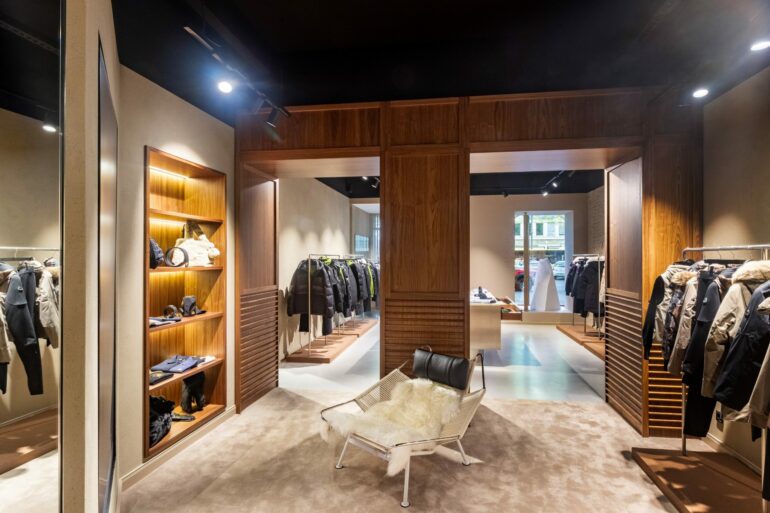
Travertine for a brand that dresses the cold: the choice speaks volumes about Moose Knuckles’ ambitions. In its new Berlin boutique, the Canadian label combines stone with wood, then sets them against steel and dark metals. This is not an attempt to literally replicate the outdoor world for which its clothing is designed. The focus lies elsewhere: creating a sense of domestic warmth around the product, framing the purchase of a technical garment within the context of a visit to a thoughtfully curated interior. It is through this contrast that the brand aims to assert its place in the luxury sector.
Opened on September 10 at 200 Kurfürstendamm, this first European single-brand store marks a commercial milestone. But its significance also lies in what it reveals: Moose Knuckles now wants to exert greater control over how its collections are discovered. In Berlin, the boutique becomes a space where two dimensions—sometimes difficult to reconcile—can come together: protection from the elements and a passion for fashion.
Inside, a contrast to the cold
The new design relies on a carefully curated interplay of materials to avoid merely serving as a functional backdrop. Wood and travertine are paired with brushed stainless steel, patinated brass, and dark metallic finishes. The palette thus retains an industrial element without ceding the entire space to it. Metal lends its precision; the warmer materials prevent the whole from veering into a cold display of technical prowess.
The integrated lighting complements this approach, as do the sculptural elements and residential-inspired furniture. The reference to the home is significant. It shifts the focus: visitors enter an environment designed to welcome them, whereas the clothing itself is meant to face the outdoors. Ellen Kinney, global CEO of Moose Knuckles, specifically cites this contrast as an initial intention. For a brand built around outerwear, she wanted a setting whose warmth would take visitors by surprise.
However, the goal is not to make the decor the main focus. According to the executive, the design must allow the craftsmanship and quality of the garments to take center stage. The space thus embodies a tension championed by the brand: combining the demands of luxury with those of performance, while maintaining an attitude that is less staid than a merely elegant interior might suggest. The metallic surfaces contribute to this balance. They maintain a visual edge in a space designed to be welcoming.
Berlin: A Cultural as Well as a Commercial Choice
This pursuit of contrast finds an extension in Berlin through the brand’s narrative. Ellen Kinney highlights a city committed to individual expression, where creativity can break free from conventions. She sees a kinship between this and Moose Knuckles. This argument deserves to be distinguished from the mere logic of location: for a fashion brand, choosing a city also means choosing a context in which its identity can be interpreted.
The German capital is thus viewed as a place of affinity, not merely as another retail location. The creative freedom and confidence the CEO attributes to the brand align with the attitude the label wishes to maintain, even as it adopts the materials and hospitality codes of the luxury sector. The store must strike a balance between these two aspects without one overshadowing the other. Too much formality would undermine its message of independence; an exclusively industrial aesthetic would neglect the pursuit of comfort.
This cultural approach, however, is grounded in an already established commercial foundation. According to Ellen Kinney, Germany ranks among Moose Knuckles’ top priority and best-performing European markets. Demand there is strong, and the climate lends itself to a product lineup centered on outerwear. The cold weather provides a concrete reason to buy; the brand’s identity must offer a reason to choose Moose Knuckles.
The first European store is therefore not being opened to test the waters in an unfamiliar market. It extends an existing business—whose results management highlights—by giving it its own location. This distinction prevents the launch of a single-brand network from being confused with the brand’s entry into the European market.
Showcasing More Than Just Winter Clothing
At 200 Kurfürstendamm, the assortment encompasses the entire lifestyle offering, from outerwear to accessories. This breadth highlights the effort devoted to the interior design. A space exclusively evoking the cold would have confined the visitor to a single purpose; the residential setting allows the brand to present its wardrobe and accompanying items in a broader light.

The challenge is to showcase the entire offering without diluting what sets the brand apart. Protective outerwear remains its anchor, as its CEO points out. Around it, the store organizes a less fragmented presentation of the collections. Accessories can be discovered in the same environment as outdoor pieces, sharing a common language of materials and light.
This consistency also explains the purpose of the new retail concept. Designed to remain recognizable from one country to another, it must nevertheless be able to adapt to the specific characteristics of the cities where Moose Knuckles establishes a presence. This approach avoids forcing a choice between two extremes: replicating a strictly identical decor everywhere or reinventing the brand with every new opening. Berlin offers the first European iteration of this concept, though management has not yet detailed the specific adaptations planned for each future location.
From Chicago to Berlin: Picking Up the Pace Without Announcing a Race
The German opening follows closely on the heels of the Chicago launch, which took place on September 3 at 744 North Michigan Avenue. Just one week separates the two openings. Together, they introduce this new evolution of the store concept and embody a strategy focused on major international cities. The proximity of the dates adds significance to the sequence, but is not enough to outline an expansion timeline beyond the announced projects.
Ellen Kinney advocates for selective growth. Management wishes to prioritize cities capable of boosting the brand’s reach and establishing lasting relationships with customers there. From this perspective, the store serves as much to showcase products as to convey a distinct identity. Location selection and the quality of the customer experience must take precedence over simply increasing the number of locations. No specific numerical targets for new store openings accompany these plans.
Italy provides a case in point for this cautious approach. The country plays a major role in Moose Knuckles’ European operations, with its European headquarters located in Milan. However, this established presence does not imply the imminent announcement of a new store: Ellen Kinney has not, at this stage, disclosed any plans for an Italian opening.
The brand continues to explore development opportunities there. After Berlin, the European landscape therefore remains open, with a clear distinction between markets deemed important and locations where openings have actually been decided. Milan is already home to the European teams; for now, Berlin is where customers can discover the continent’s first monobrand store.