
Make Texture a preferred source on Google to support us
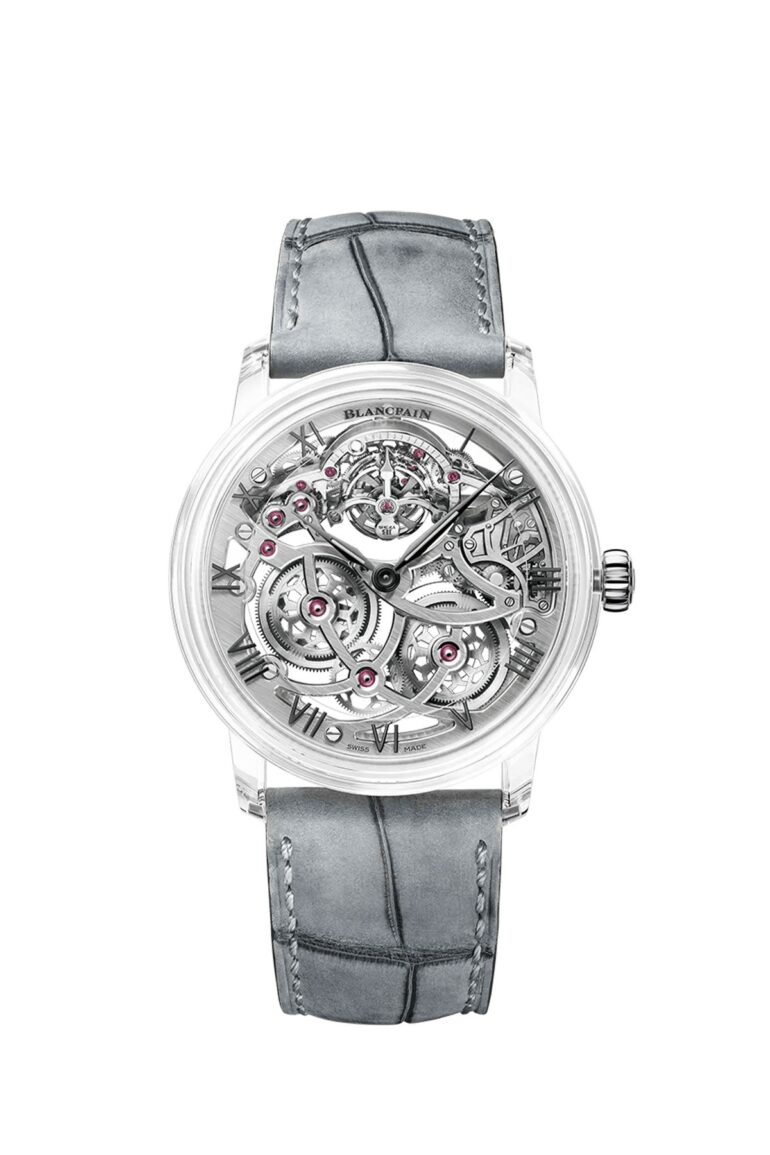
Add Texture to GoogleThe luxury watch industry favors cases that protect their secrets. Blancpain takes the opposite approach here: with the Carrousel Incliné, Ref. 66222S, the manufacture places its movement beneath a fully sapphire-encased architecture, as if the timepiece were meant to impress with what it reveals rather than what it conceals. This 380,000 Swiss franc watch is not merely a technical demonstration; it signals a clear commitment to making haute horlogerie a central focus for the house, which has long been identified with the Fifty Fathoms as well.
Transparency as a Statement of Intent
The choice of sapphire sets the tone. Blancpain does not simply use it for the watch crystal or the case back, but for the entire case: the middle and case back are joined in a single assembly, while the bezel and crystal form a second piece. When assembled, they offer an almost unobstructed view of the movement from the dial, the sides, and the back.
This apparent transparency is the result of a process that is far from industrially straightforward. The sapphire must first be produced using the Kyropoulos process, then shaped with specialized equipment over hundreds of hours. Its hardness necessitates a slow production process, which explains both the rarity of such cases and their cost. For Blancpain, this is a first: the brand had never before produced a case made entirely of sapphire.
The proportions, however, avoid the pitfall of an overly imposing laboratory-like object. The watch measures 40.3 mm in diameter and 11.3 mm in thickness. It has a bold presence for a dress watch, yet a restrained design for an inclined carrousel movement. The blue-gray lacquered alligator strap, secured between the transparent lugs, adds a more classic touch to this radical design exercise.
Reviving a Mechanism That Has Remained in the Shadows
The heart of this watch is not the tourbillon—a familiar feature in fine watchmaking—but the carousel. Both systems address the same concern: reducing timing deviations caused by the effects of gravity on the regulating organ by allowing it to move within a rotating cage. The tourbillon, designed by Abraham Louis Breguet in 1801, is the more famous of the two. The carousel, conceived by Bahne Bonniksen in 1892, has long occupied a much more discreet place.
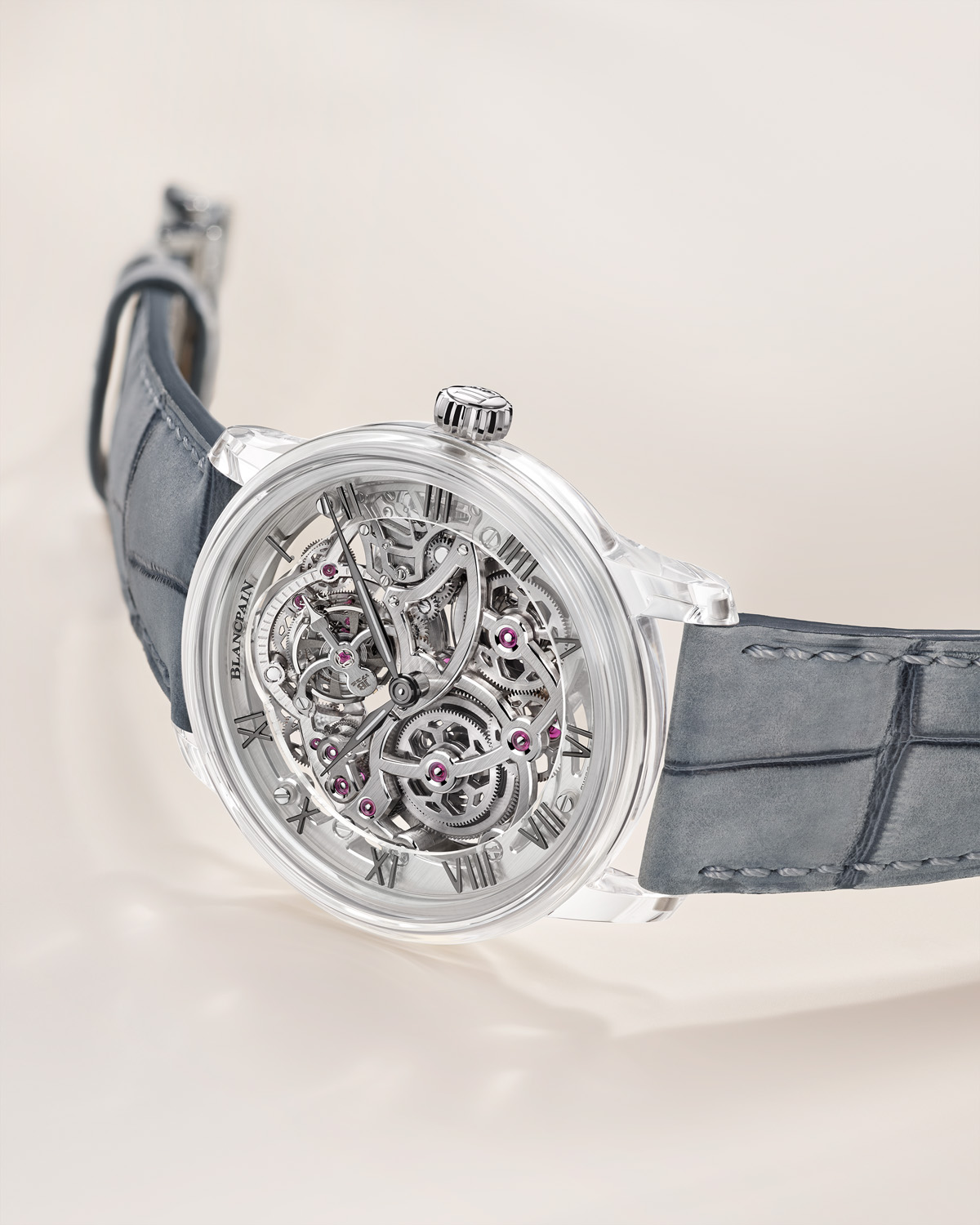
The difference is not merely a matter of semantics. The carousel relies on two gear trains, whereas the tourbillon uses only one. This mechanical design is fully on display in the Caliber 222ISQ, which reveals its gears, bridges, and springs without the obstruction of an opaque dial. The movement is available in rhodium-plated 5N gold or 5N red gold, two finishes that profoundly alter the visual perception of this open-worked movement.
Blancpain had already played a role in the return of the carousel in 2008, at a time when the mechanism had largely fallen into obscurity. With the Carrousel Incliné, the goal appears to be different: the 222ISQ caliber was designed to serve as the foundation for an entire generation of carousel watches. This is therefore not a one-off endeavor intended to enrich a catalog of complications, but rather a mechanical platform developed over the long term.
Four years to find the right angle
The development of the caliber required four years of research and development. The key factor lay in the cage’s angle of inclination. Blancpain explored several configurations before settling on a 30-degree angle, deemed the most consistent across a watch’s six standard positions: four vertical and two horizontal.
This angle is by no means merely decorative. It serves a very concrete chronometric goal: a stated accuracy of between -0 and +2 seconds per day. The movement must maintain this performance throughout its entire 100-hour power reserve. To achieve this, the torque output has been optimized so that the available energy remains sufficiently stable throughout the entire operating period. In a watch where the mechanics are on full display, this pursuit of consistency ensures that the spectacle does not overshadow the primary function: keeping accurate time.
The caliber beats at 28,800 vibrations per hour, or 4 Hz. Two barrels mounted in series provide the power reserve; they, too, are visible through the skeletonized structure. This exposure transforms elements usually reserved for the collector’s eye into an aesthetic language. The watch does not seek to simulate simplicity: it reveals the density of its architecture and embraces the complexity of its components.


A mechanical scene synchronized to the second
The carousel completes one full revolution in one minute. It thus serves as the small seconds display, integrated into the moving center of the movement. Its seconds hand is housed within the cage, and its tip curves sharply downward so that it passes beneath the sapphire crystal without adding any extra thickness to the watch as a whole. This solution, unobtrusive at first glance, epitomizes the type of compromise sought in this timepiece: preserving a spectacular mechanism without sacrificing relatively modest dimensions.
A dual ball-bearing system also helps reduce the height of the cage. At the same time, Blancpain increased the balance wheel’s diameter to 8 mm while limiting the cage’s width to 9 mm. The result aims for a more balanced visual relationship between the balance wheel and its rotating frame. Viewed through the sapphire crystal, this proportion becomes essential: the movement is no longer seen merely as a succession of components, but as a composition in which each element must find its place.
The hours and minutes are indicated by two black, slender central hands, the tips of which are coated with a luminescent material. They move above a black hour scale suspended on a peripheral sapphire ring. This design enhances the sense of depth, but it also reveals the inherent limitation of heavily openworked watches. As the hands alternately pass through empty spaces, bridges, springs, and moving wheels, immediate readability inevitably becomes less straightforward than on a solid dial.
Blancpain Expands Its Horizons
This slight concession to readability speaks volumes about the Carrousel Incliné’s positioning. It is not intended for those seeking a discreet timepiece or a conventional dress watch. Its appeal lies precisely in this tension between the measurement of time and the display of its mechanism. The transparent case turns the wrist into a showcase; the inclined carousel imposes an almost sculptural presence; the 100-hour power reserve and the demand for precision serve as a reminder that the timepiece is not merely an ornament.
Presented in a custom-made wooden marquetry box, Ref. 66222S is part of a series of ultra-luxury creations. A year earlier, Blancpain had launched the Grande Double Sonnerie, priced at 1.7 million Swiss francs. Given this precedent, the Carrousel Incliné’s price of 380,000 Swiss francs—approximately 346,200 British pounds—places the piece in a category where the rarity of the manufacturing process, the movement’s architecture, and the chronometric research count just as much as the name engraved on the dial.
The question, then, is not so much whether Blancpain intends to compete symbolically with Patek Philippe, Vacheron Constantin, and Audemars Piguet. The Carrousel Incliné already provides its own answer, through both its materials and its movement: the brand seeks to establish its own language of haute horlogerie, based here on a mechanism less expected than the tourbillon and on a case that reveals every detail. More information is available on the Blancpain website.