Make Texture a preferred source on Google to support us
Add Texture to GoogleThe luxury sector favors impeccable pedigrees, aristocratic origins, and hushed salons. Yet today, the contemporary market for fine watchmaking finds one of its most fascinating sources of supply in a far harsher reality: that of judicial seizures. Ahead of the holiday season, a unique catalog is shaking up collectors’ habits. Under the auspices of Wilsons Auctions, some fifty pre-owned watches are set to find new owners, to be sold in several online auctions whose closing dates will span from November 27 to December 1. Behind the apparent ordinariness of an auction lies a peculiar story. A large portion of these pieces was, in fact, consigned to the auction house by Ireland’s Criminal Assets Bureau, the agency responsible for confiscating assets acquired through the proceeds of crime. This unexpected link between government seizures in Dublin and the world of luxury watchmaking creates a striking tension: timepieces designed to symbolize social success find themselves stripped of their glamorous aura, consigned to public auction, sometimes without even the slightest financial safety net.
Solid Gold Faces the Rigors of Auction
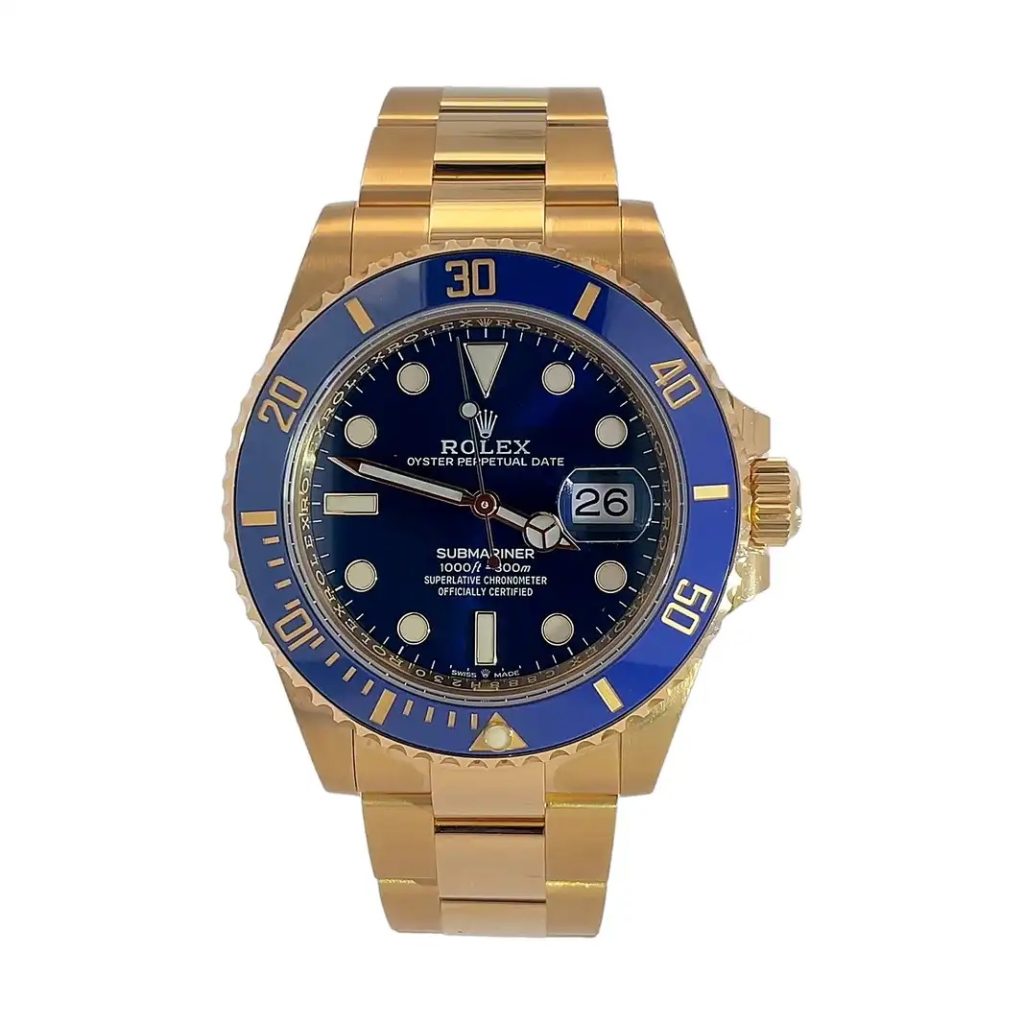
The highlight of this winter catalog centers on 18-karat yellow gold, the quintessential metal of ostentation. Two contemporary models from the Geneva-based Rolex manufacture epitomize this opulence. The first is a Submariner Date, bearing the reference number 126618LB. Released in 2021, it displays the signature dimensions of its generation with a 41-millimeter case. Its design is rooted in the brand’s fundamentals: a robust Oyster bracelet and a deep blue dial that complements the warmth of the precious alloy. While the manufacturer’s official specifications guarantee a theoretical water resistance of 300 meters, the context of a judicial sale serves as a reminder that the maintenance log and the watch’s actual condition take precedence over the manufacturer’s promises. Although it comes with its original case and documentation, the physical assessment of this luxury diver’s watch will be entirely the buyer’s responsibility.
In a style designed more for social events than for the depths of the ocean, a Day-Date 40 (reference 228238) shares the spotlight. The archetype of a status symbol, it combines a very understated white dial with much more expressive structural elements. The fluted bezel—a striking aesthetic signature—crowns the famous President bracelet, whose semicircular links made of precious metal require particular attention regarding wear and tear. The presence of the original papers is confirmed for this lot—a detail that reassures buyers of the item’s immediate traceability but does not exempt them from a careful review of the condition reports. This model illustrates the paradox of the auction: a timepiece designed for absolute ostentation is treated with the clinical detachment of a government lot.
The Thrill of No Reserve
While precious metals catch the light, the mechanics of an auction without a reserve price generate the adrenaline rush. The strategy of selling without a reserve is a perilous exercise that, when applied to icons of sports watchmaking, inevitably draws attention. The catalog features two GMT-Master II models offered under this radical format. The first, a steel reference 116710BLNR, sports the famous black-and-blue bezel that has earned it the nickname “Batman” among collectors. It is joined by a two-tone variant, reference 126711, affectionately nicknamed “Root Beer” for its brown and black hues. Throwing these highly speculative models into the fray without any safeguards reflects the very nature of repossession auctions: the goal is the swift liquidation of the asset, not the preservation of its market value.
This auction model extends geographically to Queensferry, where another session dedicated to jewelry features four pieces by TAG Heuer, also sold without a reserve. Meanwhile, a government auction with no reserve includes a Breitling Colt (reference A73380). This absence of a reserve price acts as an alluring mirage. The pre-owned market knows, however, that a bargain must be calculated with fees included. Access to the auction requires a prior commitment: a security deposit set at 1,000 euros for the Dublin auctions and 1,000 pounds sterling for the no-reserve government auction.
Patina, Nicknames, and Alterations
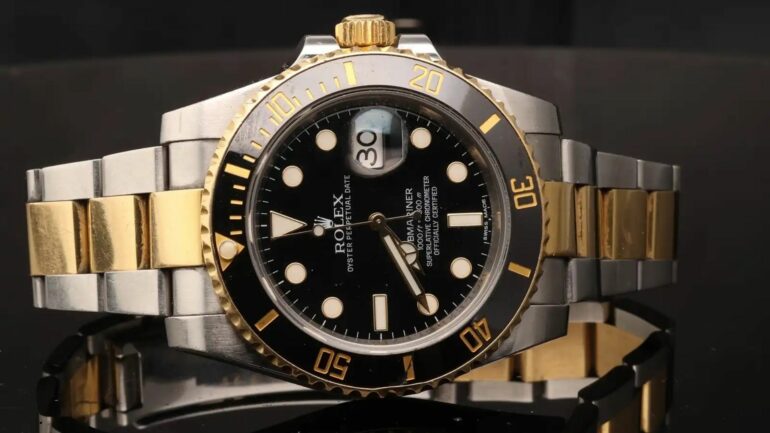
The historical depth of the Dublin gathering allows one to observe Rolex’s aesthetic evolution over several decades. Collectors fond of unofficial nicknames will come across a 1991 Datejust Turn-O-Graph there. Nicknamed “Thunderbird,” it derives its uniqueness from its rotating bezel—a functional anomaly that sets it apart from the classic Datejust family. The same production year also yielded a two-tone Submariner (reference 16613), whose ocean-blue dial earned it the nickname “Bluesy.”

More subtle is a yellow gold Oyster Perpetual Date (reference 1501), which catches the eye with the texture of its dial. This blue dial, crisscrossed with faint horizontal striations reminiscent of raw silk weave, is known as “shantung.” These visual details and affectionate nicknames form the secret language of enthusiasts. However, under the auctioneer’s hammer, these poetic considerations pale in comparison to the harsh reality of the facts. The presence of a recent service, the integrity of the internal components, or the excessive polishing of a case carry infinitely more weight than the appeal of a nickname.
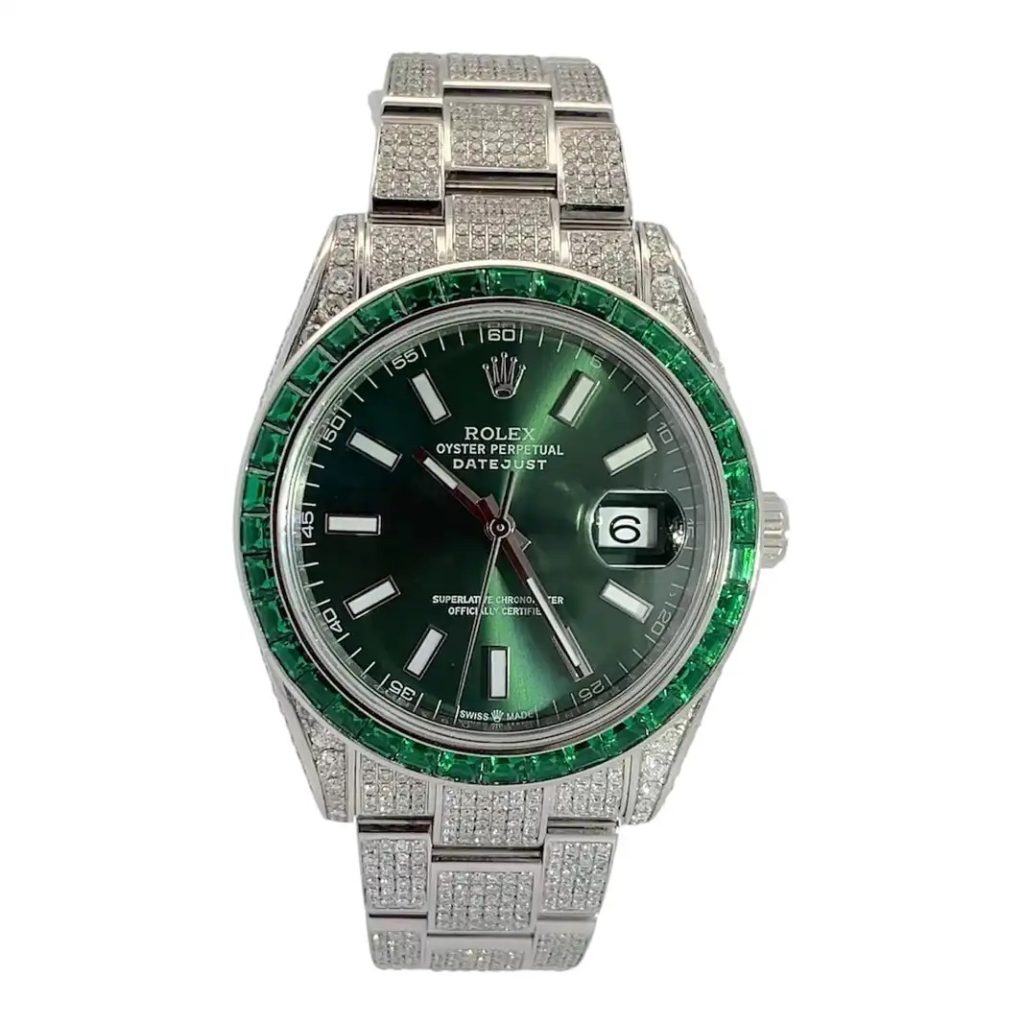
The female representation, moreover, highlights the limits of absolute authenticity. No fewer than twelve Lady-Date and Lady-Datejust models span the eras, ranging from a 2017 stainless steel piece to yellow gold references from the 1970s and 1980s. The organizer’s fact sheets reveal that some of these timepieces underwent modifications after leaving the workshop, notably through the subsequent setting of diamonds. This practice of “customization” (or personalization), although common in the pre-owned market to accentuate a piece’s precious nature, compromises its manufacturing integrity and radically alters its heritage value.
Cost Structure and the Buyer’s Responsibility
Given this diverse inventory, Wilsons Auctions assumes responsibility for the overall authenticity of the lots offered. Such a guarantee is a necessary foundation, but it cannot replace the buyer’s own vigilance. The financial structure of a judicial sale involves its own complexities. The excitement of winning a bid is invariably followed by the calculation of commissions. For lots sold in Dublin, a 20% buyer’s premium is added to the hammer price, to which value-added tax is then applied. These accounting factors, which vary depending on the exact location of the lot and the nature of the auction, transform an impulse purchase into a rigorous calculation exercise.
The virtual nature of the event creates a distance from the physical object. It is impossible to weigh the gold in the palm of your hand or assess the tension of a bracelet with the naked eye. Methodically reviewing the individual listings becomes the only safeguard against disappointment. The exact location of the item to plan for pickup logistics, a precise inventory of included accessories, and details of any imperfections: the process requires a cool, calculated approach. In the world of seized criminal assets repurposed as watch-making opportunities, the prestige of the name printed on the dial is merely an introduction. The true verdict lies in the margins of the description, where the object’s clinical condition ultimately dictates its true value.