
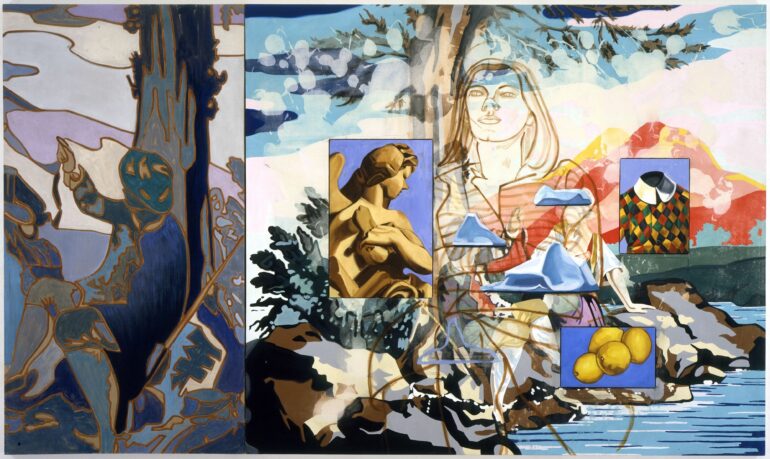
The admission is scathing, almost a provocation to the art world that propelled him to the top: “Many people in the art world simply aren’t particularly visual. And not just collectors. ” This observation, slipped in between courses during an interview for the “Lunch With Adam” series on Artnet News on September 10, 2026, sums up David Salle’s unique position. Speaking with collector and columnist Adam Lindemann, the 74-year-old artist does more than simply comment on current events; he dissects the very apparatus of contemporary art with the precision of the theorist he has become over the decades.
The Absolute Eye in the Face of Visual Deficit
David Salle belongs to that rare category of artists whose authority is exercised as much through the brush as through the pen. Trained at the California Institute of the Arts (CalArts) under the influence of Conceptual Art—where he earned his BFA in 1973 and his MFA in 1975— he successfully transformed this intellectual legacy into a style of painting based on juxtaposition, a cornerstone of the *Pictures Generation*. Yet his observation in 2026 is a bitter one: the gaze, the very foundation of the artistic experience, seems to be losing its edge in favor of other logics.
In his conversations with Adam Lindemann, Salle highlights a growing disconnect between owning works of art and the ability to truly see them. This critique echoes his 2016 collection of essays, *How to See*, and his regular contributions to the *New York Review of Books*. For him, art is not a coded message to be deciphered with a sociology textbook, but a visual structure whose grammar is lost even on those who run the market and the institutions.
Malpractice and Institutional Abuses
The term “Museum Malpractice,” highlighted during this interview, points directly to a crisis in museum governance. Salle and Lindemann directly address curatorial choices and acquisition policies that, in their view, stray from aesthetic rigor to embrace vaguer ideological or financial imperatives. The issue of “deaccessioning”—the act of selling works from public collections—lies at the heart of this critical analysis.
This institutional practice, often perceived as a betrayal of the museum’s primary mission, transforms institutions of cultural preservation into entities that react to market pressures and contemporary political movements. For Salle, whose works are nonetheless enshrined in the world’s leading institutions, from MoMA to the Centre Georges Pompidou, this shift threatens the very survival of art history. The power dynamics between galleries, collectors, and museums are no longer merely financial; they have become the battleground for a struggle for influence over what deserves to be preserved and exhibited.
Painting in the Face of Technological Acceleration
Although David Salle is now represented by the Gladstone Gallery in New York and Brussels, his perspective on contemporary painting remains that of a meticulous craftsman. The question of “Painting Today” is not merely a matter of style, but of the medium’s survival. At a time when artificial intelligence and new technologies are redefining image production, Salle defends the unique nature of painting: this layering and juxtaposition of images that he himself theorized as early as the 1980s.
It is not a matter of rejecting the contemporary, but of understanding how painting can still mean something in a saturated world. The debate between figuration and abstraction—central to his work—remains a key lens through which to analyze current artistic creation. Despite auction prices for his major works historically ranging from several hundred thousand to over a million dollars, the artist seems more concerned with the validity of the artistic process than with its immediate market value.
A Legacy in Motion
David Salle’s influence cannot be measured solely by his presence in the collections of the Tate Modern, the Guggenheim, or the Art Institute of Chicago. It lies in his ability to maintain a critical stance in a milieu he considers increasingly permeable to external ideologies. As an artist born in 1952 in Norman, Oklahoma, who lived through the emergence of American postmodernism, he embodies a form of intellectual resistance.
The interview with Adam Lindemann reveals a man who, although integrated into the highest echelons of the art world—as evidenced by his collaboration with the Gladstone Gallery—retains a rare freedom of speech. His view of the politics of the art world is not that of a disillusioned spectator, but of a participant who continues to believe that painting—provided one knows how to look at it—remains the most accurate barometer of our times. The discussion concludes with this observation: the art world may change in terms of governance or technology, but the act of seeing remains a discipline that artists are responsible for protecting.