
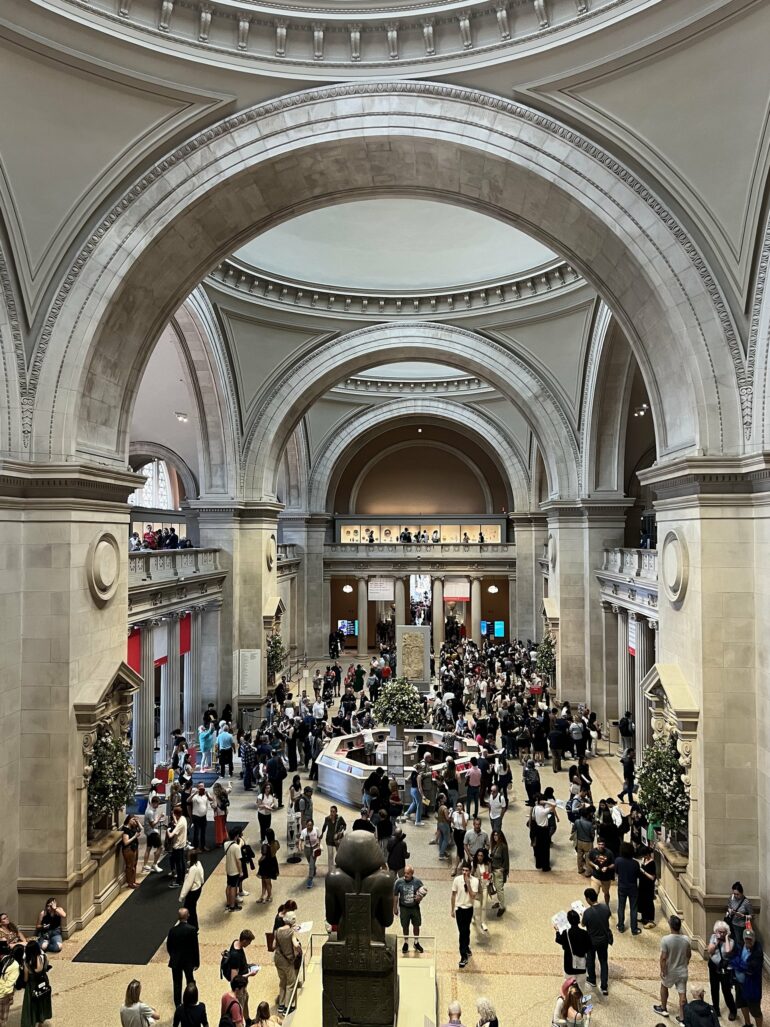
The new Condé M. Nast Galleries at the Metropolitan Museum of Art, designed by Peterson Rich Office, bring together architectural history, inclusivity, and modernity. In this space dedicated to the Costume Institute, the celebration of the building’s past stands as a true manifesto.
Far from being a homogeneous structure, the Met is a fascinating fusion of buildings, wings, and renovations layered one upon another over the decades. In keeping with this spirit of continuous evolution, the new Condé M. Nast Galleries enrich this architectural mosaic. By transforming a previously unused interior space, the firm has created nearly 11,500 square feet of exhibition space, now dedicated to celebrating fashion.
A unique dialogue between clothing and its setting
Inaugurated this spring with the “Costume Art” exhibition, these galleries foster an intimate conversation between fashion pieces and works of art. The exhibition design revolves around a plurality of bodies, embracing a rich diversity of sizes, ages, genders, and abilities. This large-scale project provides the Met’s fashion department with a space that is both more flexible and sustainable, serving as the culmination of a vast renovation campaign of the institution’s historic spaces.
Peterson Rich Office’s priority was a complex ambition: to transform an exhibition space into a prism through which visitors can interpret and grasp the museum’s overall essence. Where contemporary architecture often succumbs to the temptation to fade into the background or hide itself, this approach forcefully asserts the building’s presence—its layers, its joints, and even its asymmetries. The result reveals a perfect symbiosis between exhibition design and architecture, evident in every detail.
Thresholds, Light, and Physicality
The initiatory journey begins in a reception gallery that seems to stretch visually toward the legendary Great Hall. Two monumental display cases then act as thresholds: they offer a prelude to the curatorial work while guiding the gaze of visitors arriving via the main staircase. Opting for noble and timeless materials, the architects incorporated limestone—echoing the historic halls—as well as imposing solid-oak doors capable of elegantly enclosing the space during exhibition setups.
At its heart, the space divides: a first gallery, majestic and bathed in light, contrasts with a second, more intimate and subdued one. This contrast, far from being purely aesthetic, shapes the perception of the displayed silhouettes, which are sometimes presented at eye level and sometimes mounted on pedestals. The ceilings, soaring to dizzying heights, diffuse an even light that deliberately breaks with the dramatic, spot lighting traditionally associated with fashion.
Conceived by artist Samar Hejazi, the mannequins with mirrored faces offer a subtle reflection: by gazing into them, the visitor becomes part of the artwork, merging the observer with the exhibited object. A poetic way of reminding us that fashion cannot exist without the body that wears it, the posture that brings it to life, and the distance of the observer.
A Tribute to Historical Layers
The emotional power of the project reaches its peak in the final gallery. There, Peterson Rich Office made the bold choice to expose the masonry traces of the museum’s very first foundations—the original work of Calvert Vaux and Arthur Lyman Tuckerman. The eye also encounters a concrete pillar there, a remnant of a more recent era. This mineral palimpsest stands in stark contrast to sanitized renovations that smooth over history in favor of streamlined presentations. This laying bare of the building’s structure lends the space a rare depth: the Met no longer merely exhibits its collections; it invites visitors to interpret its own institutional memory.
This approach underscores a fundamental truth: the museum is a living organism, in a state of perpetual change. The weathered plaster, the raw materiality, and the permanent display cases weave this narrative together. The architecture does not mimic the past; rather, it invites it to engage in a dialogue with a resolutely contemporary vocabulary.
Extending beyond the gallery walls, the renovation also reimagines the dining areas, gift shops, and the majestic 83rd Street entrance on Fifth Avenue. These improvements streamline visitor flow and optimize accessibility, demonstrating the museum’s commitment to grounding its legacy in the practices of its time.
Once perceived as an immutable sanctuary, the Met now fully embraces its capacity for transformation through these new galleries. The work of Peterson Rich Office—discreet and intelligent—replaces spectacle with genuine architectural meaning. Its greatest achievement is having skillfully orchestrated the interplay between the body and fashion, stone and light, and a place’s history and its present reality.