
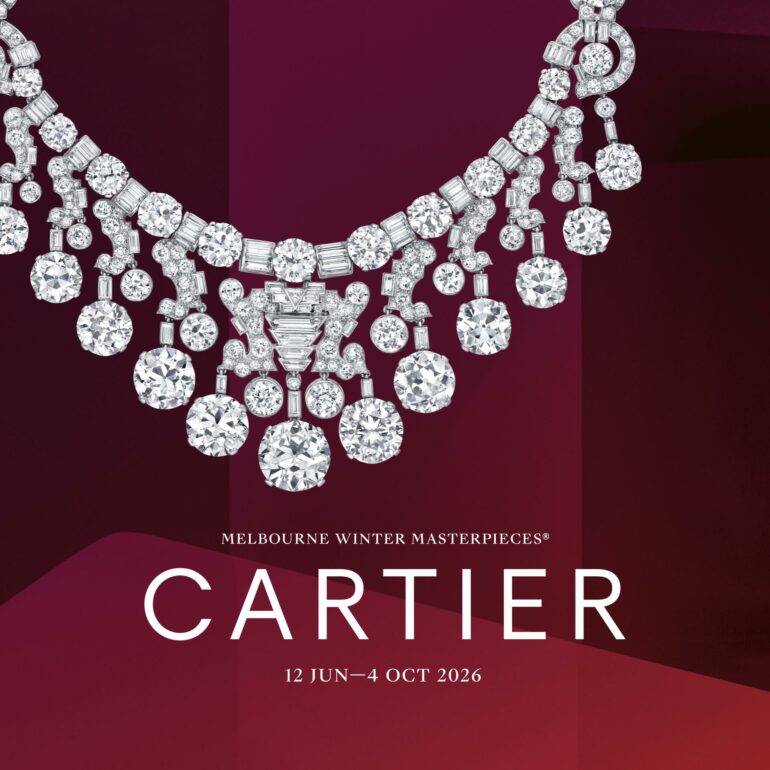
Before catching sight of a single carat, visitors are confronted with their own reflection. The entrance to the Cartier retrospective at the National Gallery of Victoria (NGV) in Melbourne opens onto a long, mirrored corridor, designed by artist and designer Sabine Marcelis in collaboration with architect Paul Cournet. Beams of light fragment within it, multiplying the silhouettes and casting cool glints on the walls. This immersive passageway immediately sets the terms of the curatorial vision: precious materials do not exist in their pure state; they are shaped by the way they are illuminated and the space created for them. The tone is set for this expansive exhibition, part of the Melbourne Winter Masterpieces program, which will be on view at the Australian institution from June 12 to October 4, 2026.
Bringing fine jewelry into a museum often requires resolving a paradox. Objects designed for private adornment—the ultimate symbols of privilege—must be extracted from their private context and subjected to public scrutiny and critical analysis. The NGV avoids the pitfall of a mere commercial showcase by approaching the French house’s work through the lens of engineering and color. Rather than presenting an exhaustive catalog or a tedious chronology, the institution displays nearly 400 pieces—watches, objets d’art, and jewelry sets—through an exhibition design that makes light the cornerstone of the aesthetic experience.
A chromatic language rather than a mere accumulation
The museum tour breaks down the brand’s universe into eight distinct sequences. Visitors inevitably encounter the motifs that have shaped the house’s visual language—from the omnipresent panther to commissions linked to cinema’s golden age, as well as the rigorous evolution of style and the design of tiaras. But the ingenuity of the exhibition lies in its classification system. The curators chose to organize the space around families of gemstones and dominant color palettes.
Whether it’s the opaque depth of lapis lazuli or the internal geometry of an emerald, the exhibition dissects the technical choices. The transparency, grading, and cut of each gem become the true subjects of study. This approach pushes the impression of sheer opulence—that suffocating sense of scale that sometimes overshadows jewelry exhibitions—into the background, instead imposing an almost architectural vision of the goldsmith’s craft.
Critics, particularly in the pages of *Artist Profile* magazine, have also highlighted the precision of this spatial balance. The Melbourne institution has at times tended, in its recent programming, to drown the works in redundant scenographic devices, where the setting took precedence over the subject. That pitfall has been avoided here. The exhibition retains an undeniable sophistication, but the environment serves as a sounding board rather than a smokescreen, allowing the objects to speak for themselves.
The Assimilation of Global Aesthetics
This formal approach allows us to dissect the mechanics of a dizzying expansion. When Louis-François Cartier founded his Parisian workshop in 1847, his ambitions were local. It was at the dawn of the 20th century that the company entered a whole new dimension. His three grandsons—Louis, Pierre, and Jacques—orchestrated the brand’s globalization and transformed a Parisian address into a network of international influence.
This conquest of new markets was accompanied by a massive assimilation of foreign ornamental styles. The exhibition clearly illustrates how the workshops assimilated and reinterpreted influences from Egypt, China, Japan, India, Iran, and the entire Islamic world. The brand’s creators functioned as formidable visual translators, drawing on distant motifs to mold them into the framework of Western elegance. This cultural permeability gives rise to a hybrid formal language, capable of expressing both modern geometric rigor and stylized Orientalism.

A dreamlike soundscape set against the harshness of reality
The visitor’s sensory immersion is completed by a specially commissioned musical piece. Composers Ai Yamamoto and Erkki Veltheim, both based in Melbourne, have created a soundscape that permeates the galleries. This acoustic dimension reinforces the feeling of entering a timeless enclave—a sanctuary dedicated to rarity and power, where technical excellence alone justifies the presence of the objects.
But this perfect isolation also reveals its conceptual limitations. Transforming a raw mineral into a status symbol involves a chain of interventions that extends far beyond the doors of Parisian workshops. As Artist Profile astutely noted, the NGV retrospective chooses to barely touch upon the geopolitical realities inherent in its subject. In this sea of brilliance, a single explanatory panel is devoted to the issues surrounding gemstone extraction, the asymmetries of colonialism, and current concerns regarding supply-chain transparency.
Such discretion raises questions about the role of the museum as an institution in relation to the luxury industry. The global circulation of precious materials has historically been underpinned by economic and political systems of great brutality. By confining this reality to a footnote, the exhibition preserves its enchantment at the expense of historical completeness. Cultural engagement with India or Egypt, however generous it may be from an aesthetic standpoint, remains suspended in a vacuum if we overlook the material and commercial conditions that made these exchanges possible.
The Melbourne exhibition remains a masterful demonstration of Cartier’s ability to sculpt materials so that they speak the language of their time. Goldsmithing is treated here with the analytical rigor demanded by high-level applied arts. However, the perfection of the reflection offered by the mirrors in the entrance should not make us forget what lies behind the scenes. Jewelry is never merely a matter of cut and light; it is always, fundamentally, a story of geography and the extraction of resources.