
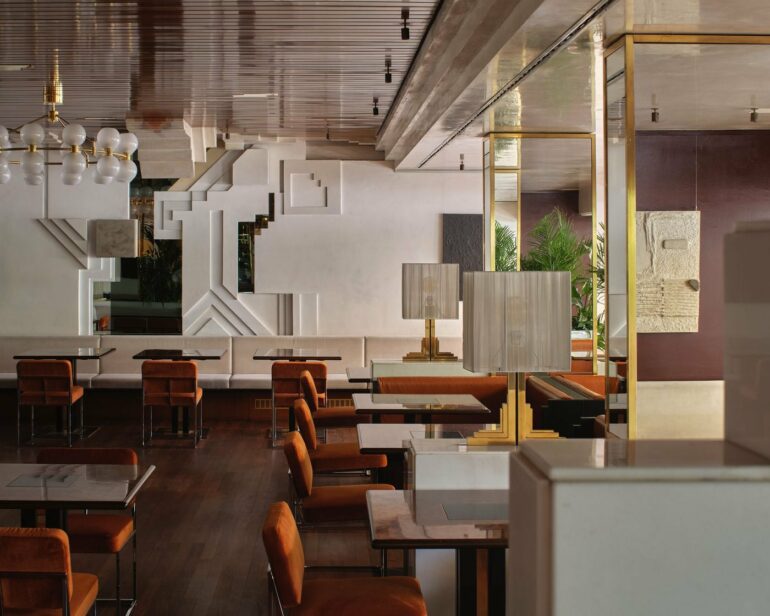
In Merano, on the famous Passer Promenade, a quiet revolution has taken place, shaking up the understated conventions of South Tyrol. Here, in a region where the hospitality industry seems governed by an immutable dogma—light wood, muted tones, and careful integration into the landscape—the Hotel Aurora has decided to shatter the mirror of convention. Gone is Alpine restraint; in its place is a visual boldness one would expect more in the trendy neighborhoods of Los Angeles, Paris, or London. This isn’t just a renovation; it’s a manifesto for a city that is finally asserting itself as a cosmopolitan Central European metropolis rather than merely a mountain village. The starting point for this transformation? A telling anecdote: in the hotel’s new “listening bar,” a group of seasoned travelers from Cologne are having a blast listening to hip-hop, comfortably settled on immaculate cream-colored carpeting. A clash of cultures that, all on its own, sums up the Aukenthaler family’s successful venture.
The Legacy of a Family in Search of Modernity
For more than six decades, the Aurora has been owned by the same family. For a long time, the hotel buzzed with the energy of musical evenings and a few impromptu techno parties in the basement organized by the owners’ children. Today, those same children—Melanie and Philipp Aukenthaler—have taken the reins of the establishment. But instead of simply managing this legacy with the usual caution of the region’s hoteliers, they’ve chosen a radical path. For Melanie, it wasn’t just about giving the walls a fresh coat of paint, but about creating a space that truly reflects our times. The conclusion was simple: Merano is not a high-altitude hamlet; it is a city with a Central European tradition, a crossroads of cultures that deserved an aesthetic worthy of it, far removed from the clichés of the traditional chalet.
The duo therefore entrusted the hotel’s transformation to a local native who had cut his teeth in the Lombard capital: architect and designer Hannes Peer. Known for his work on the Manner Hotel in Manhattan, Peer approached this project with a particular sensitivity, refusing to wipe the slate clean of the past. His mission was to forge a connection between the raw authenticity of the existing structure and a contemporary vision—at times bold, but always elegant. Rather than erasing the layers accumulated by previous generations, he chose to engage with them, preserving, for example, the Laas marble in the dining room and a geometric sculpture by Herbert Kinkelin—a collector’s piece once commissioned by the family.
An aesthetic blending tropical modernism and Milanese precision
The tone is set from the moment you enter. Hannes Peer has infused the common areas with influences from faraway lands, notably Brazil and California, creating an atmosphere of “tropical modernism” unique to these latitudes. The lobby is adorned with exotic plants and two thousand colorful ceramic tiles, handcrafted by Milanese artisans at Officine Saffi. This attention to artisanal detail continues all the way to the reception area, where a curved wooden desk takes center stage—a direct homage to the lines of Milan’s Teatro Manzoni. This interplay of textures is complemented by a Brutalist sculpture by Ursula Huber, the artist and mother of the architect, adding a personal and organic dimension to the whole.
Lighting plays a pivotal role in this design. On the ceiling, a monumental chandelier composed of hundreds of fragments of yellow glass captures the light. This centerpiece is from the “Paysage” collection, a collaboration between Hannes Peer and 6:AM Glassworks. This choice of vibrant colors and strategically placed mirrors marks a definitive break from the gray and black minimalism that currently dominates new construction in South Tyrol. Here, the original wooden structure—particularly the ceilings in the common areas—has not only been preserved but also faithfully reproduced in the guest rooms to ensure tactile and historical continuity, proving that it is possible to be modern without losing touch with the past.

Reunifying the Architecture to Better Envision the Future
The project did not stop at interior design. One of the major challenges was to give architectural coherence to what were once two distinct buildings, situated at different elevations. To meet this challenge, the family enlisted the Austrian architectural firm Feld72. The architects carried out a major “surgical” intervention: the roof of one of the structures was simply removed and raised to the same level as its neighbor. This technical feat not only created additional guest rooms but also unified the complex under a new contemporary envelope that now covers the façade, giving the hotel a distinctive silhouette in Merano’s urban landscape.
Inside, this comprehensive transformation has also extended to the dining experience. The Artè restaurant has been completely redesigned, changing its name and menu to align with this new identity. But the real highlight remains this bold lounge area, where thick cream-colored carpet—a risky choice for a public space, yet one that underscores the project’s domestic and luxurious character—welcomes music lovers. Equipped with a high-fidelity audio system, this space has become Merano’s first “listening bar”—a place where sound quality takes precedence over everything else, transforming the hotel experience into a total cultural immersion.
An Ongoing Expansion Project
What visitors experience today, however, is only the first phase of a much broader master plan orchestrated by the Aukenthalers. Of the hotel’s fifty-nine rooms, only eighteen have been redesigned by Hannes Peer so far. The next phase is already in the works, with the ambition of transforming the hotel into a true hub for the city. Among the future projects, a rooftop pool and a jazz bar are set to round out this offering, which focuses as much on well-being as on intellectual vibrancy. The family also plans to offer a regular cultural program, aiming to make the hotel a meeting place for Merano residents as well as for passing travelers.
The Hotel Aurora has thus achieved the remarkable feat of winning over its long-time loyal guests while attracting a new clientele in search of places with deeper meaning. By breaking free from traditional Alpine conventions, Melanie and Philipp Aukenthaler did not merely renovate a building; they have redefined what luxury in the mountains means in the 21st century. It is a vision in which design does not serve to obscure the landscape, but rather to assert a strong urban and cultural identity. To learn more about this unique project and follow its progress, the hotel’s official website offers a detailed look at this transformation: Hotel Aurora. Merano has perhaps never been closer to Milan, while remaining true to its Tyrolean roots.