
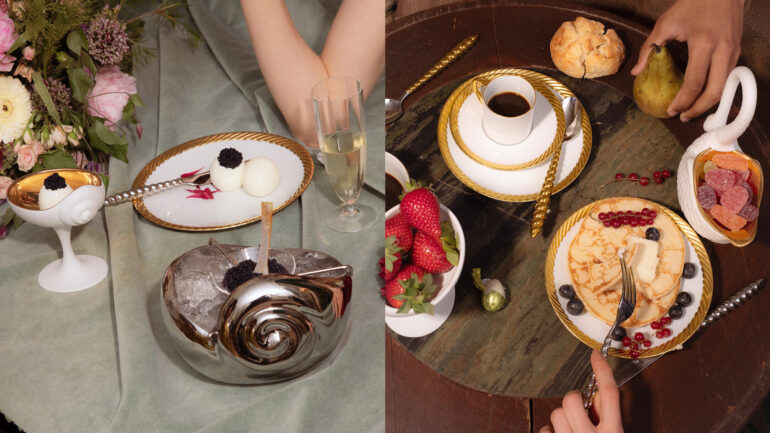
A caviar dish is no longer content to simply present sturgeon roe: it now captures the light with the geometric precision and meticulous craftsmanship of a gem-set brooch. Home luxury is currently undergoing a fascinating transformation, blurring the once-rigid boundary between tableware and fine jewelry. It is precisely on this fine line that Elad Yifrach, founder of L’Objet, has chosen to position himself by unveiling a groundbreaking collaboration. For the first time since founding his brand in Los Angeles, the entrepreneur is merging his world with that of a jewelry designer, Jessica McCormack. Far from a simple logo pairing, this partnership offers a literal translation of body jewelry techniques applied to the private sphere, transforming our reception accessories into interior adornments.
Maritime aesthetics in the service of function
The aesthetic vocabulary chosen for this line sketches a distinctly architectural seascape. The collection employs a lexicon in which shells and spirals are not mere decorative motifs but dictate the very form of the pieces. The central element of this ornamental language is a finely twisted rope. This maritime detail runs along the bases, highlights the rims, and structures the handles of the various containers, establishing a rigorous visual dialogue from one end of the table to the other. The collection ranges from bathroom accessories to dining room centerpieces, marking at the same time L’Objet’s very first foray into cutlery design.
Among the pieces offered, the treatment of the material invites a tactile experience at the table. Bowls crafted from bisque porcelain—characterized by their porous matte finish and mineral-like whiteness—are highlighted by hand-painted details using 24-karat gold. This tension between raw ceramic and the pure brilliance of the precious metal is also evident in champagne buckets, ice bowls, and large serving trays. For Elad Yifrach, the approach follows a strict logic: to infuse the millimeter-level precision characteristic of jewelry workshops into everyday objects. The challenge lies in elevating the status of these utensils to make them deeply personal, while ensuring they fulfill their primary function without fail.
From Madison Avenue to the Dining Table
The decision to partner with Jessica McCormack is part of a specific intellectual journey. The designer does not view jewelry as an isolated element, cut off from its surroundings. Her own New York boutique, located on Madison Avenue, already serves as a manifesto for this interplay between disciplines. There, customers wander through a curated space where her jewelry designs sit alongside antiques, curiosities, and contemporary artworks. This collaboration with L’Objet thus represents a logical extension of her own aesthetic ecosystem.
The jeweler approaches this foray into home design through a strictly self-serving and pragmatic lens, stating that she has applied her favorite motifs to objects she ardently desired to own and use in her own home. This approach avoids the pitfall of creating an untouchable gallery piece. The mutual admiration between the two houses is rooted in this shared foundation: a deep respect for traditional craftsmanship coupled with a highly contemporary vision of form and function. It’s not about displaying objects, but about living with them—objects whose craftsmanship borders on the exceptional.

Growth Driven by a Thirst for Intimate Aesthetics
The realization of this ultra-luxury partnership comes at a pivotal moment for L’Objet, which is consolidating its impressive geographic expansion. Founded on the U.S. West Coast in 2005, the company is now meticulously weaving an international network. After establishing itself on New York’s Upper East Side, the company reached a decisive milestone in 2023 with the opening of its Paris flagship store. Its network of retail locations now stretches from London to India, with a notable presence in New Delhi.
Financial indicators confirm the success of this strategy of measured expansion. By 2025, the brand anticipates revenue of around $20 million. This revenue is largely driven by the U.S. market, where consumers demonstrate a fierce and sustained appetite for enhancing their living environments. In the United States, the home décor, tableware, and home fragrance sectors show no signs of slowing down, driven by a clientele that now places as much importance on the olfactory and visual signature of their living room as on the designer label of their wardrobe.
The Subtle Balance Against the Risk of Ostentation
To sustain this growth and firmly establish itself in the ultra-luxury segment, L’Objet masters the art of strategic partnerships. The brand has made collaboration a key tool for strategic development. Last June, it partnered with Fleuriste by Chauvin Paris, offering an immersive experience of its world. These successive alliances signal a clear shift toward the high-end market, where the physical product almost fades into the background behind the overall sensory experience, blending scents, ornamentation, and gastronomy.
However, this growing sophistication of the domestic space raises a practical question. By pushing the refinement of everyday objects into such exclusive realms, the risk of creating static interiors—reminiscent of cold exhibition halls—becomes palpable. The success of the collaboration between L’Objet and Jessica McCormack lies precisely in its ability to circumvent this display of power. Although the jewelry-making heritage is evident in the precision of the proportions and the brilliance of the gold finishes, the pieces remain free of any arrogance. They stand out through a skillful balance between sculptural precision and the ease of everyday use. Beneath the interlacing porcelain and twisted cords, the household silverware seems to have discreetly adopted the vocabulary of the diamond cutter, without ever losing sight of the fact that it is first and foremost designed to be handled.