
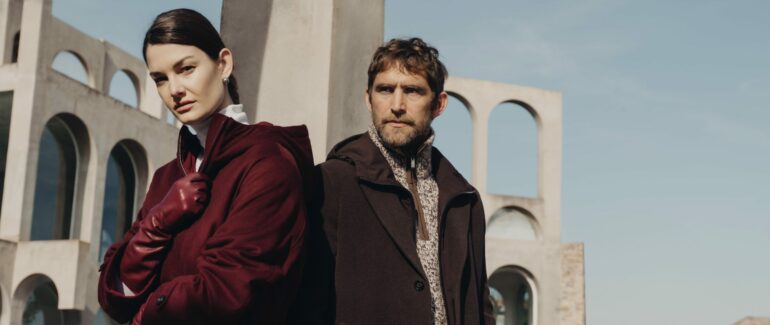
Waterproof cashmere: Paul & Shark’s Fall-Winter 2026 collection could be understood simply through this juxtaposition. On one hand, a fabric whose very name evokes softness; on the other, a property that places the garment in a very concrete relationship with the weather. It is in this tension that the collection finds its appeal. Here, luxury appears less as a way to keep everyday life at arm’s length than as a way to approach it differently. The challenge remains to give shape to this ambition. The brand seeks it in its own designs, in its work with textiles, and—for its campaign—in architecture.
Revisiting a jacket rather than starting from scratch
The most personal anchor of this collection has a name: “The Paolo Blouson.” Designed by the founder of Paul & Shark, this garment returns this season in a cashmere version, featuring knit details. This detail is more than just a nod to the brand’s heritage. It offers insight into how the brand intends to evolve its wardrobe: retaining an iconic style while reinterpreting it through material choices.
The choice of cashmere, in fact, alters how a blouson is perceived even before one examines its details. The word evokes a tactile quality, while the garment’s category suggests an outdoor function. The knitted elements bridge the gap between the two. The exercise, therefore, is not merely about reviving a historic name; it juxtaposes a piece rooted in the brand’s history with its current creative direction.
However, it is important to distinguish between the various pieces of information. While waterproof cashmere is listed among the collection’s materials, the description of “The Paolo Blouson” states only that it is made of cashmere. There is no basis for attributing the treatment described for the entire collection to this particular model. This nuance matters in a collection where the technical qualities of the textiles are just as important as their appearance.
Aliseo: A Garment That Bridges Two Categories
With “Aliseo,” the dialogue takes a different turn. This wool-and-cashmere jacket bridges the gap between outerwear and knitwear—two areas that Paul & Shark brings together in its design research. Whereas “The Paolo Blouson” offers the depth of a design created by the founder, Aliseo provides a concrete example of the principle of hybridization that runs through the season.
The term may seem abstract. Here, it takes on a fairly simple meaning: designing a garment without confining it to a single category. A jacket can draw inspiration from the world of knitwear without sacrificing its place among outerwear pieces. This interplay is more significant than the “hybrid” label itself, because it forces us to consider construction, material, and the garment’s intended use as a whole.
The collection thus combines outerwear, knitwear, and styles that straddle these categories. It would be reductive to view them as three separate compartments. On the contrary, the two jackets featured in the presentation suggest a wardrobe built around transitions: between a vintage reference and a modern interpretation, between the presence of a woven fabric and that of a knit. Cohesion is found in these connections rather than in superficial uniformity.
Technique, without flashy displays
The choice of materials provides the foundation for this approach. Alongside waterproof cashmere are Aqualeather, rain-resistant wools, winter linen, and jersey. This selection brings together familiar names with formulations that highlight a specific adaptation or property. The textile vocabulary already tells part of the story: not separating the pleasure of the material from the practical needs it can fulfill.
Rain-resistant wools and waterproof cashmere are the most explicit examples of this approach. Protection is embedded in their names. For Aqualeather, on the other hand, the product description mentions the leather without detailing its characteristics. As for winter linen, its editorial appeal lies in the very combination of words: the brand positions it for the cold season, within a collection that also features wool and cashmere.
Paul & Shark highlights manufacturing expertise as much as the selection of yarns, production processes, and technologies. Performance is therefore not isolated as an afterthought. It plays a role in defining the pieces, with a deliberately minimalist visual aesthetic. This combination imposes a requirement: while the appearance remains understated, the difference must lie in what the fabric enables and in the way it is crafted.

The presentation provides neither durability metrics nor details on technical specifications. We can therefore identify a direction, but not establish a performance assessment. This is also what makes the campaign’s visual approach interesting: it must convey the material’s quality without being able, on its own, to showcase all the advertised properties.
Architecture as a Tool for Interpretation
To photograph this Fall-Winter 2026 collection, Charlotte Lapalus set up shop at Casa Taller Corberó, not far from Barcelona. The venue features arches, surfaces with a distinct materiality, and contrasts of light and shadow. Rather than merely serving as a backdrop for the campaign, it provides a framework for interpreting the clothing.
The architectural geometries are juxtaposed with the textiles. This juxtaposition shifts the perspective: we consider a garment not only for its lines but also for the way its surface interacts with its surroundings. The building provides a sense of scale and rhythm to this encounter. It is not necessary to attribute architectural forms to the garments to understand the connection; it is built through the interplay of materials.
Natural light plays a specific role here: it makes the fabrics and their finishes more visible. This choice aligns with the collection’s logic. Since evolution is driven in part by fibers and treatments, the image must draw attention to something other than just a general silhouette. Shadows and areas of light become the tools of a narrative centered on the garment’s physical presence.
Timelessness is measured by its evolution
The brand describes its aesthetic as timeless. The term, often used too conveniently, deserves to be put to the test against the actual pieces. Permanence does not mean the absence of change: historic designs are, in fact, reimagined with updated materials and design solutions. What remains is a starting point, not an obligation to reproduce the original exactly.
It is from this perspective that the campaign finds its significance. The architecture sets the stage; the textiles introduce their nuances; the jackets offer a tangible expression of the connection between heritage and innovation. The standout detail is “The Paolo Blouson”: a model designed by the founder, reimagined in cashmere and accented with knit. The house’s history lives on in this manufacturing decision.