
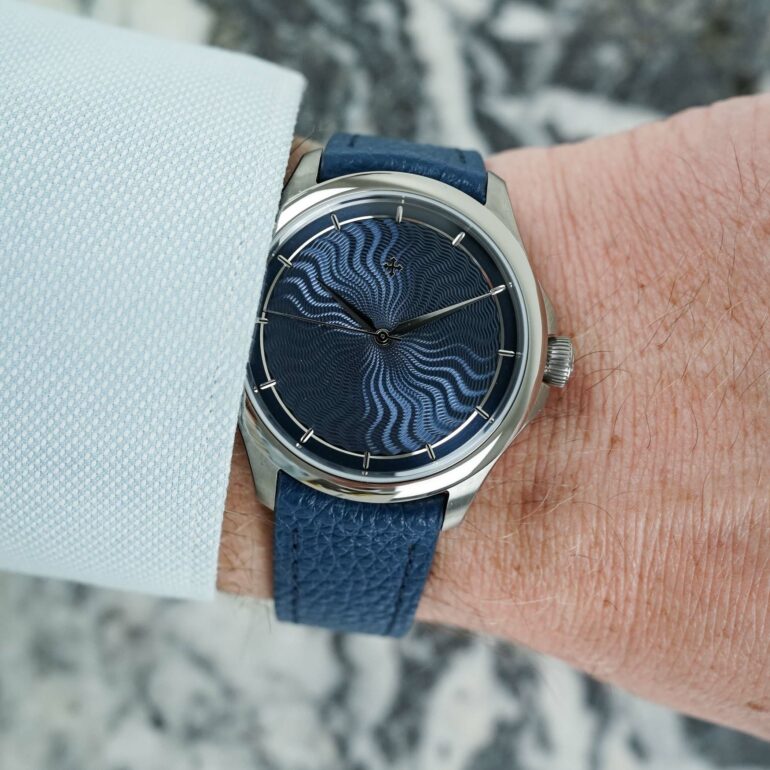
A 38-mm dress watch weighing 48 grams, including the strap, raises a question rarely asked in fine watchmaking: What if luxury also meant blending into the background? With the Redentore Levius, Venezianico takes titanium out of its traditional realm—that of rugged instruments and technical cases—and transforms it into a city watch with understated lines. The result is far from a disguised exercise in sporty style. On the contrary, it is based on a precise idea: to lighten the watch’s presence without obscuring the craftsmanship of the material or the artisan’s touch.
Weight as an Aesthetic Choice
Lightness is often touted in contemporary watchmaking for imposing timepieces designed for diving, adventure, or professional use. In such cases, it serves to offset generous proportions. Here, it produces a different effect. The Redentore Levius retains the compact design of the Redentore family, with a diameter of 38 mm, a thickness of 8.9 mm, and a lug-to-lug width of 44.2 mm. These dimensions are not intended to dominate the wrist, but rather to sit on it with restraint.
However, the switch from steel to Grade 5 titanium profoundly changes the feel of the watch. The case alone weighs 12.9 grams. With its movement and crystal, the watch head weighs 40 grams; with the handcrafted Italian leather strap, the total weight is just 48 grams. These figures are not merely technical specifications. They define the everyday relationship with a mechanical watch: it doesn’t pull on your shirt, doesn’t require readjustment, and can maintain a visual presence without imposing a physical one.
Titanium has a more favorable strength-to-density ratio than steel, which explains its place in utilitarian watchmaking. But its use in a dress watch remains rare. The reason lies less in its strength than in its resistance to delicate finishes. Brushed or sandblasted finishes suit it naturally; polishing, on the other hand, requires greater skill to achieve a clean and uniform finish. Many titanium watches therefore adopt a functional design language. Venezianico defies this convention with surfaces that alternate between brushed and polished finishes, applied to a case designed to remain discreet.
The Challenge of Titanium in Formal Wear
This design does not fit into an oversaturated category. Dress watches made of titanium remain rare, precisely because the material can quickly give a timepiece the look of equipment rather than an accessory. A model like the Grand Seiko Icefall in titanium, however, demonstrates that this metal can find its place in a more formal setting when paired with a meticulous surface finish and a dial capable of reflecting light.
The Redentore Levius navigates this tension without trying to overemphasize it. Its very name, Levius, suggests a variation on lightness. It does not replace the collection’s identity with a futuristic interpretation; rather, it refines its design language. The understated diameter, the slim case, and the Italian leather all contribute to a watch designed to complement a silhouette rather than dominate it. Its water resistance to 30 meters—or 3 bars—also clearly signals the watch’s purpose: everyday wear, not athletic performance.
This choice is also consistent with the brand’s recent history. Venezianico enlisted OISA 1937 to develop an Italian-made movement for its high-end models. The Redentore Utopia and Utopia II had already embodied this ambition in stainless steel cases. The Levius does not abandon this foundation; it reinterprets it through metal and color. It is a more subtle evolution than a new aesthetic language, but it touches on the sensitive point of any dress watch: the way it is worn, not just the way it looks.
A Wind Engraved in the Old Style
The dial prevents the Levius from becoming a mere statement of lightness. On the contrary, it introduces a sense of depth and texture. Its guilloché decoration is hand-engraved using a pattern called Zefiro, whose movement evokes the wind. Its name refers to Zephyr, the classical deity associated with the west wind. In a watchmaking landscape often drawn to industrial textures, this choice of a lively, almost dynamic design gives the dial a special function: to capture changes in light without resorting to an accumulation of effects.
This engraving is created by Linda Renzetti on an antique guilloché lathe, also known as a rose engine. The process requires the artisan’s direct intervention to create, line by line, the patterns that bring the metal to life. It is therefore not a decoration mechanically reproduced from a simple printed pattern. The dial’s value lies in the controlled irregularity of the artisan’s touch, in those minute variations that automated production tends precisely to erase.
The blue chosen for this dial is inspired by the Venetian lagoon. While such an evocation might be expected from a brand that emphasizes its Venetian roots, it remains understated here. The blue does not serve as a mere decorative device; it acts as a deep backdrop for the Zefiro pattern and complements the gray of the titanium. This combination avoids an overly stark contrast between a technical case and a handcrafted dial. The lightweight metal lends an almost matte finish; the guilloché work, meanwhile, creates the texture.
The Italian movement, in its silver-finished version
On the back, the Redentore Levius features the V5000 caliber previously used in the first Redentore Utopia. This hand-wound movement is manufactured in Italy and offers a 60-hour power reserve. Its frequency is 3.5 Hz. In such a slim watch, the choice of a manual-winding caliber naturally contributes to the overall design: it allows the watch to maintain its 8.9 mm thickness while incorporating a simple ritual—that of winding.
A comparison with the Utopia II sheds light on this decision. The Utopia II uses the V5001 caliber, which differs from the V5000 primarily in its finishes. For the Levius, Venezianico opted for the V5000’s silver-toned mainplate rather than a gold-plated version. This choice makes sense: the cooler sheen of this design complements the reflections of the titanium, whereas a gold hue would have introduced a more classic warmth, but one less closely tied to the character of the case.
This movement aptly captures the model’s intent. It does not seek to hide its Italian origins behind a generic aesthetic, nor does it overstate them with overly conspicuous design elements. Local manufacturing, the hand-guilloché dial, and the handcrafted bracelet are all part of the same narrative, yet each element plays its proper role. The watch remains recognizable as a wristwatch before becoming a showcase of craftsmanship.
A measured positioning
Priced at 4,750 euros—approximately 4,070 pounds sterling or 5,550 dollars—the Redentore Levius is positioned slightly above the steel Redentore Utopia models, which are priced at 4,500 euros. The price difference is minimal given the use of Grade 5 titanium and the complexity of the hand-engraved dial. A comparison with a few similar offerings is revealing: the Grand Seiko Icefall retails for around 6,800 pounds, while the Straum Jan Mayen is priced at 1,890 pounds, with a design much closer to a 1970s sports watch than to a dress watch.
The Levius thus occupies a narrow but distinct niche: that of titanium watches with handcrafted dials designed for everyday wear. It will be available for order starting September 25 on the Venezianico website. Its appeal lies less in the novelty of titanium than in the way it is used: not to build a suit of armor, but to shed a few grams from an object that didn’t need to be any more imposing.