
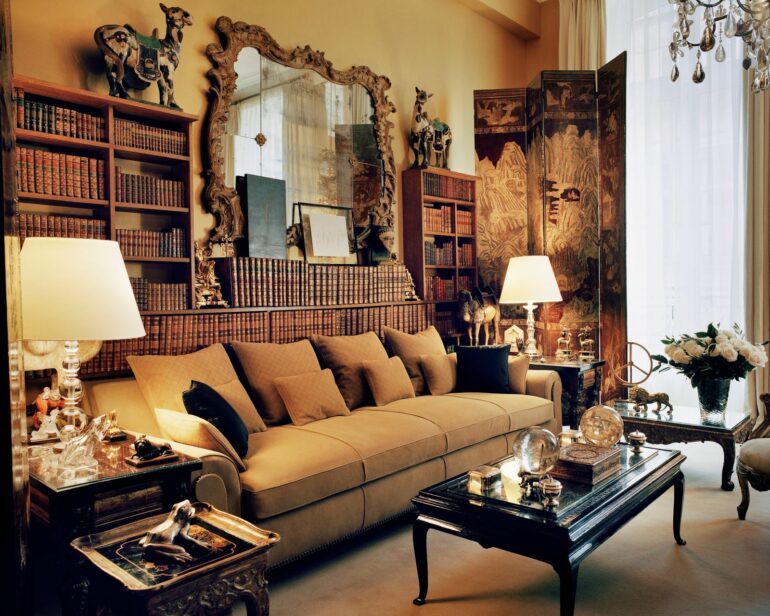
For her, No. 15 Place Vendôme was never just a temporary address or a luxurious stopover for a wealthy traveler. When she moved into the Ritz Paris, Gabrielle Chanel didn’t just choose a hotel; she claimed a territory in which to unfold her vision of the world. The woman who spent her life breaking down the constraints of women’s fashion applied the same rigor and the same aesthetic uncompromisingness to her living spaces. Whether it was her sun-drenched retreats on the Côte d’Azur or her Parisian apartments, every space she inhabited became an extension of her personal style: a paradoxical blend of almost monastic austerity and absolute luxury, stripped of all unnecessary artifice.
A Geometry of Simplicity
Chanel’s style does not stop at the seams of a tweed jacket or the drape of a pair of jersey pants. It is expressed with equal force in the layout of a living room or the choice of wall covering. This designer, whose approach shattered all the established boundaries of design in her era, imposed a “strict-chic” aesthetic that refused to compromise. In her interiors, nothing was left to the whims of the traditional decor of the time, which was often cluttered and stifling. She preferred empty space, straight lines, and a form of visual discipline that acted as a protective framework.
This obsession with structure never left her. Wherever she set down her trunks, she transformed the space to meet her own standards of comfort and clarity. At the Ritz, her suite became a living manifesto. She brought in her own furniture and her Coromandel lacquer screens, transforming an impersonal hotel room into a fortress of style. This is where her true boldness lies: daring to impose her own interior architecture on places that already had their own history, erasing the codes of the past to replace them with her own mythology.
The Riviera: Minimalism Facing the Sea
While Paris was her center of gravity, the Mediterranean was her laboratory of light. On the Riviera, her villas were not vacation homes in the traditional sense, but extensions of her aesthetic philosophy. In these residences overlooking the sea, the “strict elegance” she cherished found a special resonance. Far from the ostentatious opulence often associated with the French Riviera, Chanel favored clean lines, airy spaces, and a subdued color palette that gave pride of place to the outdoor environment while maintaining total control over the interior atmosphere.
In these vacation homes, the boundary between interior and exterior became porous, yet always under control. There, she established a way of living that was, in itself, a revolution. It was not about flaunting one’s wealth, but about cultivating a way of life rooted in the essentials. Under her influence, the villas of the Côte d’Azur became models of modernity where design took a back seat to better serve the occupant’s serenity. This ability to tame the landscape through architecture and furnishings reflects her “boundary-buster” approach—that of a woman capable of redefining not only what we wear, but how we inhabit the world.

The Ritz as a Personal Sanctuary
Her choice to reside almost permanently at the Ritz Paris was not a matter of vanity, but a strategic decision by a woman who refused to be burdened by ordinary domestic constraints so she could better devote herself to perfecting her immediate surroundings. In this jewel of a setting on Place Vendôme, she managed to strike a balance between the impeccable service of a luxury hotel and the extreme personalization of a private residence. Every object, every mirror, every texture—whether suede or silk—was designed to fit into this rigorous vision of chic.
Those who had the privilege of entering her world were struck by this absolute coherence. There was no distinction between the public and private woman; her interior was a mirror of her spirit. This suite was not merely a setting, but a workspace and a sanctuary. By imposing her own codes on an institution like the Ritz, she proved that style is a supreme force that does not bow to any institution. Her time there left an indelible mark on these walls, transforming the very concept of luxury hospitality into a bespoke experience, where the designer’s aesthetic takes precedence over the original furnishings.
The Legacy of an Uncompromising Vision
Chanel’s impact on interior design remains as powerful today as her influence on haute couture. By breaking down the boundaries between disciplines, she paved the way for a holistic approach to creation. Her taste for contrasts—beige and black, dark wood and crystal, the raw and the precious—continues to inspire the projects of contemporary architects. She left behind not just a catalog of forms, but a moral imperative: never to succumb to the easy way out or to passing trends.
“Strict elegance” is not merely a catchphrase; it is a constant discipline that demands the elimination of everything that is unnecessary. When observing her homes—from the Riviera to the salons of Place Vendôme—one realizes that her true masterpiece may have lain precisely there: in this ability to sculpt emptiness and give meaning to space. She turned her homes into manifestos of her independence, proving that one can feel at home anywhere, provided one has the strength to impose one’s own perspective on things. Today, as design often struggles to find its footing between cold minimalism and clutter, Chanel’s lesson remains as relevant as ever: chic is a matter of structure, not ornamentation.