
The inspection often begins in a heavy silence, under harsh white light. Even before slipping the watch onto his wrist, the modern buyer pulls out his jeweler’s loupe. He scrutinizes the edges of the case, hunting for the slightest sign of excessive polishing that might have softened a line meant to remain sharp. They examine the typography on the dial, verify the consistency of the serial number, and demand to see the mechanical inner workings ticking to the relentless rhythm of the chronocomparator. The purchase of a prestige timepiece has undergone a transformation. Romantic impulse has given way to rigorous scrutiny. On the global market—and particularly in the city-state of Singapore—acquiring a piece of fine watchmaking now requires the discipline of an archivist, where passion constantly clashes with pragmatism and skepticism.
Singapore today embodies all the tensions and paradoxes of this sector. The city has established itself as a key hub for Asian and international collectors—individuals who are no longer satisfied with the mere promise of a logo. They demand documented perfection. In this hyper-competitive ecosystem, the traditional sales channel is showing its limitations. Walking through the doors of an authorized dealer in the hope of walking out with a stainless-steel sports watch is nothing short of a pipe dream. Waiting lists stretch out for years, turning the buying experience into an exercise in patience that sometimes borders on subtle humiliation. Faced with this orchestrated shortage, the market has organized itself around alternative players.
The Rise of Private Warranties
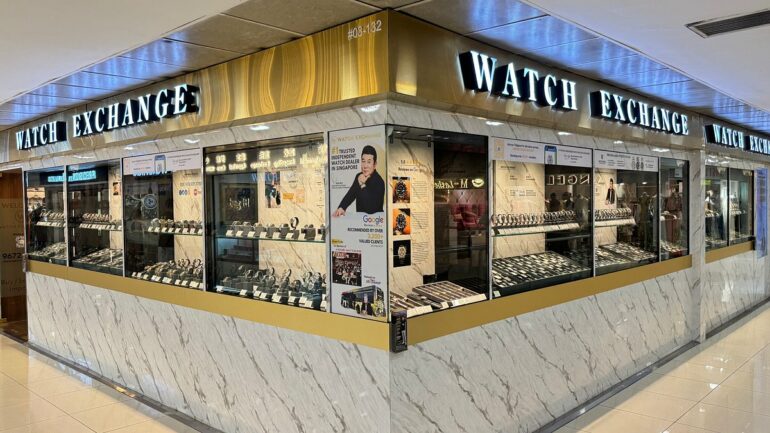
Independent shops have fully grasped this frustration and turned it into their business model. They offer what the official network can no longer guarantee: immediacy. However, this immediate availability comes with an almost pathological need for reassurance. Buyers demand a detailed history for every piece. The original box, paperwork, and international warranty card are no longer mere accessories but integral components of the item’s financial value.
Some local dealers take this logic of transparency to its extreme. This is the case with Crown Watch Group, which seeks to mitigate the risk inherent in the secondary market. By offering watches that are systematically authenticated, fully insured, and backed by a 13-day inspection period, this type of independent dealer directly addresses the prevailing paranoia. For the danger is real. The proliferation of extremely high-quality counterfeits—capable of fooling the untrained eye—is forcing sellers to make traceability of provenance a selling point as powerful as the watch’s aesthetics themselves.
The Crown’s Dominance Amid Fluctuations in Demand
At the heart of this Singaporean buzz stands, invariably, the same manufacturer. Since its founding in 1905 by Hans Wilsdorf, Rolex has maintained an overwhelming psychological and financial grip on the sector. Data compiled by Morgan Stanley analysts in collaboration with LuxeConsult confirms this de facto monopoly: the Geneva-based brand alone accounts for approximately 32% of the total value of the global market for new luxury watches. But it is in the pre-owned market that its dominance literally dictates the rules of the game.
Figures drawn from Bob’s Watches’ records illustrate the scale of the phenomenon. In 2024, the brand with the crown accounted for nearly 74% of all their pre-owned transactions. This overrepresentation stems from a structural mismatch between the meager in-store supply and a demand that refuses to wane, automatically generating exorbitant resale premiums. Yet this monolithic foundation is beginning to show tiny signs of fragmentation. A forward-looking report by Chrono24, dated September 10, 2026, estimates the brand’s share at 31% of the financial volume in the secondary market. Although this figure confirms its absolute leadership, the study highlights a notable decline in interest among customers under 30. Since 2022, this age group has tended to diversify its purchases, exploring other watch brands and refusing to be confined by status-driven conformity.
The Dictatorship of Country of Origin
Despite these slight demographic shifts, the heart of the market still beats to the rhythm of a few untouchable models. The Submariner continues to dominate sales volume, closely followed by the Datejust. Introduced in 1945, the Datejust defined the style of the contemporary dress watch, with its distinctive Jubilee bracelet and Cyclops lens overlooking the date window. Frequent travelers, meanwhile, continue to snap up the GMT-Master II, whose dual-time-zone complication allows for simultaneous and unambiguous reading of two time zones. As for the Daytona chronograph, it retains its aura of absolute exclusivity.

Apart from these highly publicized models, the Oyster Perpetual carves out a different path. Stripped of all superfluous complications, it offers a design of radical simplicity. This discretion acts almost as an ironic counterpoint to the ostentation that often characterizes the luxury sector, attracting a clientele that seeks manufacturing reliability without the overly flashy social status symbol.
But regardless of the model chosen, the bottom line always comes down to the watch’s physical condition. Even the slightest alteration to the original geometry severely impacts the selling price. A clumsily restored case, which erases the characteristic bevels of a Submariner or a GMT-Master II, drastically diminishes the piece’s appeal. The manufacturer itself strongly emphasizes its internal maintenance protocols, designed to preserve structural integrity and chronometric performance over the very long term. Entrusting your watch to an unqualified workshop means running the risk of erasing part of its history and, consequently, its market value.
The Triumph of Rationality
The evolution of the Singaporean market acts as a magnifying mirror for the global shifts in the luxury watch industry. The acquisition of a historic timepiece is no longer driven solely by aesthetic desire or a desire to display status. The transaction has become a heavily regulated investment, requiring tangible evidence, cross-verified certificates, and specialized technical expertise.
Faced with models that are often overpriced and a growing scarcity of pieces in their original condition, the enthusiast must give way to the analyst. It is no longer enough simply to find the coveted watch; the challenge lies in proving that the asking price is justified by the movement’s condition, the case’s integrity, and the completeness of the accompanying documentation. This disciplined, quantified, and meticulously documented form of luxury redefines the very concept of prestige. Owning an exceptional watch today means, above all, being able to prove, beyond a reasonable doubt, that it is exactly what it claims to be.