Make Texture a preferred source on Google to support us
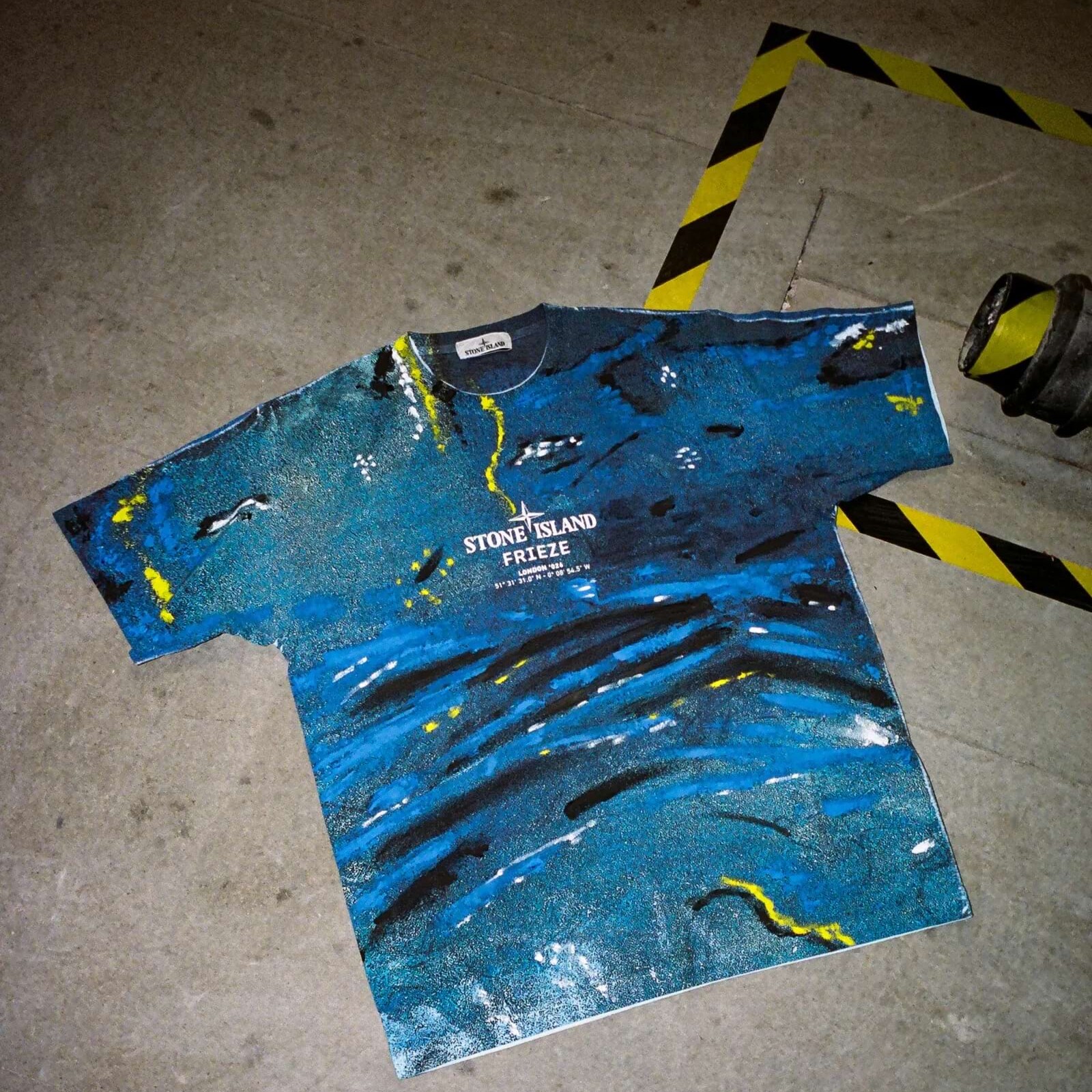
Add Texture to GoogleAmid the vast, immaculate expanse of Regent’s Park, as the Frieze London art fair unfolds its aisles before an audience of 95,000 visitors and representatives from more than 400 international institutions, a specific section captures the attention of even the most discerning eyes. The “Focus” section, reserved for galleries that have been in operation for less than twelve years, stands out as the event’s experimental hub. Supported by a program of direct grants from the Stone Island brand, this section brings together 35 exhibitors from 17 countries, under the watchful eye of an advisory committee composed of Cédric Fauq (chief curator at the CAPC in Bordeaux), Joumana Asseily, and Freddie Powell. It is here, far from the more predictable offerings, that the boldest initiatives of this edition take shape.
The Economy of Desire: Ella Fleck’s Infiltration
One of the most striking works in this edition is by Ella Fleck, represented by the Ehrlich Steinberg Gallery (Los Angeles). The artist received the Camden Art Centre Emerging Artist Award at Frieze, which guarantees her a future institutional exhibition at the Camden Art Centre. Her installation, titled *training material*, is the result of a quasi-anthropological immersion: the artist worked as a chat operator for an agency managing OnlyFans model accounts. On the floor, a sculptural platform emits physical vibrations and directional sound. Male voices can be heard reciting scripts designed to monetize sexual fantasies. This work, which dissects the industrialization of digital intimacy, was acquired by a European family collection for 14,000 pounds sterling (approximately 16,800 euros), split between the floor structure and the three-screen software piece.
Political Textiles and Sound Archives: Jayeeta Chatterjee
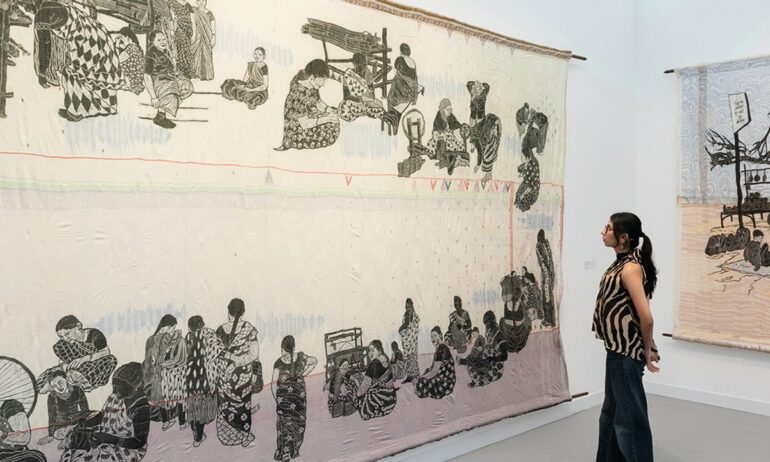
The Mumbai-based Chemould CoLab gallery is presenting the work of Jayeeta Chatterjee, whose major piece, *The Infinite Weft*, was immediately acquired by an Indian museum. The artist uses the traditional nakshi kantha technique—an ancient Bengali embroidery style—to assemble secondhand saris. On these textile surfaces, she creates woodcuts (xylographs) depicting female workers at a weaving workshop in Hampi. The conceptual dimension of the work lies in the integration of motifs reproducing sound waves—visual transcriptions of the interviews the artist conducted with these women about their economic empowerment. Commercial success followed critical acclaim, with three textile pieces selling for between $13,000 and $26,000.
The Brutality of Steel in Isaiah Davis’s Work
In contrast to the softness of textiles, Isaiah Davis (King’s Leap Gallery, New York) explores a violent materiality. His sculptures made of recycled welded steel—notably *Undertow* and *Vesselhood*—evoke rib cages or restraint devices. The artist engraves direct inscriptions on them, such as the phrase “Token gets spent” or the first names “Don,” “Jeff,” and “Sean”—explicit references to Donald Trump, Jeffrey Epstein, and Sean Combs. Davis uses the aesthetics of the reliquary and the harshness of industrial steel to examine the historical and contemporary vulnerability of the Black body, transforming the metal into a fetish laden with social tensions.
Metamorphoses of the Object and the Living
The Focus section also features works that explore tactile disorientation and organic hybridizations. Amanda Moström (Rose Easton Gallery, London) presents *Bikini Bottom*, an evolving installation in which mundane objects found at flea markets—an umbrella, an office chair, a box of tissues—are entirely covered in goatskin. This shift of the object—from the popular flea market to the exclusive art market—creates an erotic and uncomfortable tension, accentuated by the presence of a found photo album depicting a nude woman.
In a more futuristic vein, Yuli Serfaty (Xxijra Hii, London) exhibits *Who’s a Good Girl?*, a headless creature with multiple breasts. This hybrid sculpture interacts with a computer-generated imagery (CGI) video. In it, Serfaty develops a narrative centered on the autonomy of artificial intelligence and resistance to surveillance drones through the use of software bugs. The work becomes an allegory of digital emancipation against a backdrop of ecological anxiety.
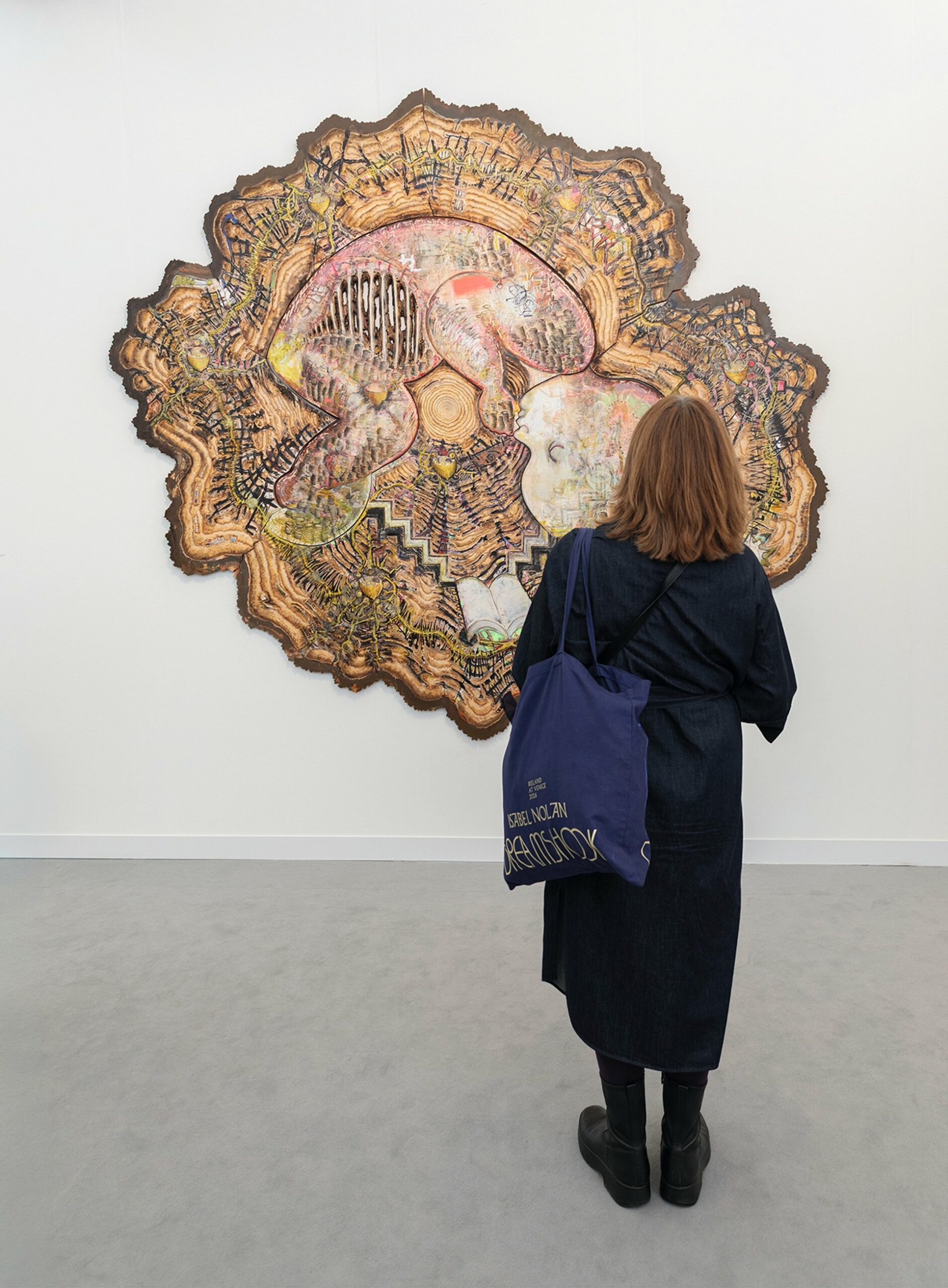
Finally, Tom Hardwick-Allan (South Parade, London) presents *Engine of Sickness and Light*, a reflection on biological cycles. He has engraved the cross-section of an ancient tree onto nine plywood panels, revealing the figure of an infant at the heart of the wood. This installation is accompanied by a staircase-like structure housing the artist’s personal library, with each book protected by translucent glassine paper, creating a link between natural regeneration and the preservation of knowledge.
Market Dynamics and Institutional Support
Beyond individual successes, the vitality of the section is measured by the involvement of acquisition funds. The Dasha Shenkman Focus Fund enabled the Abbot Hall Museum, located in Cumbria, to acquire three works by Okiki Akinfe (Greenfield Forbes Gallery). Other transactions confirm the segment’s strength: the Montreal-based Eli Kerr Gallery recorded sales ranging from 4,000 to 12,000 pounds sterling for the artist Simon S. Belleau. These figures, though modest compared to the highs reached in the main sections, demonstrate the commitment of collectors and institutions to a new generation of artists who, through their formal explorations and thematic engagements, are the true driving force behind the Regent’s Park fair’s future.