
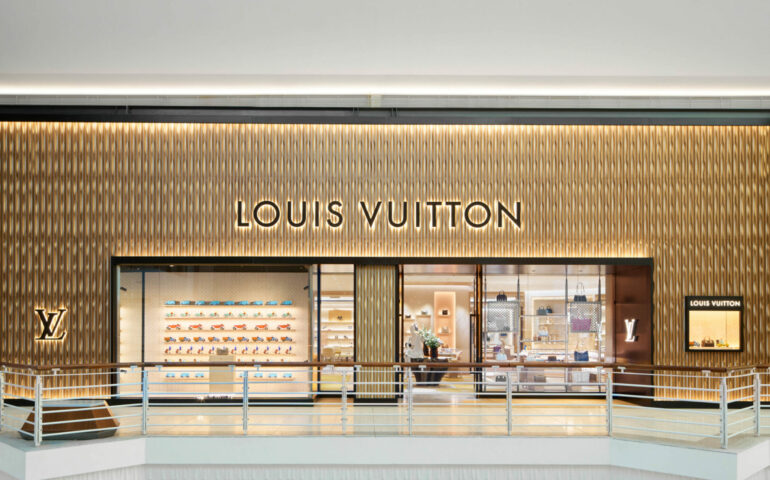
The luxury retail industry has definitively turned its back on the simple transaction. Gone are the days when simply displaying items behind a glass window was enough to attract a wealthy clientele. Now, the act of purchasing must take a back seat to the staging, the experience, and the act of strolling through the space. The recent transformation of the Louis Vuitton space in Cape Town, South Africa, perfectly encapsulates this shift. Present in the city since 2007, the French brand made a strategic shift on July 31 by moving into new premises at Victoria Wharf. This move is far more than a simple lease change. It represents a complete redefinition of the brand’s presence on the continent, no longer conceived as a retail outlet but as a living space governed by a precise choreography.
Architecture as a Tool for Slowing Down
The first encounter with this new location sets the tone. The exterior façade breaks with traditional smooth surfaces to mimic, in carved wood, the striated grain of Epi leather. This texture—the luggage maker’s historic and subtle signature—acts as a filter between the hustle and bustle of the shopping mall and the hushed atmosphere of the interior. The architectural goal is clear: to disrupt the visitor’s rhythm, forcing them to slow their pace the moment they cross the threshold.
Once inside, the space unfolds like a series of private salons rather than retail aisles. The layout divides the store to avoid a sense of overwhelming mass. Upon entering, the women’s section opens onto the leather goods collections and a space dedicated to perfumes. The decor features a wealth of tactile and visual details, combining ribbed oak seating with handmade Japanese wallpaper. The journey toward ready-to-wear, shoes, and accessories then continues through macramé panels featuring the iconic flowers of the Monogram canvas. This approach to the openness of the spaces contrasts sharply with the men’s section, located on the other side. There, the color palette is deliberately darker, favoring French oak finishes and heavy, leather-upholstered furniture, creating the atmosphere of a private club.
The Dialogue Between International Flair and South African Roots
The main pitfall for a brand of this stature is to sterile-ly replicate a global concept, resulting in interchangeable interiors found in Tokyo, Milan, or New York. To anchor its location within the local landscape, the design incorporates elements from outside its own catalog. Works by South African artists punctuate the customer’s journey, engaging in a dialogue with pieces from the brand’s Objets Nomades collection. Even more telling of this commitment to integration is the fact that part of the furniture was commissioned from Weylandts, a South African design firm. This fusion of the strict codes of Avenue Montaigne with regional craftsmanship helps forge a sense of connection with the local clientele.

The range of collections reflects this new scope. The store brings together nearly all of the brand’s product lines: ready-to-wear for men and women, shoes, accessories, gifts, travel items, leather goods, fragrances, and, of course, the historic trunks. But the products alone no longer justify the trip. It is the ancillary services that keep customers coming back: customization workshops offering engraving on perfume bottles, an integrated after-sales service, and, above all, the systematic offering of personalized appointments.

Contemplating the Victoria Pond
The highlight of this hospitality strategy lies at the very back of the store, away from the main flow of traffic. A vast winter garden has been created, designed as the natural culmination of the visit. Covered by a bamboo ceiling and filled with lush vegetation, this space is surrounded by floor-to-ceiling windows. The view opens up entirely onto the Victoria Basin. It is within this space, hidden from outside view, that the brand’s events and private receptions are held. Here, commercial architecture reaches its limits: the inventory is hidden from view, and the cash register is out of sight. The goal is to build customer loyalty through comfort, transforming the shopper into a guest.
A Battle of Position on the Waterfront
The deployment of such resources by a major player in the sector never occurs in a vacuum. It is a direct response to changes in its immediate environment. The V&A Waterfront is engaged in an intensive process of moving upmarket, significantly expanding the retail space in its luxury wing. The immediate neighborhood demands an escalation of prestige.
Competition in these shopping aisles has intensified significantly. Long-established brands such as Burberry, Gucci, and Dolce & Gabbana sit side by side with Versace, while highly specialized local players, such as the South African label MaXhosa Africa, are redefining the standards of regional elegance. In this hyper-competitive environment, the breadth of the product offering and the extended hours—the store is open daily from 9 a.m. to 9 p.m.—have become essential strategic assets. One logistical detail, in fact, underscores the complexity of this location: the official physical address provided by the brand differs slightly from the one recorded by some commercial real estate observers, reflecting the constant reconfiguration of spaces within the complex.
Ultimately, this evolution of the luxury landscape in Cape Town raises questions about the very nature of these new temples of consumption. By seeking to offer complete, meticulously curated, and highly staged escapades from everyday life, luxury brands undeniably succeed in enriching their narrative and capturing attention. The cultural and aesthetic dimensions gain depth as a result. Yet, by transforming every visit to a store into a premeditated journey and a planned appointment, the industry sacrifices the very essence of impulse buying: its spontaneity.