
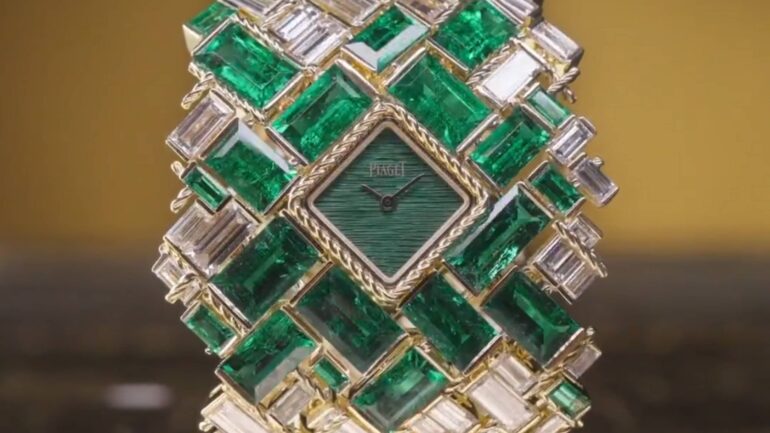
The Swiss house of Piaget concludes its high jewelry trilogy with *Colours of Extraleganza*, a collection of 65 pieces in which color becomes an architectural and contemporary language, blending tradition and innovation.
Piaget concludes its high jewelry trilogy with Colours of Extraleganza, a collection of 65 pieces in which color truly takes center stage in the creative process. The Swiss Maison thus continues on a path it began in 2024 with “Essence of Extraleganza,” and further explored with “Shapes of Extraleganza.” Far from being a mere succession of jewelry sets, this approach is akin to a style manifesto. At Piaget, color does more than simply adorn: it structures and builds.
A chromatic and architectural vocabulary
This project is part of a deliberate effort to revisit the codes of the 1960s and 1970s, free from any sense of nostalgia. This trilogy explores the Maison’s rich heritage while reinterpreting it through a resolutely contemporary vocabulary. While “Essence of Extraleganza” celebrated creative energy and ornamental gemstones, and “Shapes of Extraleganza” highlighted geometric forms and the interplay of volume, this final chapter transcends the exercise.
With this final collection, Piaget does more than simply bring a series to a close: the Maison orchestrates its heritage around a central theme—that of a jewel that treats the material like a painter’s palette. Each creation thus appears as a deliberate step toward absolute harmony, lending profound meaning to the body of work as a whole.
Visual tension as the climax
In “Colours of Extraleganza,” the palette unfolds with unapologetic boldness: sapphires, emeralds, rubies, tourmalines, and opals are joined by eclectic touches of mother-of-pearl or tiger’s eye. The gemstones are not selected solely for their rarity, but rather for their visual tension. It is their contrast, their resonance, and their ability to interact that take precedence. Rose gold and yellow gold play an active role in this symphony of color: far from being mere settings, they play a fundamental role in the sculptural balance of the pieces.
This virtuosity is part of Piaget’s rich historical legacy. Since the launch of the famous ultra-thin 9P caliber in 1957, mechanical prowess has evolved into an aesthetic signature. By freeing up space, this finesse made it possible to introduce color onto the dials—a bold move that was later carried over to high jewelry. The history of watchmaking thus becomes the grammar of a decorative art that combines the highest Swiss precision with a radiant freedom of expression.
The Architecture of Light
Among the collection’s masterful creations, the Blue Illusions necklace alone requires nearly 900 hours of workshop labor. It combines a Madagascar sapphire, a Paraíba tourmaline, and a black opal, set with diamonds and custom-cut gemstones. The piece rests on a geometric structure that captures light with purely architectural precision. This mastery of lines extends to rings and earrings that feature the same exceptional motif.

The House also reinterprets its iconic 1969 long necklace-watch in a version named Flamboyant Links. The combination of rose gold, tiger’s eye, and mandarin garnet revives the stylistic spirit of the 1970s. Designed to be worn as a choker or a bracelet depending on one’s mood, this piece embodies Piaget’s philosophy: high jewelry designed to transform while maintaining impeccable consistency.
Between Tradition and the Avant-Garde
The Gold Swirl collection, in turn, evokes the organic lines of that flamboyant era, sculpting rose gold around tourmalines and fire opals. A remarkable necklace combines meticulous fluted goldwork with a diamond-set dial, highlighting the interplay of contrasts. Pushing formal audacity a step further, the Gems Pop set draws inspiration from the Memphis movement of the 1980s, offering radical color combinations where mandarin garnet, pink sapphire, aventurine, and white opal intersect, all crowned by a detachable watch pendant.
Far from diluting the design’s intent, this wealth of influences underscores the strength of a House that has always fostered a dialogue between watchmaking and jewelry with disconcerting fluidity. Technical lightness becomes an aesthetic in its own right, and color, freed from its role as mere ornament, becomes a structural component in its own right. The resulting creations are spectacularly elegant, underpinned by a design of the highest standards.
With “Colours of Extraleganza,” Piaget delivers far more than a celebration of opulence: it is a masterful demonstration of creative rigor. The Maison presents a collection in which exuberance is perpetually enhanced by light, architectural rhythm, and a deep respect for its own modernity.