
Make Texture a preferred source on Google to support us
Add Texture to GoogleThe load-bearing wall is no longer the enemy. After decades of a frantic quest for maximum space—during which interior designers tore down every partition to create vast open layouts—the trend has abruptly reversed in the ultra-luxury real estate sector. The loft, with its receding perspectives and kitchen open to the living room, is now revealing its psychological limitations. In Parisian townhouses as well as in contemporary residences, clients are once again demanding doors, entryways, and nooks. Among these revived spaces, one historic room epitomizes this thirst for seclusion: the boudoir. Far from the outdated image of a powder room, this small, secluded space has emerged as the epicenter of a new relationship with intimacy, redefining the very contours of domestic luxury.
The End of the Dogma of Transparency
For nearly half a century, bourgeois domestic life mimicked industrial aesthetics and the fluidity of an art gallery. Living spaces were meant to reveal everything, to absorb everything. Natural light served as the exclusive design criterion, and privacy dissolved into reception areas designed to impress. Yet, living day-to-day in a space without boundaries is exhausting. The disappearance of partitions has systematically eliminated areas of retreat, exposing residents to the constant gaze of other household members. Faced with the growing blurring of lines between professional life, hyper-connectivity, and the private sphere, interior architecture is making a radical return to compartmentalization.
The contemporary boudoir directly addresses this spatial need. It is typically situated between the bedroom—which has become merely a place to rest, and is sometimes too shared—and the bathroom. It is neither a passageway nor a featureless transitional space, but a destination in its own right. Its deliberately modest scale is reassuring. Whereas the large reception room can be intimidating due to its proportions and high ceilings, this modern alcove feels enveloping. Designers play with lowered ceilings and hidden doors that blend into the woodwork, creating the illusion of a secret room to which only the owner has access.
The Etymology of Subtraction
To grasp the significance of this resurgence in popularity, a detour into the very origins of the concept is necessary. First appearing in the 18th century during the reign of Louis XV, the term derives, quite simply, from the verb “to sulk.” Yet this was no mere whim, but a genuine strategy for spatial emancipation. In castles where daily life unfolded as a perpetual performance, under the constant watch of servants and the weight of court etiquette, the boudoir established itself as the first space exclusively reserved for women. A room physically removed from the rules of the court.
It was the place for private correspondence, solitary reading, and intellectual pursuits. Even then, its design broke with the icy symmetry and rigidity of the grand salons. It featured low seating, asymmetrical chaise longues, and silk wall coverings that absorbed sound. Today, interior designers are reviving this decorative style while stripping it of its Rococo opulence. The fundamental goal remains the same: to create a space of absolute seclusion.
The Antithesis of the Formal Dressing Room
A persistent misconception sometimes reduces the boudoir to a mere extension of the wardrobe—a glorified makeup area. The luxury market, however, has firmly distinguished these two categories in recent years. The contemporary dressing room, heavily influenced by image culture and digital display, follows a logic of exhibition. It is a clinical, meticulously precise space, organized like a ready-to-wear boutique where leather goods and fine timepieces are displayed under technical lighting with adjustable intensity. The purpose of the dressing room remains deeply materialistic and focused on appearance.
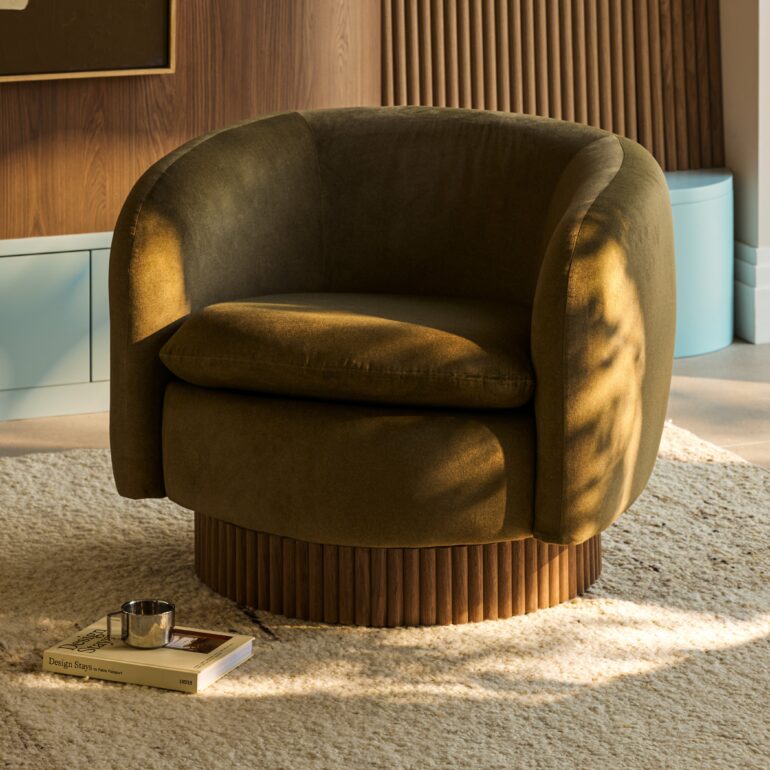
The boudoir, by contrast, serves a sensory and intangible purpose. The interior design of these new retreats visually reflects this shift. Architects are moving away from cold marble, glass, and polished steel in favor of materials that absorb light and muffle footsteps. The walls are clad in cashmere, short-pile velvet, or finely grooved walnut paneling. The floor calls for thick carpets made of plant-based silk or hand-woven rugs. Furnishings are sparse, reduced to the essentials: a cutting-edge reading lamp, a generously sized armchair, a charred-wood pedestal table. The room’s function is not dictated by specific furnishings, but by its soothing emptiness. One retreats here to produce nothing, store nothing, display nothing.
The Engineering of Silence
In the creation of these contemporary sanctuaries, technology plays a central role—on the express condition that it remains invisible. The era of the triumphant home automation of the 2000s is over. Controls disappear behind weathered brass switches or beneath touch-sensitive surfaces concealed within the cabinetry. Light, a crucial element of the atmosphere, categorically rejects direct overhead lighting. Architects favor indirect light sources, low-angle wall sconces, and mood lighting that sculpt the spaces with extreme softness, mimicking the warm glow of late afternoon.

The ultimate luxury of these spaces, however, lies neither in the textiles nor in the lighting, but in their acoustic engineering. Acoustic insulation is the subject of almost obsessive attention during construction. Decoupled double walls, solid doors fitted with soundproof seals, and porous wall coverings transform the boudoir into a sensory isolation chamber. This textured silence—free from urban vibrations, distant sirens, and the hum of the central air conditioning—alters the body’s physical perception of space. Some homeowners have analog hi-fi systems installed there for pure musical listening; others use it as a sanctuary for meditation, or simply store a collection of rare editions there. The common thread remains this fierce determination to suspend the passage of time.
The Redefinition of the Domestic Space
The return of the boudoir reflects a profound shift in the aspirations of the urban elite. Whereas social status was once displayed through the square meters dedicated to entertaining guests, it is now measured by one’s ability to isolate oneself from them. The period of successive lockdowns acted as a sudden catalyst for this realization. Forced to live 24 hours a day in homes designed with an open-plan layout, many clients felt the glaring absence of physical boundaries. The vital need for a private space has never been more pressing, transcending, moreover, the issue of gender. While the historic boudoir was sociologically feminine, its contemporary version appeals just as much to a male clientele seeking a reimagined smoking room, a secluded reading room, or a decompression zone between business trips.
This room alters the overall flow of the home. It creates a rhythm, an unexpected pause in the sequence of living spaces. Major international architecture firms now incorporate it from the very first sketches, no longer hesitating to trim the size of the master suite to free up those precious square meters dedicated to introspection.
Time as the Ultimate Privilege
The enduring popularity of the boudoir offers a precise diagnosis of our times. In a society that demands constant availability, that hunts for attention through screens, and that celebrates continuous performance, creating a room whose sole purpose is to provide a retreat constitutes an act of resistance through design. The ostentatious display of objects or vast glass surfaces gives way to a much more subtle luxury: absolute control over one’s cognitive environment.
The heavy door that closes silently on this small, cozy space marks a clear boundary between the hustle and bustle of the outside world and inner tranquility. An architecture that embraces disconnection, proving that the evolution of luxury living no longer revolves around the mere conquest of space, but rather the appropriation of something infinitely rarer: inaccessibility.