
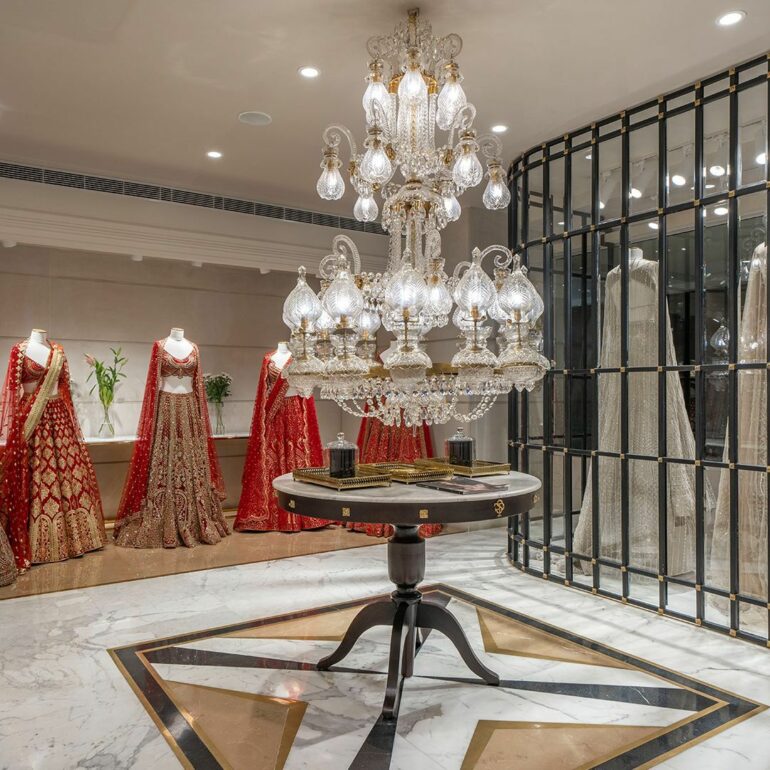
The gilded splendor of the Taj Falaknuma Palace immediately creates an atmosphere that money can’t buy. It was in this former royal residence, steeped in the legacy of the Nizams’ era, that designer Anamika Khanna chose to unveil her collection, marking the opening of India Couture Week. The collection, woven with delicate Barmer embroidery and dotted with references to Kalighat paintings, could easily have settled for playing the nostalgia card. Yet it was, in fact, a highly strategic move. By relocating the kickoff of this prestigious event to Hyderabad, the Indian fashion industry is signaling a clear break with its own traditions. The center of gravity for luxury—long confined to the hushed salons of Delhi and the upscale avenues of Mumbai—is shifting, moving south and east, and completely redrawing the geography of exclusivity on the subcontinent.
The fact that Rahul Mishra closed out this same Delhi Haute Couture Week does not obscure the underlying trend: the domestic market has transformed. The major fashion houses are now facing a clientele that has become geographically dispersed, whose purchasing power has skyrocketed, and whose expectations have become increasingly complex. This elite no longer systematically travels to historic capitals to acquire exceptional pieces. It demands that luxury come to it, set up shop in its own territory, and adapt to its own social rhythms.
The Real Estate Equation and the New Wealth Landscape
The appeal of Hyderabad stems from more than just a fascination with its palatial architecture. The figures underscore this shift. Knight Frank estimates that 80% of the country’s ultra-wealthy are now concentrated in just five major cities. The capital of Telangana state alone accounts for 6.3% of this top segment of the population, forming a customer base capable of absorbing the most expensive developments. Chennai is following the same trajectory, forcing retail strategists to rethink their expansion plans.
Beyond raw purchasing power, expansion into these new strongholds is driven by commercial reality. Establishing a presence in Delhi or Mumbai means facing overwhelming real estate pressure, which automatically reduces fashion houses’ margins. Commercial rents there are sky-high. By investing in major cities like Hyderabad or Bengaluru, luxury brands gain access to larger retail spaces for a lower investment. This financial breathing room allows for more resources to be allocated to the customer experience, while local shoppers—freed from certain costs inherent to overcrowded megacities—have a larger budget for ceremonial saris, fine jewelry, and formal trousseaus. As noted in Kearney Asia-Pacific’s analysis by Neelesh Hundekari, status aspirations and consumer demand have converged at a higher level, erasing the provincial complexes of the past.
The wedding calendar, the master of all schedules
If fashion is expanding beyond its traditional strongholds, it is because it closely follows its primary economic driver: the colossal Indian wedding industry. The ceremonies, which span several days and require multiple formal outfits, alone justify the opening of very large brick-and-mortar retail locations. Fittings, alterations, and assisting families require a geographical proximity that online retail can never match.
Store openings are therefore taking place at a rapid pace, transforming certain neighborhoods into veritable hubs of haute couture. Rahul Mishra established a presence as early as 2024 in the highly sought-after Banjara Hills district of Hyderabad, showcasing his formal gowns and skirts—directly inspired by his Parisian runway shows. Anamika Khanna, in turn, opened her own store there in 2025. The trend is massive: Sabyasachi doubled down with simultaneous openings in Bengaluru and Hyderabad that same year, while Tarun Tahiliani chose Hyderabad as the venue for his anniversary fashion show.
Moreover, these markets’ appetite isn’t limited to traditional aesthetics. The West and high-end watchmaking are rushing into the same arena. TimeVallée is setting up shop in Chennai, Off-White is testing the market in Bengaluru, and Ralph Lauren has its sights set on Kolkata for 2025. The territorial network is becoming increasingly dense, encompassing cities that may seem smaller in size but possess equally formidable potential. The Aditya Birla Group, through its brand The Collective, is expanding its presence in strongholds such as Raipur, Jalandhar, and Patiala. Ogaan is setting up shop in Chennai, and Raw Mango established a presence in Kolkata last year. This physical network is expanding with relentless logic, targeting organized, loyal shoppers who are ready to spend locally.

The Psychology of Style and Regional Norms
However, applying a single sales strategy across this vast territory would be a misreading of the situation. The decentralization of the luxury market reveals extremely fragmented consumer habits. Designer Rimzim Dadu must adapt to the spontaneity of her Hyderabad clientele, who are accustomed to last-minute purchases. This behavior demands aggressive logistics, requiring her to maintain deep, immediately available inventory—a stark contrast to the typical timeline of haute couture, which involves orders placed well in advance and months of waiting. Her order book highlights another phenomenon: the appeal of these new metropolises extends beyond regional borders. His boutiques see an influx of shoppers from Nagpur, Guwahati, and Raipur, as well as a nearby international clientele crossing the borders from Nepal or Bangladesh to purchase exclusive pieces.
Stylistically, expectations vary from one zip code to another. Designer Arpita Mehta maps out a precise landscape of desires: while Chennai demands restraint and a certain formal discretion, Chandigarh is keen on visual experimentation, leaving Hyderabad with a monopoly on a strict pursuit of elegance and refinement. Standardization is merely a facade.
Admittedly, the ubiquity of social media has accelerated the spread of trends, as stylist Aisha Rao observes. Today’s shoppers have mastered the technical vocabulary of the ateliers. They identify fabrics, recognize the signature of a drape or an embroiderer’s technique long before they even step through the door. They no longer view fashion as a fleeting ceremonial disguise, but as a tool for self-expression and a means of asserting their social standing. A customer’s geographic origin has less and less influence on her boldness, allowing personal style to dictate the purchase.
Knowing how to sit at the right table
Despite this enthusiasm and the order books filling up outside Delhi and Mumbai, expansion is proceeding with clinical caution. The management teams of the major fashion houses know that simply opening a spectacular space adorned with the opulence of local architecture is not enough to ensure the long-term viability of a business model. Conquering these markets requires deep sociological roots.
They must tailor their offerings in real time, train sales teams capable of deciphering local networks of influence, and, above all, have a thorough grasp of a region’s social calendar. Wedding seasons, regional festivals, and family dynamics shape the flow of business far more than international Fashion Weeks. The future of Indian design is now being shaped far from its historic hubs. But it is not entering this territory as a conqueror. It must learn to navigate these markets with the wisdom of those who know they must first earn acceptance before dictating taste.