
Make Texture a preferred source on Google to support us
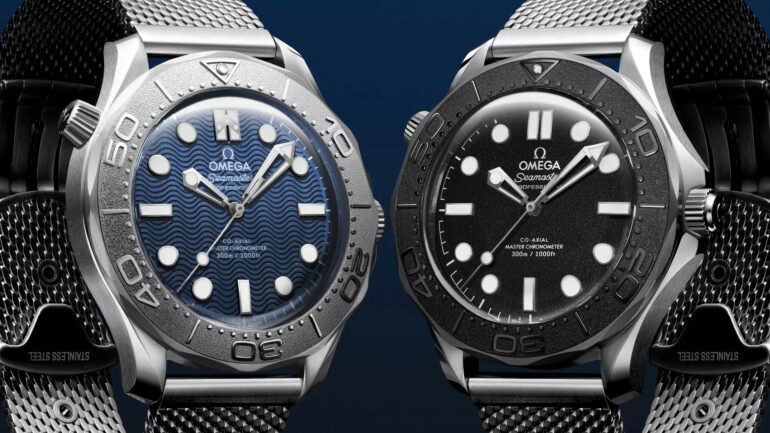
Add Texture to GoogleOctober 5, 2026, will mark a subtle shift in the way the luxury watch industry leverages its cinematic myths. Until now, the relationship between the Swiss watch industry and the silver screen has almost always centered on a charismatic, heroic central figure. Since 1995, when Pierce Brosnan first slipped a Seamaster over his cuff in *GoldenEye*, OMEGA has built a one-sided narrative around Agent 007. The watch was the exclusive preserve of the savior. However, this new series breaks that narrative monopoly. For the very first time, the British hero is forced to share the spotlight—and the watch face—with Spectre, the criminal syndicate that haunts his missions. The Biel-based manufacturer isn’t seeking to revolutionize its engineering here, but rather offers an unexpected reflection on duality. On one hand, the weight of duty and loyalty to institutions; on the other, a radical, secret, and destructive independence. The timepiece ceases to be a mere accessory and becomes the stage for a psychological showdown.
The Seamaster Diver 300M as a Battleground
To give tangible form to this tension, a platform was needed capable of absorbing such symbolic weight without losing its integrity as a precision instrument. The choice naturally fell on the Seamaster Diver 300M. This model, whose relaunch in 1993 marked a turning point in the aesthetics of modern dive watches, features a case design familiar enough to allow attention to focus on the surface details. The overall design remains austere and imposing. The 42-mm case ensures a bold presence on the wrist, extended by the classic metal mesh bracelet that gives the watch the appearance of contemporary armor. The unidirectional rotating bezel and the massive case profile serve as a reminder that, before being a marketing tool, the watch is designed to withstand the pressure of the depths. The six new variations all share this same chassis; the challenge is to distinguish the protagonist from its adversary through the sheer power of textures and finishes alone.
Steel in two radically contrasting interpretations
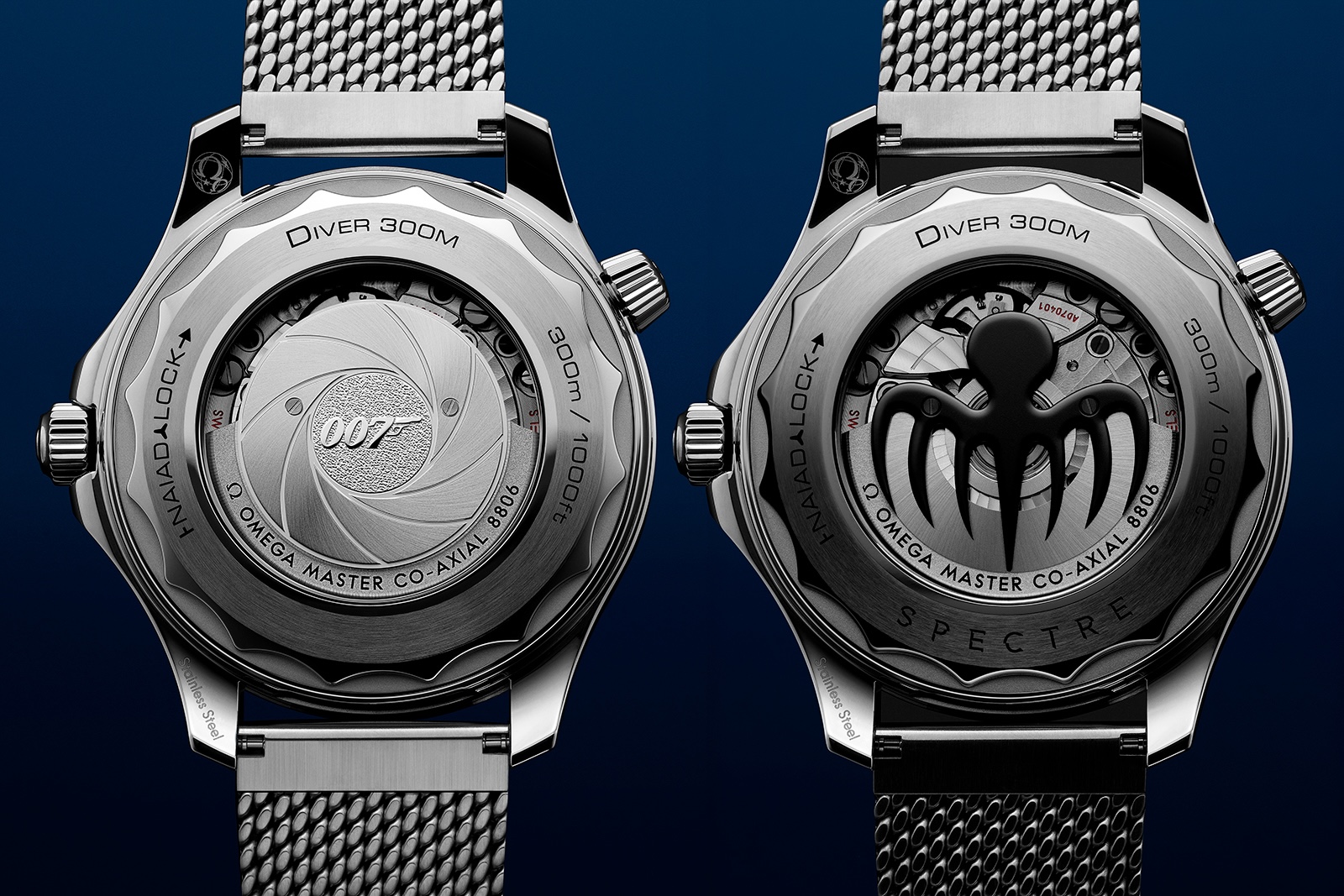
In its stainless steel version dedicated to the secret agent, the timepiece plays on nostalgia and legibility. The aluminum dial features a deep blue hue, crisscrossed by the famous laser-engraved wave motif that acts as a “Madeleine de Proust” for long-time enthusiasts. This textured surface complements a bezel crafted from Grade 5 titanium, lending a technical matte finish to the watch’s face. The narrative touch is evident in the details: the 12 o’clock hour marker gives way to the Bond family crest, while the rotor—visible through the sapphire caseback—replicates the helical rifling of a pistol barrel, a direct nod to the franchise’s opening sequences.
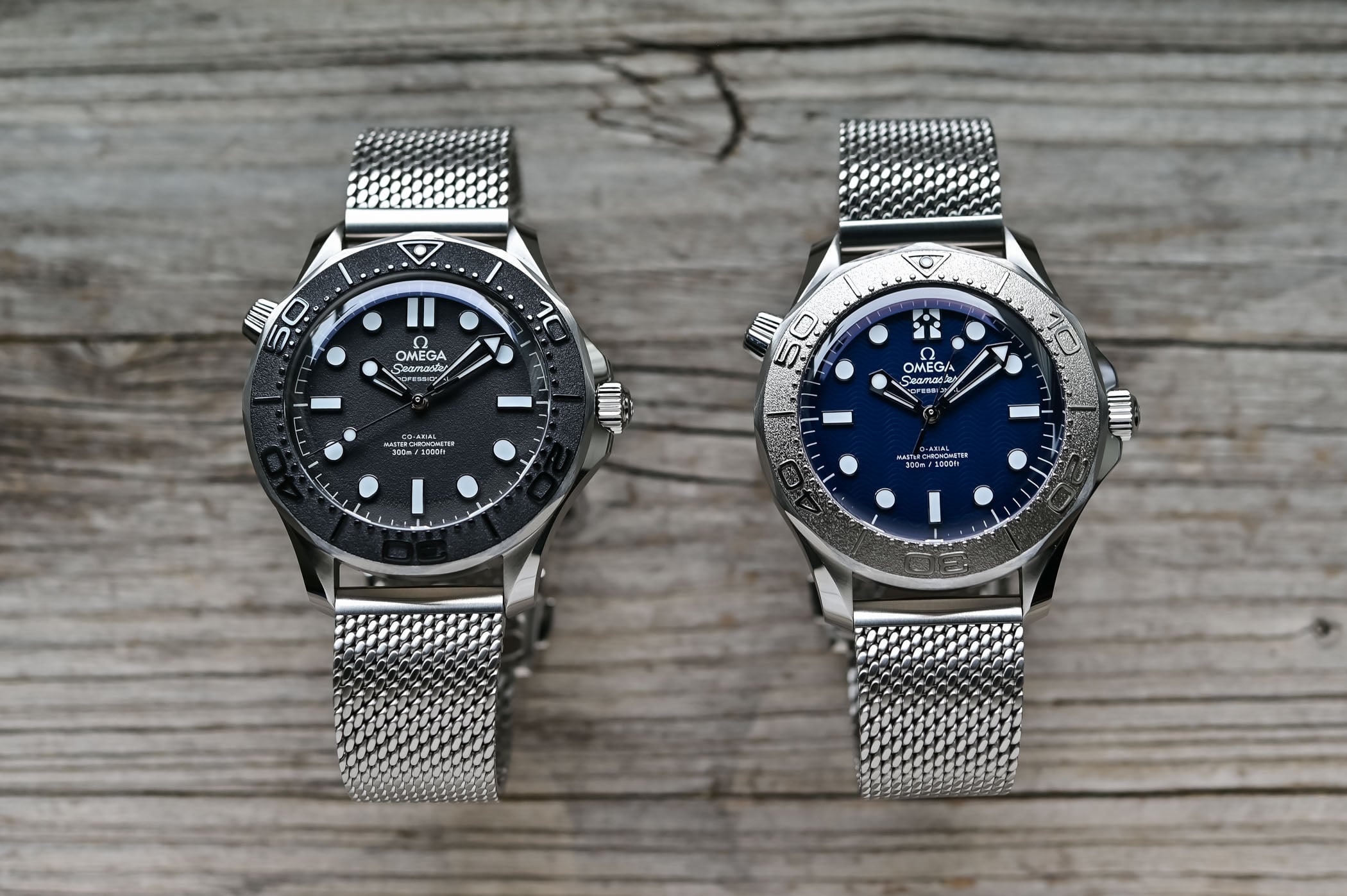
In contrast to this bold display of affiliation, the Spectre model opts for a strategy of understated elegance. Visual clutter gives way to surgical precision. A black ceramic bezel frames a black grained dial, absorbing light rather than reflecting it. No flashy emblems disrupt the reading of the time. The emblem of the criminal organization—tentacular and menacing—remains concealed on the case back. This contrast in design proves particularly apt. Rather than veering into a caricature of a villain’s gadget, the brand offers the shadowy syndicate a tool of great understated elegance, proving that in the aesthetics of power, concealment is often more eloquent than ostentation.
The Fetishism of the Rare Object: Limited-Edition Sets
While the steel models represent the more accessible offering in this dual launch, the dramatic tension truly reaches its peak with two sets strictly limited to 77 pieces each. In this realm, watchmaking veers toward absolute exclusivity and ostentatious presentation. The marketing strategy takes a tougher turn: these pieces cannot be separated and are presented as indivisible pairs, combining steel with significantly more exclusive metals such as platinum and gold. The move upmarket is immediately reflected in a much more assertive visual aesthetic.

The dials have moved away from aluminum to 18-karat white gold, enhanced by a gradient PVD finish. The color darkens toward the edges, shifting from a saturated blue for the heroic variant to an anthracite gray—almost spectral—for its malevolent counterpart. The ceramic bezels feature a diving scale directly cast in platinum, while the rotor shines thanks to the use of 18-karat Moonshine gold. The array of accessories included with these 77 boxes borders on fetishism: a specialized tool for changing the bracelet, an additional NATO strap for a more tactical look, cufflinks, a cord, a watchmaker’s loupe, a card holder, a leather travel pouch, and a certificate of authenticity. The Swiss brand commands a premium price for access to this level of storytelling, embracing the idea that cinematic emotion, when crystallized in gold and platinum, belongs to an elite group of collectors.
The Mechanical Precision Behind the Hollywood Facade
Beneath this scripted veneer, the mechanical heart makes no concessions to spectacle. The six models, ranging from stainless steel to precious metals, are all powered by the same movement: the Co-Axial Master Chronometer 8806 automatic caliber. The technical specifications uphold the standards of robustness that have forged the line’s reputation since the 1990s. The power reserve stands at a comfortable 55 hours, water resistance guarantees diving to a depth of 300 meters, and the Master Chronometer certification attests to colossal anti-magnetic resistance, capable of withstanding magnetic fields of up to 15,000 gauss without flinching.
While the design may evoke the aesthetics of spy fiction, the watch retains its primary function as a survival tool. This uncompromising technical foundation justifies the stylistic exercise. Connoisseurs will recognize a familiar lineage here. In recent years, the Diver 300M case has already proven its versatility, successfully adapting to variations such as the matte titanium version for the release of *No Time To Die* or recent experiments with bronze alloys. The difference this time lies in the editorial intent.
The watchmaking showdown scheduled for October 2026 will not revolutionize the history of micromechanics. However, it does capture an era in which cutting-edge watchmaking recognizes that the enduring legacy of a myth requires shedding light on the shadows that define it. The metal becomes silent or talkative, brilliant or dark, reminding us that between the precision of a blue dial and the darkness of a ceramic bezel, there remains a vast space to bring the legend to life.