
The Wrist as a Social and Intimate Indicator
Rolling up the sleeve of a shirt or a cashmere sweater reveals much more than a simple measuring tool. The choice of what adorns the wrist dictates a relationship with the world, a way of occupying space, and an understanding of the passing of time. Within the very exclusive circle of Swiss haute horlogerie, two visions face off, sizing each other up, and ultimately dividing enthusiasts. On one hand, an absolute quest for invulnerability. On the other, the celebration of craftsmanship so refined that it becomes almost delicate. Choosing between Rolex and Audemars Piguet amounts to taking sides in a philosophical debate that extends far beyond the confines of the watch face.
These two watchmakers—one from Geneva, the other from Vaud—do not appeal to the same instincts. To grasp the essence of what they offer requires looking beyond simply telling time to observe the mechanics of their prestige. One has made consistency a religion; the other has built its legend on architectural audacity and the complexity of its finishes.
The Dictatorship of Reliability Versus Visible Artistry
Rolex’s approach is rooted in a philosophy of continuous industrial refinement. The manufacturer has forged its legend by designing timepieces capable of withstanding the rigors of daily life, resisting the pressure of the deep sea or magnetic fields, without ever failing. The precision of the movement and the longevity of the components take precedence. A Submariner or a GMT-Master II requires no special care. They were designed to keep pace with the wearer, to withstand water, temperature fluctuations, and the wear of time, ultimately fading into the background in favor of their primary function: utility.
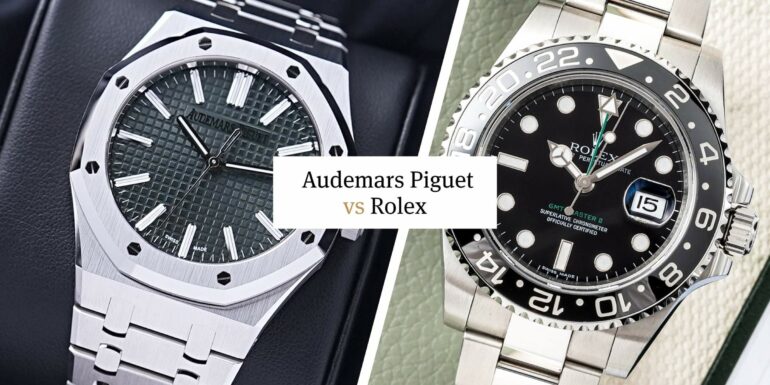
Audemars Piguet’s philosophy belongs to an entirely different realm, rooted in a watchmaking tradition with more aristocratic overtones. Here, the movement is not merely a mechanism hidden beneath a brushed-steel case; it is a canvas for expression. The artisan’s hand intervenes to bevel, polish, and satin-finish. Every surface, every bevel captures the light. But this visual sophistication comes at a price: that of vulnerability. The taut lines and clean geometries that define the brand’s signature inevitably expose the timepiece to the rigors of daily life. Even the slightest scratch on an octagonal bezel speaks to the inherent fragility of this aesthetic pursuit.
1972 and the Design Breakthrough
The history of contemporary watchmaking was upended by an aesthetic revolution that still defines Audemars Piguet’s positioning today. The launch of the Royal Oak in 1972 established an idea that seemed absurd at the time: offering a stainless steel sports watch at the price of a gold watch. Its radical proportions, exposed screws, and integrated bracelet redefined the very concept of luxury. The watch ceased to be a round, discreet instrument and became a bold, almost aggressive sculpture.
Rolex, by contrast, has never sought to break with tradition. Its stylistic language evolves by millimeters. Cases grow thicker or thinner by a fraction of a line from one decade to the next, materials improve, but the silhouette of a professional Rolex remains instantly recognizable. This consistency is reassuring. It promises the buyer that the watch purchased today will retain the same visual relevance half a century from now.
The Legibility of Status
Beyond the technical aspects, the competition plays out in the realm of social perception. Rolex possesses a universal language. In every corner of the world, the crown symbolizes a hard-won success, a milestone achieved. It is a form of social currency that everyone can instantly recognize. This clarity explains the massive, constant demand that depletes the inventories of authorized retailers and fuels an uninterrupted stream of enthusiasts eager to acquire this piece of legend.

The owner of an Audemars Piguet seeks a different form of validation. He appeals to a circle of connoisseurs capable of identifying a tapestry dial or understanding the complexity of a multifaceted case. The brand’s distribution reflects this elitist approach. Gaining access to the masterpieces of the Le Brassus manufacture often involves a rite of passage. Acquisition here is more of a status symbol, subject to a rigorous selection process that cultivates rarity and fuels the desire of the initiate.
Safe-deposit-box logic and speculative thrills
This divergence in image is starkly reflected in the figures from the secondary market. When it comes to investing or preserving capital, Rolex stands out as a mathematical certainty. The overwhelming majority of professional models resell with disconcerting ease, maintaining their initial purchase price—or even happily exceeding it. It is a liquid, predictable asset—almost like cash.
Audemars Piguet’s financial trajectory proves to be significantly more turbulent. The most coveted models—foremost among them the Royal Oak—can reach stratospheric heights, offering spectacular capital gains. However, this rise is accompanied by marked volatility. The price curve reacts more sensitively to trends and economic fluctuations. This is the playground for collectors willing to accept risk, drawn more by aggressive speculation than by the security of a safe-haven asset.
The Presence on the Wrist
Ultimately, the choice between these two giants comes down to the physical experience of wearing the watch. Slipping a Rolex onto your wrist is like choosing a silent companion. It withstands shocks, goes underwater without flinching, and disappears beneath a jacket sleeve, only to reappear at the right moment. It is the natural extension of an active life that refuses to be burdened by precautions.
Wearing an Audemars Piguet requires full awareness of the object. Its sharp edges and intricate finishes demand constant attention. It does not want to blend into the background; it demands to be seen, embraced, and protected from bumps against door frames. The choice, therefore, is not merely financial or aesthetic. It determines whether one wishes to go about one’s daily life with a free spirit, protected by cutting-edge engineering, or whether one prefers to come to terms with the demanding and fragile beauty of high-end mechanical watchmaking.