
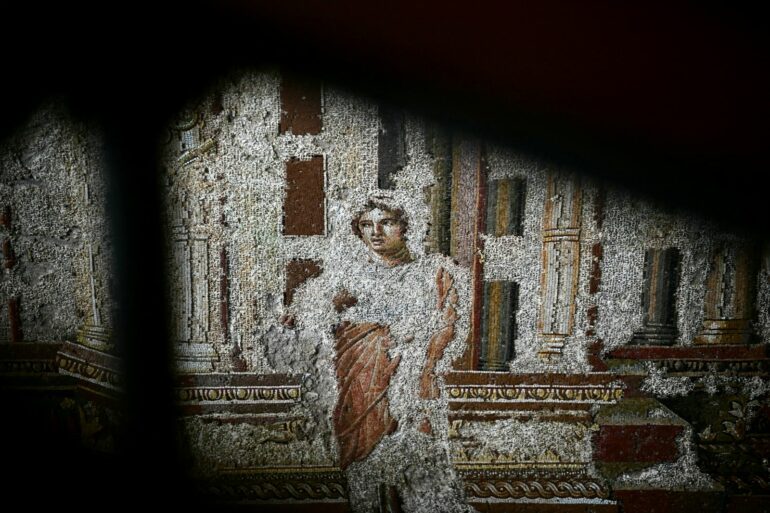
Rome reveals its secrets only to those who are willing to take the long view—one measured in millennia rather than in news cycles. Beneath the bustle of the Italian capital, deep within the Oppius Hill, a presence lay in wait, shrouded in the total darkness of the imperial foundations. This work, whose existence dates back two thousand years, has just seen the light of day after half a century of playing hide-and-seek with archaeologists. This is not merely a discovery; it is the culmination of a three-decade-long wait, a reminder that in the Eternal City, heritage is a living organism that chooses the moment of its reappearance.
The site in question is far from trivial. We are at the heart of Trajan’s Baths, that monumental complex which, from the beginning of the 2nd century, came to cover up the excesses of Nero and his Domus Aurea. It is here, within this architectural mille-feuille where each century builds upon the one before it, that researchers have finally been able to uncover a major work of art in its entirety. Long lost in the limbo of history, this creation comes to us today with the strength of those who have survived everything, including human oblivion.
The Missed Opportunity of the 1990s
To understand the significance of this event, we must rewind the calendar to the 1990s. At that time, exploratory excavations had already identified the presence of this work beneath the massive structures of the thermal baths. It was known to be there, hidden beneath tons of earth and debris accumulated over the centuries. But Roman archaeology is a discipline that requires extreme patience and involves complex budgetary decisions. At the time, although contact had been made, the artwork could only be partially glimpsed, leaving experts wanting more.
That first, incomplete encounter turned the work into a phantom of art history. Its exact location was known, and its significance was surmised, but it remained trapped within its earthen shell. The transition from the 20th to the 21st century did nothing to change its situation: it remained a promise, a point on an archaeological map that the curators of the Sovraintendenza Capitolina ai Beni Culturali kept carefully in mind, awaiting the right moment, the appropriate technologies, and the necessary funding to complete what had been started thirty years earlier.
This thirty-year gap between identification and full excavation underscores the reality of the Roman archaeological landscape. You don’t unearth a two-thousand-year-old relic the way you open a time capsule. Every centimeter uncovered requires technical expertise to prevent sudden contact with modern air from degrading what the soil has protected for two millennia. The wait was not abandonment, but a form of respect for the integrity of the artifact.
Under the Reign of Stone and Silence
The setting for this discovery—Trajan’s Baths—dictates its own rhythm. Inaugurated in 109 A.D., these public baths were, at the time, the largest in the Roman world. They were not merely a place for hygiene, but a political statement by Emperor Trajan, who chose to offer the people recreational spaces on land once confiscated by Nero for his personal pleasure. This work of art—which may have predated the structure or been incorporated into it—is thus located in the lower levels, where Roman engineering had to employ ingenious methods to stabilize gigantic vaults.
Working in these spaces means immersing oneself in an architecture of excess. The fact that the work has never been fully uncovered until now attests to the difficulty of accessing these underground areas. It is easy to imagine archaeologists making their way through narrow tunnels, beneath the colossal weight of the ruins that overlook Colle Oppio Park. The silence that reigns in these depths stands in stark contrast to the hum of the modern city located just a few meters above their heads.

The work itself, dating back twenty centuries, tells us of a Rome that was not yet the city of grand brick monuments we see today. It belongs to that historical era in which artistic refinement and technical mastery came together to create works capable of enduring the test of time. Its complete excavation finally allows us to analyze its structure, its details, and the way it fits into the iconography of its time, thereby filling a documentary gap that had persisted since its first fleeting discovery.
The End of a Long Archaeological Wait
What makes this discovery so special is that it is not a matter of chance. It was not an accidental find during roadwork, but the result of a deliberate search. Completing today what was begun three decades ago marks a victory of scientific continuity over immediacy. In a cultural world often obsessed with constant novelty, the field of Roman cultural heritage reminds us that true value sometimes lies in perseverance.
The process of fully uncovering the work required meticulous cleaning to remove the sediment that had sealed it away. This surgical-like operation revealed details that had remained invisible during the test excavations of the 1990s. Today, the work is no longer merely a mention in an excavation report, but a physical, tangible reality that experts can now study in its entirety. It joins the list of treasures that make Rome an open-air museum—or rather, a museum whose most fascinating exhibits are often found right beneath our feet.
The question now is one of its conservation and accessibility. Removed from its protective cocoon, the artwork begins a new life, exposed to public view and analysis. It emerges from the realm of geology to enter definitively into the history of art. This transition from the status of “identified relic” to that of “revealed heritage” marks the culmination of a cycle that required two thousand years of slumber and thirty years of administrative and technical patience. A timescale that, on the scale of Rome, seems almost reasonable.
The completion of this work beneath the Baths of Trajan marks not only the end of a construction project. It serves as a reminder of the rich history of the Esquiline neighborhood, where every excavation promises new revelations. The Roman soil has not yet finished returning what it borrowed from time, and this structure, now freed from its earthen shell, is but one more testament to a splendor that refuses to fade. It now awaits historians and the public to take up its story, so that these two thousand years of solitude may become nothing more than a distant memory.