
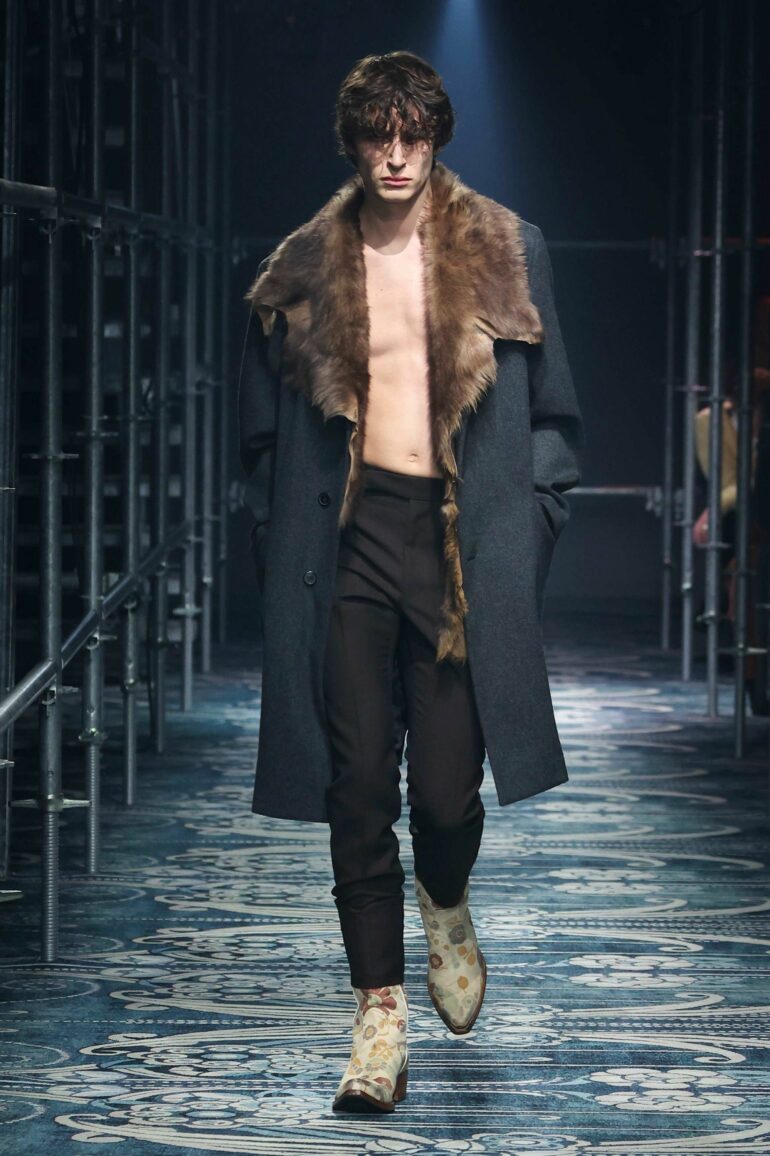
A curious temporal neurosis has taken hold of men’s fashion. Looking ahead to the fall-winter 2026–2027 season, one thing becomes clear: the contemporary man refuses to choose between timeless heritage and the allure of decay. He wants the look of a garment that will survive the decades, while demanding that it already bear the scars of a turbulent life. Gone is the quest for clinical purity or the lukewarm reserve of understated luxury that has dominated until now. The new silhouette is rooted in a battered reality, playing on the ambiguity of textures and blurring the boundaries of a masculinity long constrained by its own codes.
This stylistic shift isn’t the result of a single designer’s flash of inspiration, but rather a groundswell. The men’s wardrobe is finally allowing itself to be disorderly. It gets wrinkled, deliberately gets dirty, and sheds its obsession with the new to embrace what can only be called an “aesthetic of the scar.”
The End of Textile Innocence
As early as the summer of 2026, the fashion press had sensed the tide turning. Men’s fashion was emerging from a long period of lethargy. The dead calm is now giving way to a palpable, carnal, and at times brutal tension. The tone is hardening and taking on a more edgy edge. Houses like Saint Laurent, Hermès, and the KidSuper label are infusing their collections with latex, thick leather, and an undeniable aura of dominance, reconnecting with an almost subversive energy.
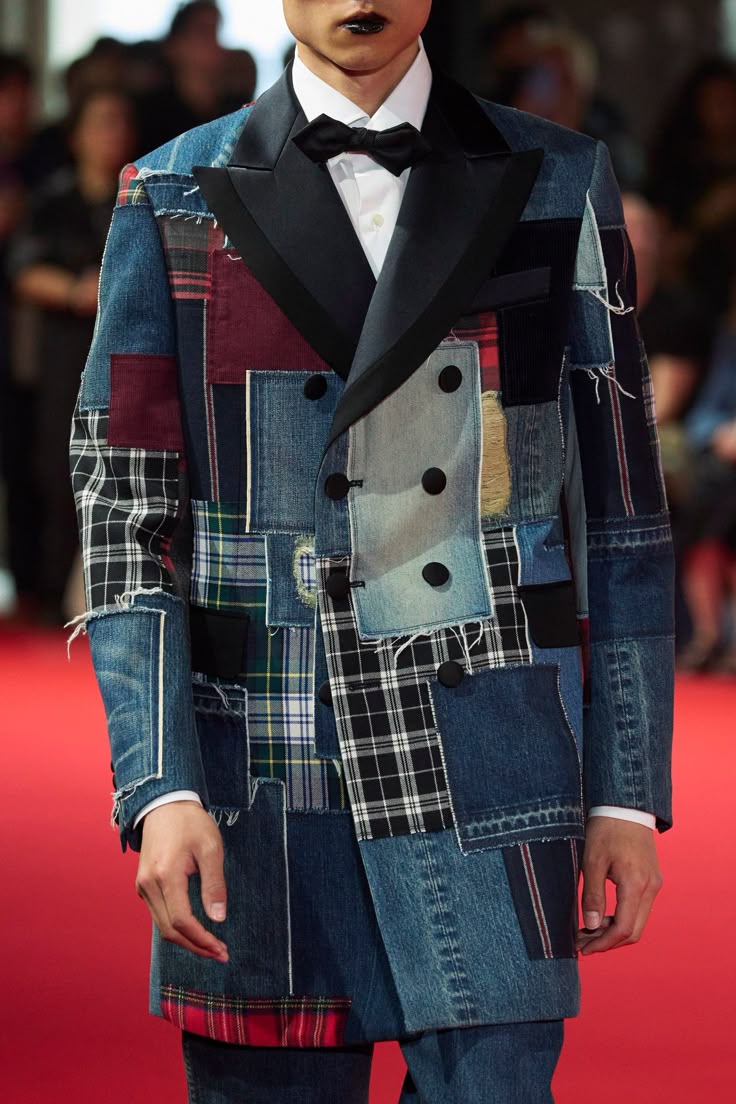
This aesthetic of wear and tear borders on the poetry of decay. Jackets that look like weathered armor, fabrics that seem to have withstood the test of tar and time: the season celebrates battered pieces. At Prada, under Raf Simons’s direction, this fascination with patina reaches its peak. T-shirts are deliberately worn-out, coats bear the marks of skillfully crafted wear and tear, and the gavroche cap regains its old-school swagger. The perfect object no longer excites anyone. Shoppers demand an immediate story, an extra touch of soul—even if that story is entirely fabricated in the workshop.
Eternity Behind the Scenes
In the face of this pronounced taste for controlled decay, a countervailing and equally powerful force is steering the season toward a quest for immortality. The call is no longer for frenzied consumption. At Hermès, the message even takes the form of a silent manifesto. Véronique Nichanian, for her runway show marking thirty-seven years at the helm of the house’s menswear division, made a bold statement by incorporating archival pieces into her new collection. Her call to slow down resonates like a challenge thrown in the face of an industry fueled by planned obsolescence. The value of a Hermès piece is no longer measured solely by its price or the excellence of its leather, but by its ability to stand the test of time without losing an ounce of its desirability.
Functional wear is undergoing a similar elevation. Clothing designed for physical exertion or labor is gaining sophistication, stripped of its working-class roughness. The work coverall, or boiler suit, has become meticulous and sharply tailored. At White Mountaineering, Yosuke Aizawa took his bow after twenty years of design by reaffirming the nobility of technical apparel, employing patterns of mathematical precision and bold colors. The Sacai label, for its part, brilliantly strives to shatter the age-old barrier between luxury clothing and everyday wear, reshaping the anatomy of the masculine silhouette through unexpected combinations of pieces.
The Legacy of Poiret and a New Fluidity
But the true revolution of this 2026–2027 season lies in the dismantling of gender-based dogmas. At the turn of the last century, Paul Poiret shattered the constraints that imprisoned the female body. Today, his ghost hovers over the men’s runways, acting as the catalyst for a mirror-image emancipation. Fabrics, cuts, and embellishments once locked away in the women’s wardrobe are seeping into men’s fashion with disconcerting ease.
This trend reaches new heights of unapologetic transgression at Dior, where Jonathan Anderson plays with references with jubilant audacity. He doesn’t hesitate to invoke the style of musician Mk.gee to justify a look that dares to feature sequin-embroidered tops and denim slung low on the hips, all crowned by hairstyles evoking rock’s golden age. This approach is far from mere provocative gimmickry. At Dries Van Noten, Julian Klausner confirms this trajectory by loading the silhouette with intricate accessories, cut velvet, and printed scarves. Jacquard and saturated details are no longer mere blips along the way, but the foundations of a redefined masculinity—one that is more porous and infinitely more cerebral.

Even color has lost its controversial edge. A few years ago, the mere presence of a pink sweater in the J.Crew catalog was enough to spark endless debates about masculinity. Those days are gone. Jacquemus and Prada are introducing shades of pink with disarming ease. The shade is no longer a political statement or a provocation; it has become once again what it should never have ceased to be: a simple color choice.
Between punk ruggedness and alpine leisure
This season’s attitude draws on radically opposing geographical and temporal influences. One might have expected the return to favor of the preppy style to bring a bit of calm and orthodoxy to the college campuses fantasized about by designers. That is not the case. The version proposed—notably by Auralee—bears a closer resemblance to the look of Jean-Michel Basquiat striding through New York: an athletic nonchalance, duffle coats cut from rebellious corduroy, and a thoroughly urban vibe. Brands are restructuring silhouettes, trimming lengths and widening hems to break up the heaviness of an oversized look that has become too lazy.
This nostalgia-tinged romanticism, embodied by the vibrant jackets from Louis Vuitton and Auralee, coexists with bursts of stylistic intensity. The visual vocabulary of punk is revived at Amiri and Dior. Black leather, the fury of CBGB, and the shadow of Richard Hell reassert themselves, reminding us that attitude trumps attire. Rick Owens, moreover, takes the experience of marginality all the way to the hair, offering toxic two-tone hairstyles—proof that belonging to this new aesthetic tribe demands total physical commitment.
Finally, in the background, the silhouette of an idealized mountain takes shape. The approaching Milan-Cortina Olympic Games have triggered an avalanche of references to winter sports. Yet the sophisticated ski sweaters on the runway aren’t meant to brave blizzards or powder snow. Here, sport is merely another layer of decorum—the fantasy of a luxurious vacation where performance takes a back seat to performance as spectacle.
Men’s fashion no longer seeks to smooth over its contradictions. It embraces the formal style of the 1960s, wraps itself in bold leather, layers feminine silks, and dons the artisan’s overalls. The elegance of 2026 does not lie in absolute coherence, but in the art of holding all these fractures together.