
Donatella Versace rubbing shoulders with Edward Norton or Cardi B in the front row—that’s the kind of lineup that usually calls for a spectacular setting. A Renaissance palace, a repurposed industrial wasteland—something grandiose. But for the Spring/Summer 2027 show in Milan, Demna caught everyone off guard. Gucci’s guests didn’t take their seats in front of yet another architectural allegory, but in the heart of an exact, almost clinical replica of one of the brand’s stores. A retail space. The intended effect, in fact, was not decorative at all; it was a coldly analytical statement. The aim was to highlight a fundamental truth that the industry sometimes tends to forget amid all the vague concepts: fashion, at the end of the day, is about sales. It hangs on a hanger, it’s tried on in front of a mirror, it results in a transaction. By refocusing attention on this square meter of pure commerce, the message was crystal clear. The Florentine house must become instantly recognizable again, without sacrificing the mysterious strangeness that is its hallmark.
This abrupt staging didn’t come out of nowhere, by the way. It follows directly in the wake of a recent lookbook and a film that had already subtly put the brand back at the center of industry discussions. But where one might have expected yet another strategic show of force demonstrating the designer’s ability to turn things around, the debate was deliberately shifted to a far more concrete terrain. Fewer grand theories, more clothes. We’re no longer wondering whether the legacy is being honored; we’re looking at how the jacket fits. It’s an offensive of a clarity rarely seen in a stylistic exercise often weighed down by layers of contradictory intentions.
Discipline Before Opulence
The collection first imposed an unexpected rigor. The show opened with a series of sharply defined masculine silhouettes. Total minimalism. The expansive streetwear we’ve grown accustomed to has completely given way to ultra-tailored cuts. The proportions were carved with surgical precision, imposing a new form of visual discipline. It was only then, almost insidiously, that the theme shifted toward much more intimate and sensual territory. The shapes softened, and sensuality reclaimed its place.
This progression, from austerity to abandon, demonstrates a mastery of storytelling far superior to the designer’s early drafts for the house. He no longer seeks a brutal break or a visual shock at any cost. The approach is more akin to a methodical construction. It involves laying a strict foundation to better unleash opulence later on, thereby creating a collection that is not merely a juxtaposition of looks, but a true wardrobe in motion.
The Clash of Styles
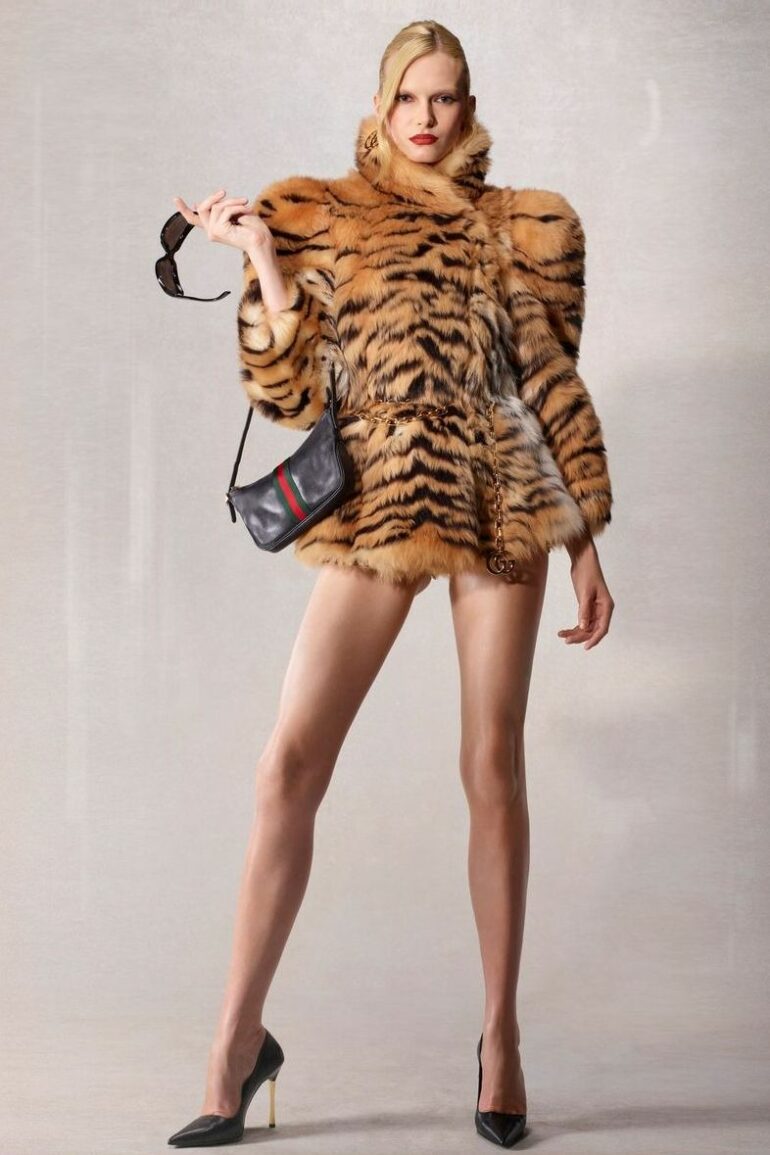
And what opulence! The collection’s aesthetic orchestrates a controlled collision between two worlds that, on paper, are polar opposites. On one hand, there’s a direct, almost brash erotic charge that unabashedly borrows from the unapologetic imagery of “mob wives.” The label may seem a bit lazy, admittedly, but it perfectly captures this desire for ostentatious, sensual luxury. On the other hand, this exuberance crashes headlong into a preppy restraint that immediately evokes manicured lawns and the polite boredom of the Hamptons.
Amid this stylistic split, one detail crystallizes the designer’s entire approach: the return of the stand-up collar. Yes, that famous 2000s fashion quirk—so long mocked and relegated to the ranks of absolute bad taste—is making a major comeback. Demna doesn’t simply use it as a vintage reference. He dissects it, isolates it, and infuses it with fierce irony. That is where his power lies. While others exhaust themselves saturating their collections with heavy-handed historical references, he prefers to tackle the most mundane gestures of daily life and elevate them to cultural signatures. Provocation at Gucci no longer needs to be shouted from the rooftops; it now lies in the vicious precision of a collar that’s deliberately ill-fitted with diabolical intent.
The Eroticism of Clarity
To understand this shift in direction, one must examine the words of the man himself. In a recent conversation with Tim Blanks for Business of Fashion, his intentions were articulated with disarming transparency. Fashion, in his view, must today be “clear,” “attractive,” and “sexy.” Three words that ring out like a rebuke to an entire segment of the industry still lost in its own intellectual deconstructions.

It’s no longer about ransacking the archives to prove one’s modernity. It’s about creating immediate, palpable desire. For years, the double-G brand has navigated between stifling maximalism, a gentle vintage melancholy, and somewhat over-the-top attempts at haute couture. The new aesthetic imposed here cuts to the quick. It strips away the superfluous without ever altering that underlying erotic tension that has always justified the brand’s power.
Toward a New Simplicity
All eyes are already on the next step. According to leaks shared with Tim Blanks, next February’s collection will revolve around a concept of “new minimalism.” Coming from a designer globally renowned for his art of subversion and excess, the term is enough to raise a smile. It’s almost an oxymoron. Yet, in light of the silhouettes seen in Milan, the direction makes perfect sense. Subtract rather than pile on.
In an industry where a show of strength is still too often measured by the weight of embroidery or the complexity of layering, this drive toward minimalism feels like a genuine power move. It is an admission, from one of the world’s most powerful fashion houses, that constant excess leads to exhaustion. Tension now arises from restraint.
The impression left by this Spring/Summer 2027 collection therefore goes far beyond mere seasonal buzz. It isn’t the most explosive show of the decade, and that is precisely what makes it relevant. We see a system that is refocusing, abandoning the race to outdo itself in order to rediscover its center of balance. Of course, the presence of Cardi B and Donatella Versace confirms that the brand remains a pop culture juggernaut—a crossroads where show business and commerce intertwine with formidable efficiency. But the real showdown is taking place far from the flashbulbs in the front row. The current challenge is no longer about whether it’s possible to provoke the public—that card has been played time and again. The challenge is to transform a highly distinctive stylistic vocabulary into a desire that doesn’t fade by the end of the season. A fashion that makes people want to buy it, wear it, and live it—beyond its own image.