

Make Texture a preferred source on Google to support us
Add Texture to GoogleThere is, in a chronograph, an almost physical anticipation: that of the crisp trigger, the hand shooting forward, and the mechanism that transforms a flick of the finger into visible motion. With the Dan W Automatic, Matthew Mercury moves his anniversary model away from quartz and into the realm of mechanical watchmaking. The change is not merely cosmetic. It affects the proportions, the architecture of the dial, and, above all, the way the watch feels on the wrist.
A case designed to accommodate the mechanical movement
The Dan W Automatic retains the 42-mm diameter of the quartz version but gains in thickness: 13.85 mm, compared to 9.8 mm previously. The difference is significant on paper, and it alters the watch’s presence. This new version does not seek to hide the bulk imposed by its caliber; on the contrary, it uses it to assert the character of a sporty chronograph.
Its stainless steel case thus takes on a more assertive stature. At 42 mm wide and nearly 14 mm tall, the Dan W Automatic belongs to a family of watches designed to make a statement, without aspiring to the discretion of a dress watch. The water resistance rated at 100 meters—or 10 bars—reinforces this utilitarian appeal. The model seems designed for active daily use rather than to remain confined to a collector’s rotation.
This added thickness also aligns visually with the world of the chronograph. The pushers, bezel, and case are no longer merely the framework for a precise display: they now encase an automatic movement, with its inherent constraints and weight. The result does not seek to obscure the mechanics; instead, it reserves a tangible place for them within the overall silhouette.
The white dial redefines the roles
The transition to a new movement necessitates a reorganization of the dial. The Dan W Automatic retains the collection’s visual identity, but its readability is now built around a different layout of sub-dials. At 12 o’clock sits the 30-minute totalizer. At 9 o’clock, the small running seconds sub-dial. At 6 o’clock is the chronograph’s 12-hour counter.
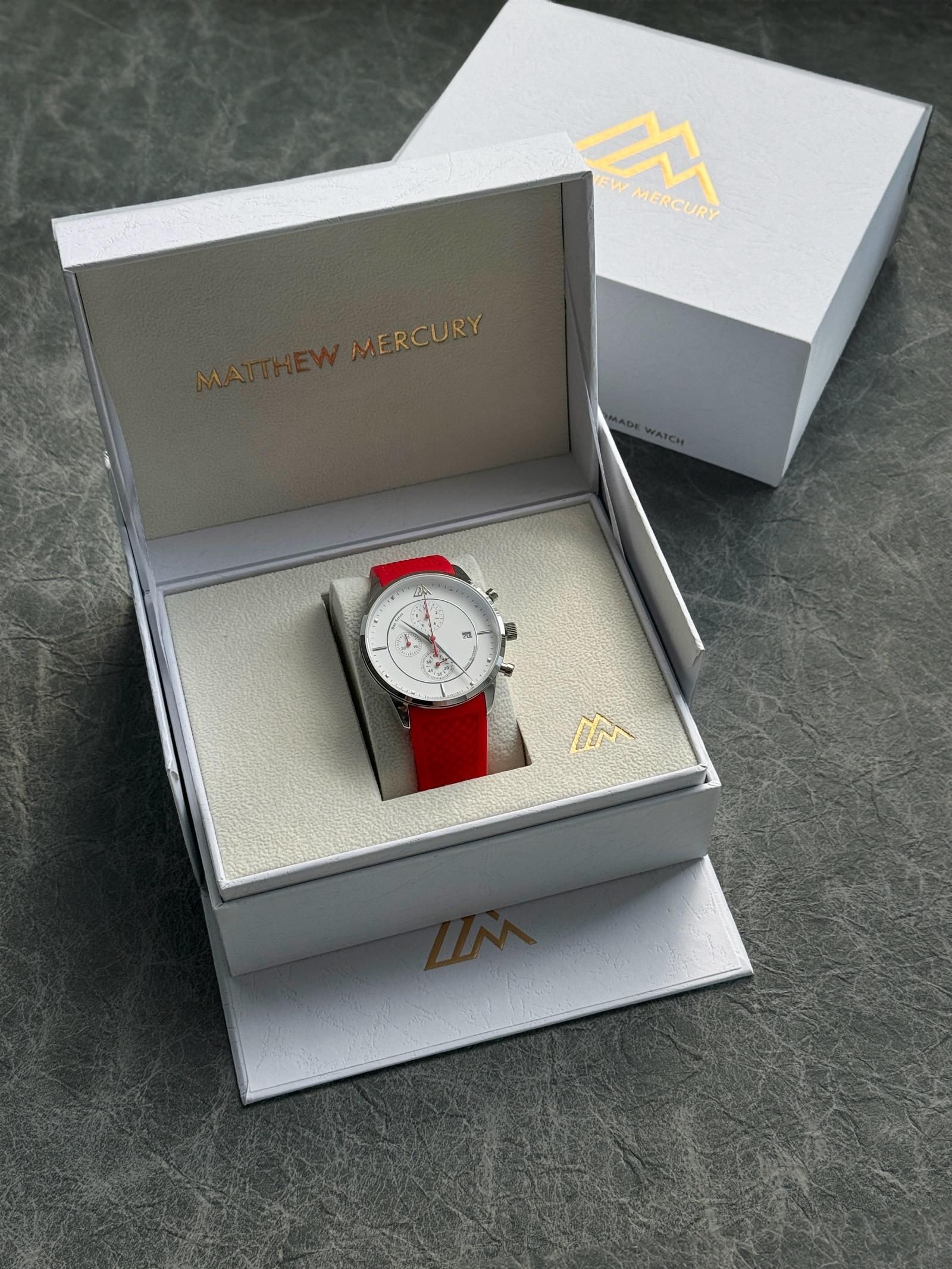
This layout gives the dial a more compact, geometric design. The three sub-dials have grown larger and are positioned closer to the blue ring that separates the hour and minute track from the central area. Against a white background, this blue circle acts as a graphic boundary: it structures the watch face and creates a dialogue between the time indications and the chronograph registers.
The choice of a 30-minute counter at 12 o’clock, paired with a 12-hour totalizer at 6 o’clock, establishes a very clear hierarchy for the chronograph readings. The off-center small seconds sub-dial at 9 o’clock completes the design without forcing symmetry. This functional asymmetry, dictated by the movement, becomes a design element in its own right.
On the outside, the watch is mounted on a royal blue FKM rubber strap, secured by a pin buckle. This blue matches the ring on the dial and avoids weighing down the overall look with a metal strap. The rubber also positions the Dan W Automatic within the realm of a sports watch, consistent with its water resistance and chronograph functions.
What a Mechanical Hand Really Changes
The most significant difference cannot be measured in millimeters or colors. It becomes apparent when the chronograph is activated. On a quartz model, the central hand moves in jerky bursts. Here, the chronograph hand moves smoothly—a characteristic unique to mechanical movement. Pressing the start pusher immediately sets the hand in motion, with a responsiveness that directly enhances the pleasure of using the watch.

The Dan W Automatic is powered by the Sellita SW500a. This automatic caliber operates at 28,800 vibrations per hour (4 Hz) and offers a 62-hour power reserve. It displays hours, minutes, seconds, and chronograph time, as well as the day and date. These technical specifications clearly place the watch in a different category from its quartz predecessor: not because one would negate the appeal of the other, but because they offer different ways of relating to time.
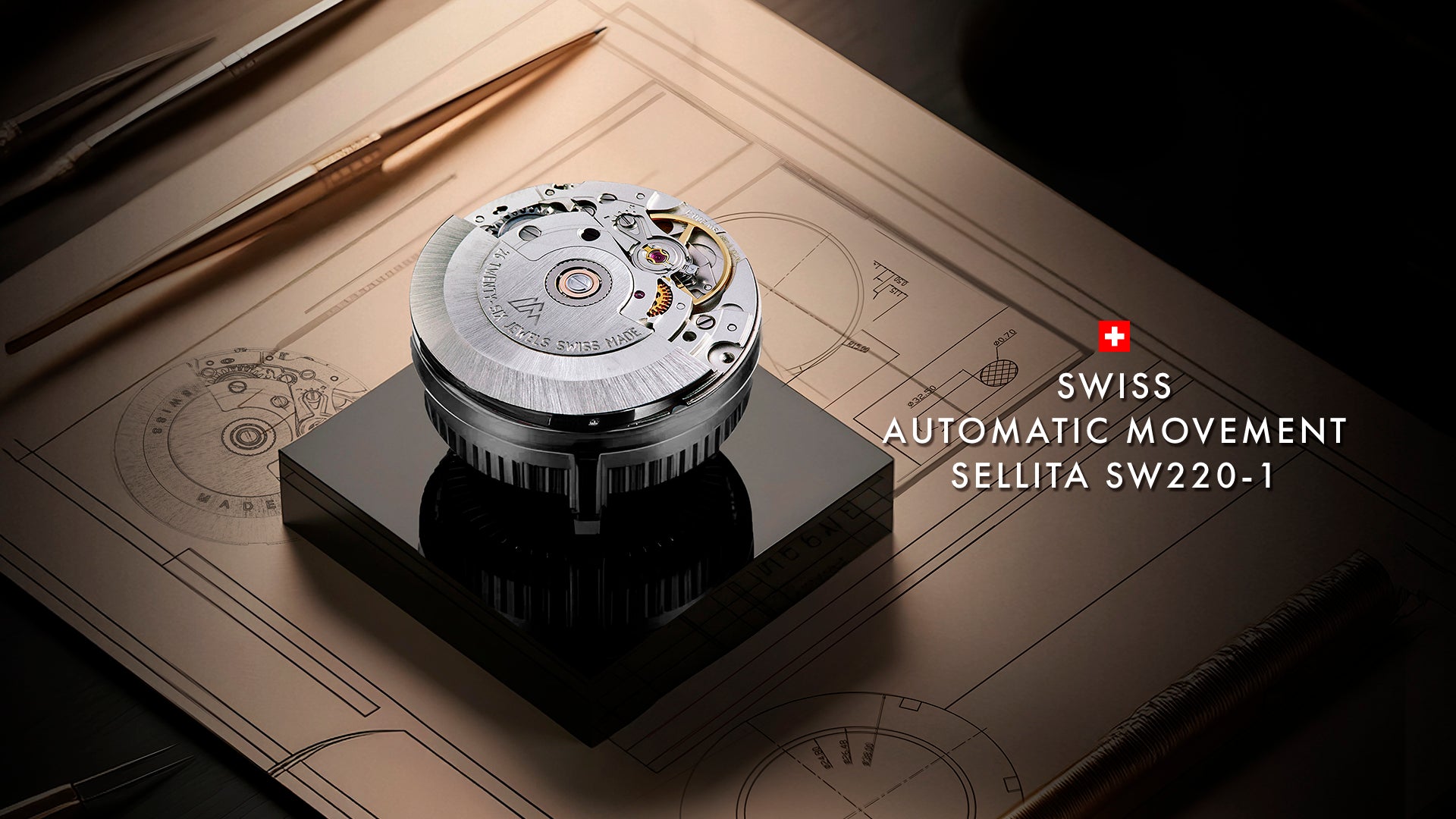
Quartz prioritizes immediate efficiency and a slimmer case that’s easier to achieve. The automatic movement, on the other hand, introduces a more tactile dimension. The watch is powered by the wearer’s movement; its chronograph features a continuously moving hand; and its case allows for greater thickness. The Dan W Automatic therefore does not attempt to replicate the anniversary edition’s formula by simply inserting a different movement—it redefines its balance.
A More Ambitious Step for Matthew Mercury
The case of the Dan W Automatic illustrates an interesting evolution for a small-production American brand: maintaining the hallmarks of an already established model while taking the risk of moving upmarket with a mechanical movement. The diameter remains unchanged, and the white dial with its blue accents maintains a sense of continuity, but the Sellita SW500a imposes its own aesthetic. The increased thickness and the new layout of the sub-dials are not merely decorative details; they stem from technical choices.
This approach gives the model a more assertive personality. The Dan W Automatic does not present itself as a retro-slim chronograph or a dress-inspired watch. Its 42 mm case, royal blue FKM strap, and 100-meter water resistance place it firmly in the sports watch category, with a dial structured enough to avoid veering into crude instrumentality.
The watch is listed at 1,150 pounds sterling, while the provided specifications indicate a price of 1,132 pounds, presented as the approximate equivalent of 1,500 dollars. At the time of this writing, the model was sold out. Information and availability can be found on the Matthew Mercury website.
What remains is a watch whose character is defined by this simple yet defining decision: replacing the electronic movement with an automatic caliber. The Dan W gains 4.05 mm in thickness, reorganizes its sub-dials, and offers a 62-hour power reserve. Above all, it restores to the chronograph that little mechanical spectacle that begins with every press of a pusher.