
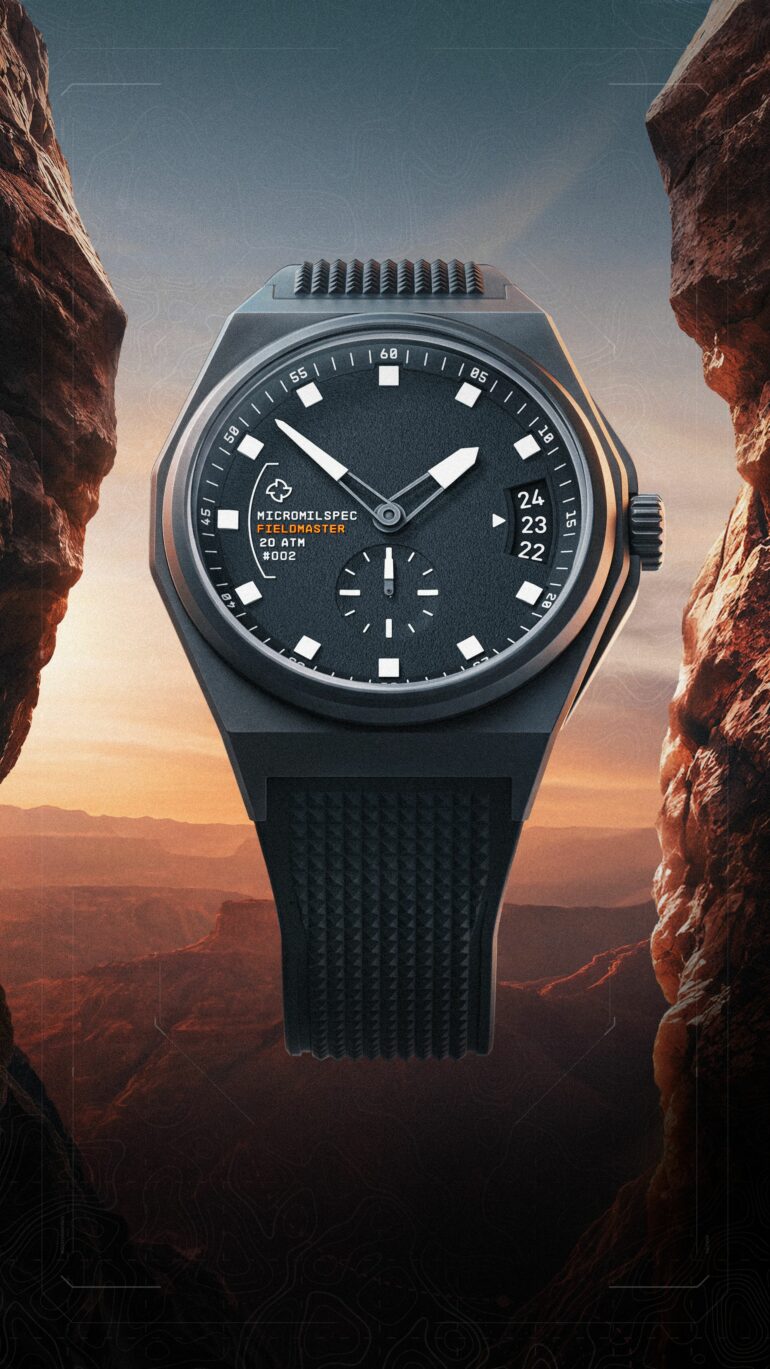
Sometimes a few words are enough to outline an ambition, but not yet to prove it. Micromilspec presents the Fieldmaster as a contemporary field watch designed around Horage’s K3 movement. The announcement fits into a single sentence, almost like a manifesto: to make this piece the benchmark timepiece for the modern field. What remains, then, is a territory to be defined—that of a watch whose very name evokes functionality, durability, and readability, without reducing the object to mere adventure props.
The field as an idea rather than a backdrop
The word “Fieldmaster” is no accident. It immediately places the watch within a specific watchmaking family: that of instruments designed to accompany action, be read quickly, and remain relevant far beyond the conventions of strictly dress watches. But the term chosen by Micromilspec adds a decisive nuance. This is not merely a “field watch”—a term that has become commonplace in the vocabulary of utilitarian timepieces—but an interpretation that is explicitly presented as modern.
This modernity cannot be reduced to a silhouette or a material—elements the announcement does not specify. It stems first and foremost from the stated intention: the Fieldmaster is presented as a watch built for the field as it is conceived today. This approach shifts the focus. The “field” is no longer necessarily an extreme, military, or distant location. It becomes a requirement: that of an object capable of serving a direct purpose, clearly displaying its function, and not getting lost in ornamentation.
In a watchmaking landscape often drawn to heritage narratives, the choice of such a straightforward name deserves attention. Fieldmaster does not seek mystery. It announces a mission. This approach gives Micromilspec a clear starting point: to offer a watch whose primary promise lies not in status, but in practicality. A timepiece made to be worn, admired, and put to work.
The K3 movement, the mechanical heart of the project
At the heart of this new offering lies Horage’s K3. Micromilspec cites it as the mechanical component that powers the Fieldmaster, which is enough to place the movement at the forefront of the narrative. In a watch designed for the field, this choice does not come across as a detail reserved for collectors. It is integral to the very identity of the piece.
Here, the mechanics are not relegated to the back of the case or to a technical specification sheet. They are highlighted right from the outset. This serves as a reminder that the concept of a “tool watch” is not at odds with horological artistry. On the contrary, the project explicitly pairs a functional purpose with a movement that is named, identified, and proudly showcased. The Fieldmaster, therefore, is not defined solely by its aesthetic appeal or the promise of abstract ruggedness: it is also defined by the caliber that powers it.
This emphasis reflects a broader shift in how we talk about utility watches. For a long time, field watches were described primarily through their external features: dial, hour markers, strap, case, and real or imagined military references. By including Horage and its K3 in the very title of the ad, Micromilspec reverses this trend. The inner workings become part of the narrative, without the discussion veering into inaccessible technical jargon.
No additional details are provided about the movement’s specifications or the Fieldmaster’s construction. This restraint ensures that the brand’s intent does not devolve into a mere technical demonstration. It does, however, reveal a clear hierarchy: for Micromilspec, the pursuit of a modern field watch begins with its mechanical architecture.
An ambition that demands precision
Describing a model as “the ultimate modern field watch” is a bold statement. It sets a high bar, especially since the word “ultimate” suggests a synthesis rather than a variation. It is no longer a matter of adding yet another watch to an already established category, but of offering a vision compelling enough to redefine the standards.
This ambition is intriguing because it immediately raises the simplest question: what do we expect from a field watch today? The answer cannot be limited to the vocabulary of durability. A timepiece is also judged by the quality of its design, the clarity of its readability, the balance between its presence and its function, and the coherence of its mechanical choices. A watch intended for the field must inspire confidence even before it is put to the test in a demanding situation.
The Fieldmaster thus finds itself in a demanding position. Its name evokes authority, while its movement positions the project within a discourse of connoisseurs. Between the two, Micromilspec must strike a balance that remains accessible. The task is not simple: too much emphasis would make the watch seem like an adventurer’s prop; too much technicality would risk making it seem distant. The strength of a field watch lies precisely in its ability to appear natural. It must seem to know what it’s doing, without trying too hard.
The term “modern” adds another layer of tension. Much of the imagery associated with the field watch rests on a deeply ingrained nostalgia: gear, expeditions, uniforms, patina, and historical references. Micromilspec seems to be taking a different path by presenting a contemporary take on this theme. It is not, at least in the language used, about reenacting the past. The watch is presented as a modern response to an old idea: having a wrist-worn instrument suited for action.
The simplicity of an announcement, the clarity of a positioning
Paradoxically, the limited information available lends this presentation a sense of clarity. Micromilspec does not pile on the selling points. The brand combines a name, a watch type, a movement, and a vision. That’s all there is to it. This economy of words avoids the excess of details that often accompanies watch launches, but it also leaves the project open-ended.
For the reader, the appeal lies less in a nonexistent list of specifications than in the coherence of the announced concept. The Fieldmaster is introduced with a practical vocabulary and an explicitly identified movement. It’s a combination that appeals as much to the wearer focused on functionality as to those who view a watch as a crafted object, whose technical choices contribute to its character.
This approach can also be seen as a welcome reminder. A field watch does not need to be disguised to exist. It does not need to pile on conventional symbols or burden itself with a heroic narrative. Its identity lies in the precision of its purpose. Micromilspec distills this intention into the Fieldmaster: a contemporary watch, powered by Horage’s K3 movement, designed with the explicit goal of taking the concept of the field watch to the next level.
What follows will necessarily depend on the timepiece itself—its proportions, its dial, its construction choices, and how the K3 fits into the whole. For now, the Fieldmaster stands as a statement of approach: starting with a Horage movement and subjecting the watch’s aesthetics to a simple question—namely, what a field watch can still mean today.