
Make Texture a preferred source on Google to support us
Add Texture to GoogleThe scar left by torn fabric is by no means a failure: it serves as the starting point for an intellectual reflection on the persistence of the object. For the American artist Lee Krasner, the deliberate destruction of old canvases served as a visceral driving force for recomposing entirely new works. This process of fracture and reassembly, far from being confined to abstract expressionist painting, now drives the strategic direction of a unique fashion house. Under the leadership of its CEO, Suzie de Rohan Willner, the Toast brand is radically moving away from the planned obsolescence of seasonal collections to establish a vocabulary rooted in repair, reuse, and the preservation of memory. The wardrobe is no longer conceived as a succession of trends, but as a space of sedimentation where art, architecture, and craftsmanship define the trajectory of every fiber.
Material as a Discipline of the Mind
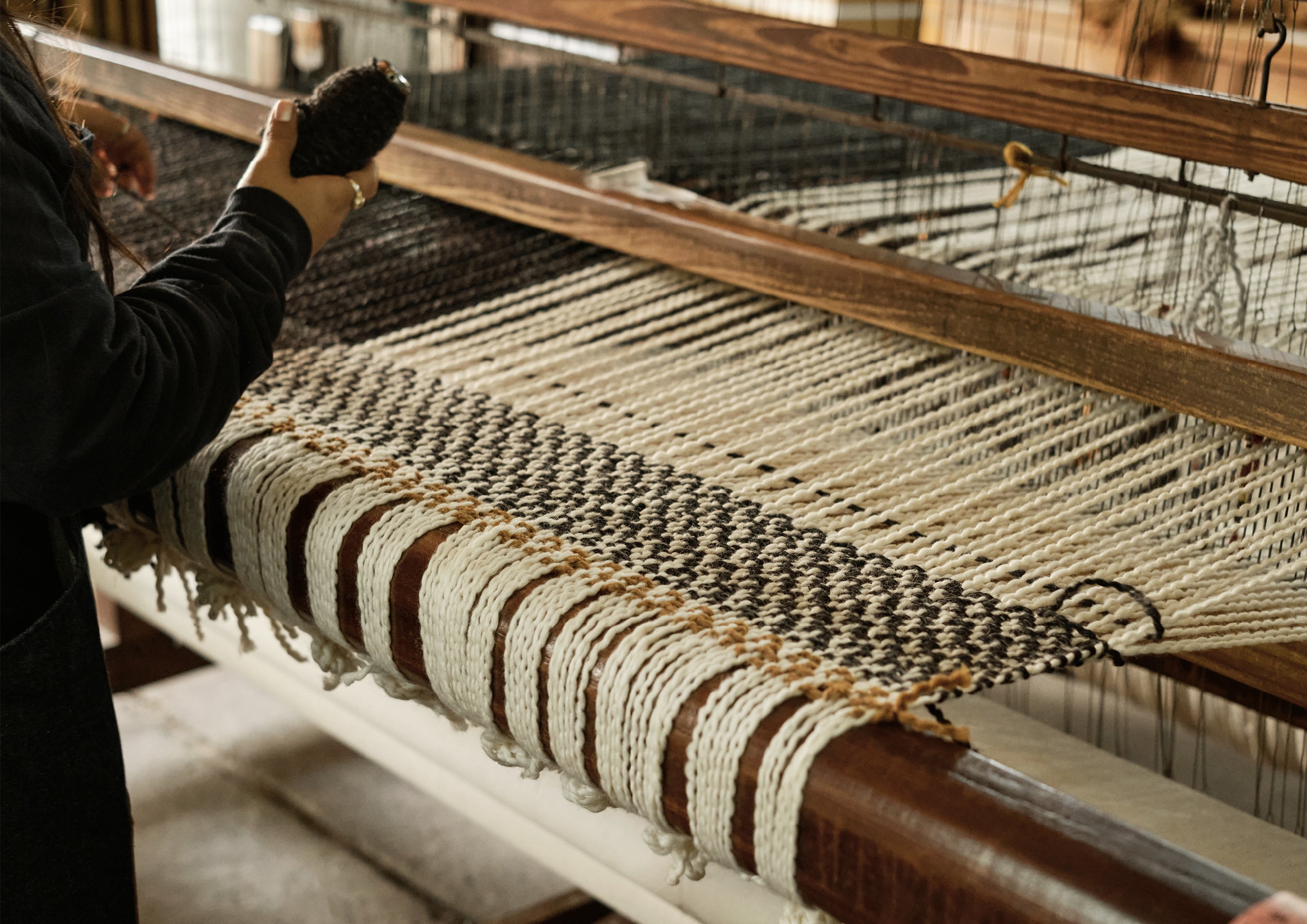
Treating thread as a material for pure invention requires breaking free from the strictly decorative function of clothing. This methodological rigor draws directly from the legacy of Anni Albers. Born in Berlin in 1899, the designer upended academic hierarchies during her time at the Bauhaus, liberating tapestry and weaving from the condescension of the applied arts to transform them into a realm of absolute intellectual experimentation. The material dictated its own rules. This deliberate subordination to the material finds a direct echo in Toast’s philosophy. Fabric is no longer a mere medium to be replaced at the slightest snag, but a substrate whose useful life is extended through precise technical gestures.
This dialectic of resistance and lightness also runs through the work of Ruth Asawa, another leading figure in this world. The Japanese-American artist forged her reputation by taming an industrial material—wire—to create suspended sculptures with an organic appearance. The eye immediately perceives a visual softness, while the hand senses an unyielding solidity. This paradox shapes the brand’s approach: designing pieces that embrace the ruggedness of their construction while offering fluidity when worn. The garment must exist within this constant tension.
The most radical application of these principles takes the form of a stylistic exercise centered on anomaly. For the capsule collection titled “Toast Renewed By,” the brand commissioned Meta Struycken, a Dutch textile artist, to work with a collection of workshop scraps, damaged items, and customer returns. The result consists of eight unique pieces. Struycken’s work never seeks to conceal the passage of time or accidental damage. On the contrary, through the deliberate use of embroidery, quilting, and appliqué, the repairs are on full display. The technique becomes the central motif, asserting that an altered garment, far from being discarded, acquires an aesthetic depth greater than that of its original state.
Tectonics and Inhabited Landscapes
Thinking about the body’s covering inevitably requires thinking about the space that surrounds it. Suzie de Rohan Willner’s aesthetic references extend beyond the loom alone to draw upon radical architecture. Philip Johnson’s Glass House, built in New Canaan, embodies this vision. The transparent building does not seek to impose itself on nature; rather, it frames it. It transforms the landscape into a direct component of the living space. Applied to fashion, this approach demands that clothing cease to be a mere adornment of the self and instead become an instrument for connecting with the immediate environment, whether rural or intensely urban.
This desire for hybridization is exemplified by a fluidity across disciplines borrowed from Isamu Noguchi. The sculptor spanned the century by refusing to be confined to a single material, moving from carving raw stone to the lightness of paper lanterns, designing furniture with the same precision as public gardens. His lesson lies in the art of balance. At Toast, identity isn’t frozen in the repetition of a seasonal motif but unfolds through a versatility of uses. Each design is conceived as a fragment of a larger scene.

The regional roots of this approach sometimes take on an intimate quality, tied to family history. William Mitchell, the CEO’s father-in-law, left a defining mark with his creation of the carved doors at Liverpool Metropolitan Cathedral. His approach to concrete—fundamentally raw and tactile—rejected any gratuitous prettiness in favor of honoring the memory of the place. This visceral rejection of the easy and the spectacular finds a literal expression in the brand’s demand for structure: design must resist fading and bear the weight of its own material construction.
Choreographies of the Long Term
The execution of these concepts is evident in the way the house brings its collections to life, substituting the idea of ritual for that of the traditional fashion show. To present “A Lightness of Being,” the Spring/Summer 2025 collection, Somerset House in London served as a testing ground. Far from the precise, measured strides of the runway, dancers Masumi Saito and Francesca Matthys brought the garments to life through performance. The challenge was to reveal the architecture of the cut through the imperfection of living movement, allowing the body’s dynamics to dictate how the fabric is interpreted.
This social and geographical context was further emphasized with the Spring/Summer 2026 collection, titled “A Shared Table.” The brand returned to its roots in Wales to create an open-air setting. The shadow of Llansteffan Castle, set against a rugged, windswept landscape, served as the backdrop for a communal lunch. The experience was not intended as a commercial showcase, but rather to place the garment within its primary function: to accompany a moment of sharing, to endure the elements, and to exist within a tangible reality.
The Fall/Winter 2026 collection, titled “Marking the Turn,” fully defines this manifesto. Built around rites of passage and folk traditions, the season embraces a strictly utilitarian aesthetic and a muted color palette. No ostentation disrupts the collection. This formal restraint reflects a modernity that does not scream for attention, preferring instead to focus on transmission and a garment’s ability to be tirelessly mended without losing any of its integrity.