
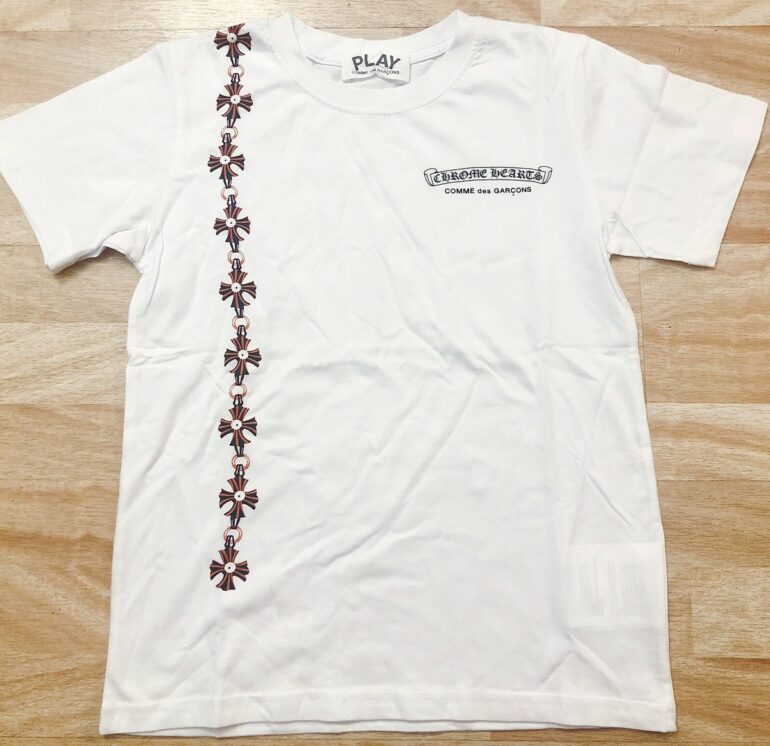
Urban clothing has long since ceased to be merely a functional piece of fabric. In the most cutting-edge spheres of contemporary fashion, it has evolved into a marker of belonging with surgical precision—a silent language intended for those who understand its codes. Amid the turmoil of an industry fueled by overproduction and frenzied renewal, two entities are swimming against the current, rooted in a philosophy of restraint. On one hand, heavy leather and solid silver from California. On the other, Tokyo’s cerebral deconstruction. The unexpected dialogue between Chrome Hearts and Comme des Garçons crystallizes a radical approach to modern luxury: asserting its authority not through noise, but through exacting standards and restraint.
The Anatomy of an Aesthetic Collision
Nothing foreshadowed the viability of such a collaboration. The story begins on different continents, with diametrically opposed visual languages. In 1969, Rei Kawakubo laid the foundations for Comme des Garçons in Tokyo. There, she developed a stylistic vocabulary based on asymmetry, a reexamination of proportions, and a certain visual discomfort. Aesthetics were never merely a matter of appearance; they were an intellectual stance. Over the decades, the studio has evolved into a vast, sprawling laboratory, spawning autonomous entities ranging from the HOMME and SHIRT lines to the PLAY division—recognizable by its heart motif—which has served as a bridge between niche fashion and the street scene.
At the other end of the spectrum, Chrome Hearts was founded in California in 1988 under the leadership of Richard Stark. The initial concept was raw, rooted in biker culture. The archives of the South China Morning Post note that the brand’s earliest designs took the form of heavy motorcycle pants adorned with Gothic motifs. This utilitarian and subversive starting point quickly evolved. The workshop expanded its reach to jewelry, furniture, and a broader range of apparel, while maintaining an air of secrecy reminiscent of a closed brotherhood. Each piece, whether in silver or leather, seems to bear the weight of handcrafted work, embodying a rock heritage pushed to its pinnacle of execution.
Their common ground lies precisely in this shared aversion to lukewarmness. Stark’s dark opulence and Kawakubo’s dissonant minimalism converge in a fierce determination never to yield to easy commercial compromise, while remaining firmly rooted in the daily lives of those who wear them.
Thirty Years of Uninterrupted Dialogue
Today’s fashion world is saturated with fleeting collaborations—these ad-hoc partnerships designed to monopolize digital attention for the span of a weekend. The partnership at hand, however, exists on an entirely different timeline. The archives trace their first joint projects back to the 1990s, a time when the very concept of cross-brand collaboration had not yet been embraced by mass marketing. This common thread was reignited in 2007, before resurfacing with renewed vigor more recently.
The Fall/Winter 2021 capsule collection, analyzed by Highsnobiety as the culmination of these three decades of professional partnership, demonstrates the precision of this balance. It is never simply a matter of mindlessly slapping one brand’s logo onto the other’s patterns. The American brand’s ornate excess and Gothic mysticism challenge the Japanese brand’s structural rigor. The result gives rise to hybrid pieces where the apparent simplicity of a hoodie is subverted by bold details, creating a palpable tension between urban comfort and collector’s item status. This mutual respect for each other’s creative domains allows their collaborative creations to stand the test of time without losing their appeal.
The Mechanics of Planned Rarity
If these pieces maintain such a high level of desirability, it is largely due to a clinical management of supply. Contemporary luxury is desperately searching for a formula to remain exclusive while increasing its volume. These two players have taken the opposite approach, realizing long before the competition that orchestrated frustration is a powerful commercial driver.

Distribution acts as a filter. Buying Chrome Hearts requires adhering to the rules of a limited network of boutiques, where the atmosphere resembles that of a private club more than a traditional retail space. For its part, the cultural capital accumulated by Comme des Garçons allows it to operate independently of traditional seasonal cycles. The direct result of this strategy is evident on resale platforms. Collectors analyze the acquisition of a garment resulting from this collaboration using the same framework as they would for a financial asset.
However, the secondary market follows its own laws of gravity. The valuation of these archival pieces remains subject to strict criteria: condition, the clarity of the collaboration, and cyclical demand for specific editions. The volatility of tastes from one generation to the next inevitably affects prices, but the conceptual foundation of these creations guarantees them a lasting core value, far removed from the immediate depreciation that affects standard ready-to-wear.
Authority Through Restraint
Wearing one of these pieces goes far beyond mere clothing. It is about embodying an attitude. The current market values ostentation, visual saturation, and hyper-communication. In the face of this clamour, the choice of restraint confers a far greater aura. The strength of this collaboration lies in its deliberate opacity. Both entities refuse to explain their intentions, leaving it up to the public to decipher the connection between the ruggedness of a silver Celtic cross and the surgical precision of Japanese cotton.
Their longevity is not a matter of magic, but of absolute rigor in maintaining their identity. Instead of chasing after an elusive modernity, they have imposed their own sense of time. The buyer is not merely purchasing a combination of high-end materials; they are acquiring a fragment of a rich cultural history—a form of material resistance against the planned obsolescence of trends.