Make Texture a preferred source on Google to support us
Add Texture to GoogleThe candle wax has solidified into droplets on the candlesticks, while the last crimson glimmers from a bottle flow into the glasses. The moment is one of transition. A window cracks open, letting in a polar breeze that bites into the room’s warmth, but no one seems to mind. Around the cheese buffet, the last few guests nibble nonchalantly, while in the narrow hallways, conversations unfold—intense and animated. Then, suddenly, a crystalline sound cuts through the hubbub: the familiar tinkling of piano keys. A guest has just issued a challenge, requesting a tune. As the melody takes shape and the song becomes recognizable, the gathering coalesces. Arms rest on neighboring shoulders, circles tighten, and, through an almost archaic alchemy, this cacophony of disparate voices transforms into a single breath. This moment of grace is not merely the end of an evening; it is a sudden and magnificent reconnection with our deepest humanity—an intangible luxury that our city lives, cluttered with concrete and forced silence, have all too often forgotten.
The Intimate Geography of the Instrument
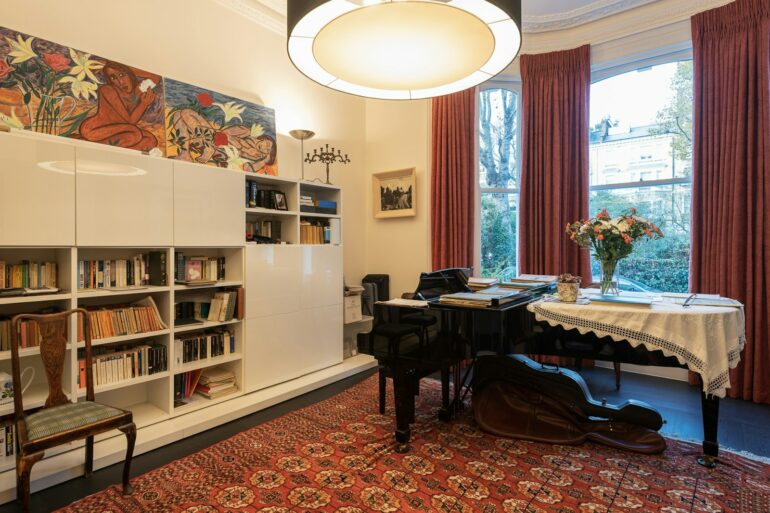
In the complex topography of our modern metropolises, owning a piano has become an act of resistance. Space constraints and walls too thin for acoustic intimacy have made this instrument a rare object, almost aristocratic in its demand for space. Yet, in the homes of these friends I’ve known since childhood, the piano is the immovable centerpiece of the apartment. As soon as you cross their threshold, you know the evening will eventually revolve around it. Within these walls, music isn’t merely background noise; it’s a language of survival. Our hosts are people of sound—one of them has even made it his profession—and our friendship was built on this foundation. We’ve journeyed through the years together, from school bus seats to church choirs, from the mistakes of youth to more formal concerts. We’ve grown, stumbled, and shaped ourselves in unison. Singing with them isn’t a performance; it’s a natural extension of our dialogue. To stop doing so would be like amputating a part of our shared identity.
The miracle of these evenings lies in their power to bring people together. Often, the table welcomes strangers—guests who weren’t there to witness our sometimes awkward teenage years. Yet when the time comes to belt out the choruses of “The Twelve Days of Christmas,” social barriers crumble. We find ourselves chanting “five gold rings” with the fervor of old friends. This is what researchers at the University of Oxford call the “ice-breaker effect”: singing’s phenomenal ability to break the ice faster than any conversational ploy. This spontaneity keeps the party going, taking us on a journey from ’80s pop-rock hits like Squeeze’s “Tempted” to nostalgic wartime anthems such as Ivor Novello’s “We’ll Gather Lilacs.” But as the year draws to a close, it’s the Christmas repertoire that serves as the universal bond. Whether you’re religious or not, these tunes belong to everyone. They’re remarkably accessible: memorable melodies, unambiguous rhythms, and repetitive choruses that let anyone jump right in, even halfway through a verse.

A Mechanism of Well-Being and Biology
Beyond the social pleasure, choral singing acts as a true physical catharsis. There is an almost organic satisfaction in feeling your voice escape, in sensing your lungs fill and then empty, your ribs expand, and your throat open up completely. Singing in a group imposes a fascinating biological constraint: everyone must breathe at the same rhythm. This synchronization is not merely aesthetic; it is neurological. The vagus nerve, which winds its way down to the vocal cords, is directly stimulated by this activity, plunging the nervous system into a state of deep relaxation. Controlled exhalation, inherent to singing, releases endorphins—the molecules associated with pleasure and serenity—while also improving heart health.
Science has, in fact, taken up this phenomenon to explore concrete therapeutic avenues. It has been discovered that group singing improves speech in patients with Parkinson’s disease and helps revive memories in those suffering from dementia. In a world increasingly fragmented by digital technology, where we communicate through screens, singing together remains one of the few ways to connect in real time—physically and through shared vibrations—with those around us. It is a return to the body, a demand for presence that nothing can simulate.

Singing as the Foundation of Civilization
For many evolutionary biologists and psychologists, singing may even predate articulate language. It is believed to be the original channel of communication, far more direct than words. Evidence dating back to the Upper Paleolithic, about 50,000 years ago, suggests that our ancestors were already gathering around the fire to sing, passing down their traditions orally to subsequent generations. Even today, despite the sophistication of our languages, singing allows us to forge bonds that are stronger than those formed through speech. In fact, a 2022 American study highlighted that choir members experienced much greater social satisfaction and a much stronger sense of connection than if they had simply chatted with one another.
Modern history confirms this unifying power. Singing has always been the preferred tool of solidarity and resistance. We find it in the spirituals of the American plantations—those songs of survival that united bodies and souls in the darkness of slavery. It could be heard in sailors’ songs—those shanties that helped synchronize the grueling labor aboard exploration ships. And of course, there is sacred song, that liberating experience practiced in places of worship, which engages the whole body. These environments were the fertile ground where the greatest voices in history blossomed. Figures such as Aretha Franklin, Elvis Presley, Sam Cooke, Luciano Pavarotti, and Patsy Cline all honed their talent in the crucible of the churches of their childhood.
Collective Excitement or the Triumph of the Human Spirit
Yet technical excellence is not the ultimate criterion. The best singers aren’t necessarily those with the most perfect vocal instruments, but those who dare to sing without restraint, from the heart. This is where the group steps in as a shield. While taking the stage alone requires exhausting mental preparation and a certain amount of courage, standing shoulder to shoulder with others instantly lightens the burden of the performance. All that remains is pure joy. If your voice falters, the others are there to support it. If you lose your place, someone is already carrying the phrase for you. The sociologist Émile Durkheim used the term “collective effervescence” to describe this sacred euphoria, this flash of joy that courses through a community when it moves and sings in unison. In those moments, we become greater than ourselves; we transcend our individuality to touch the simple joy of belonging to the human race.
Every December, these melodies resurface from old songbooks, childhood memories, and dusty recordings. Some have stood the test of time; others are imbued with deep spirituality or unabashed sentimentality. Some are even downright absurd, like “We Wish You a Merry Christmas,” where the singers demand fig pudding and refuse to leave until they’ve been served. That is precisely where the charm of these rituals lies. When the final piano chord finally fades away, and the glasses are refilled, we don’t part ways: we’re already waiting for the next song, aware that, for a few minutes, we’ve recreated a world where connection trumps everything else.