Make Texture a preferred source on Google to support us
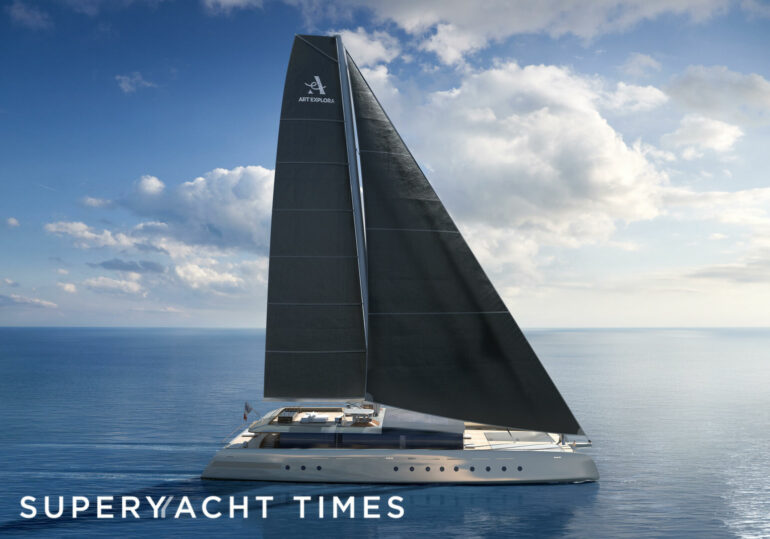
Add Texture to GoogleSeventeen meters thirty. That is the beam of Art Explorer, a 46.6-meter sailing catamaran built for French patron Frédéric Jousset, and it is this measurement—far more than its length—that reveals the multihull’s new status in the world of superyachts. For a long time, two hulls were chosen by default or for economic reasons. Now they are chosen for the space they provide, and the beam—which is what gives these boats their prestige—also dictates most of their limitations.
What Width Buys
The catamaran has long carried a reputation as a utilitarian vessel. It was seen as an aesthetic compromise, a mass-market charter platform with little resale value. That image has faded. In Monaco, the brokerage firm Moravia Yachting observes that ultra-high-net-worth clients no longer view multihulls as a technical compromise. They see them as a conscious choice, driven by the living space and freedom of access they provide.
Geometry explains this shift. A catamaran has a beam—or width—ranging from 30 to 40 percent of its overall length. Its interior volume and deck area are equivalent to those of a monohull that is 15 to 20 meters longer. For an owner, the math is simple: for the same length, they get a boat in a different class.
This transverse stability offers a second advantage, one that is less obvious but highly appreciated on board. The form stability of the twin hulls significantly reduces roll, both at anchor and underway. The catamaran can therefore do without gyroscopic stabilizers—heavy, energy-intensive equipment that monohulls often must carry to ensure a comfortable anchorage.
Draft completes the picture. Beyond 40 meters, it generally ranges between 1.5 and 2.7 meters. The shoals of the Bahamas, Polynesian atolls, and certain Mediterranean coves—off-limits to deep-draft vessels of the same tonnage—become accessible once again. This is a trend, not a rule: the Art Explorer, with its sails and 55-meter mast, has a draft of 3.4 meters.
The Art of Staying at 499
Width increases volume, and volume is measured in gross tonnage. Yet a threshold looms over the entire segment: the 500 GT mark. Above that, SOLAS conventions apply strictly, requiring fire compartments, redundant emergency exits, and a larger crew. These requirements eat into the interior space that the owner thought they had purchased. Several shipyards therefore design their catamarans to stay just below the limit.
The Art Explorer, built by Perini Navi—part of The Italian Sea Group—is a prime example. This aluminum catamaran, designed both inside and out by Axel de Beaufort and Guillaume Verdier, has a gross tonnage of 497 GT. Its carbon-fiber mast was manufactured by Lorima. Its purpose is extraordinary: it was designed to serve as a traveling contemporary art museum for the Art Explora Foundation, while also being available for charter at approximately 240,000 euros (excluding taxes) per week for the 2024–2025 season. The only French catamaran in this selection thus uses its width to benefit both the artworks and the visitors.
At Rossinavi, the Seawolf X takes the concept even further. This 42.84-meter hybrid-powered catamaran, 13.75 meters wide, was built of aluminum and rated at 499 GT—just one unit below the limit. Fulvio De Simoni designed the exterior lines, and the New York-based studio Meyer Davis designed the interiors. Listed for sale at 36.9 million euros, it was reported sold in late November 2026. Its weekly charter rate ranged from $280,000 to $380,000, or approximately 265,000 to 360,000 euros.
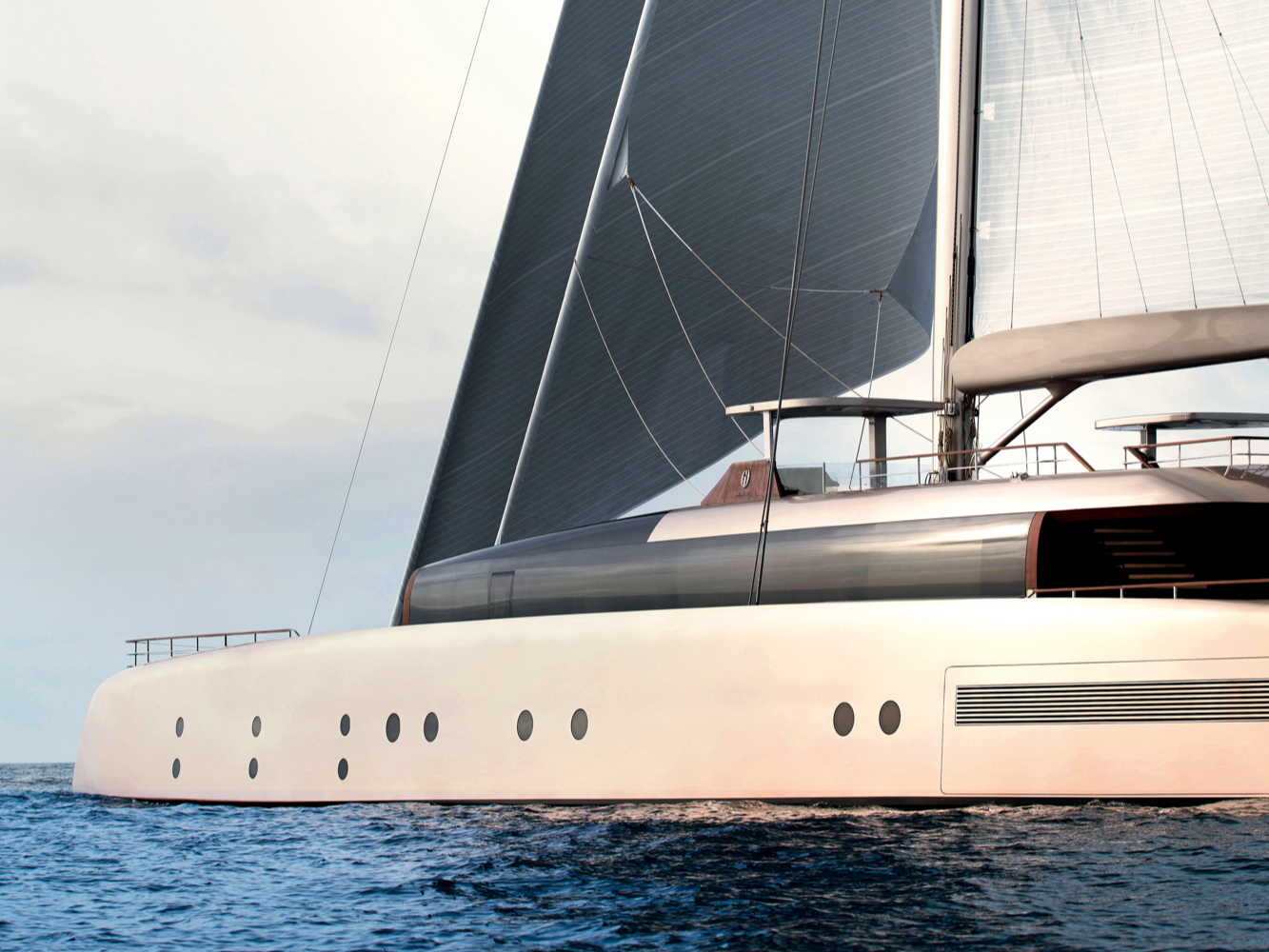
Others cross the line without holding back. “This Is It,” a 43.5-meter Tecnomar motor catamaran with a beam of 14.5 meters, also built by The Italian Sea Group, has a gross tonnage of 750 GT—or 758 GT according to the classification register. It features 600 m² of structural glass windows. Its two MTU diesel engines allow it to cruise at 15 knots, with a top speed of 17 knots and a range of 3,300 to 3,500 nautical miles. It was listed at 42 million euros on the brokerage market between late 2024 and 2025. The comparison with the Seawolf X is telling: with nearly equal lengths, one stays under 500 GT, while the other far exceeds 700 GT—and both design philosophies coexist.
A Deck Made for the Sun
The space that captivates guests also captivates engineers. Such a vast deck and superstructure accommodate photovoltaic arrays unmatched on a monohull, sometimes featuring over 200 m² of integrated panels. The slender hulls also reduce drag, making hybrid diesel-electric or even all-electric propulsion more feasible than on a high-displacement monohull.
Art Explorer features 65 m² of solar panels, with an instantaneous power output of 12 kW, connected to lithium batteries that provide more than six hours of emission-free cruising. On the Seawolf X, the BluE hybrid-electric system is controlled by onboard artificial intelligence, dubbed Rossinavi AI. The builder presents some appealing scenarios: a full day of cruising in all-electric mode, or 80% of a transatlantic crossing in this mode. However, these figures are based on the builder’s own models, developed under optimal sailing conditions. They do not represent an average guaranteed in all weather conditions.

The Polish company Sunreef Yachts has built its entire business around this concept. Based in Gdańsk, with a manufacturing facility in Ras Al Khaimah, United Arab Emirates, the shipyard builds only custom luxury multihulls—both sail and motor—ranging from the Sunreef 80 and 100 Sunreef Power series to the Ultima line. Its Sunreef 43M Eco project—a 42.7-meter electric supercatamaran with a beam of 15.4 meters—features a one-piece vacuum-infused composite hull. More than 250 m² of photovoltaic cells would be integrated into the hull and superstructure, supplemented by hydrogenerators that produce energy while under sail. The brand also counts well-known clients among its clientele: Lionel Messi has ordered a 28-meter Sunreef Ultima 88 hybrid for his MIM Ocean fleet.
The price of a 15-meter-wide yacht
The width that gives these boats their charm becomes a problem when it comes time to dock. Measuring between 40 and 50 meters in length, a supercatamaran is 13 to 17 meters wide. This exceeds the standard width of nearly all berths in Mediterranean and Caribbean marinas. This leaves two options. The first is a berth at the end of a pier, normally reserved for mega-yachts, which costs up to four times as much. The second is to remain at anchor permanently.
For an owner who is keen on returning to the dock in front of the terraces of Portofino or Saint-Tropez, this is a real constraint. Yet this situation aligns quite well with the purpose for which these boats were designed: their minimal roll while at anchor and their ability to navigate shallow waters make them better suited for offshore anchoring than for marina life. Luxury catamarans come at a high cost when moored in a marina and reward those who stay away from them.
How Far to Expand
The market is following suit. More than fifty models over 18 meters (60 feet) are in circulation or listed in catalogs for 2025–2026, a sign that a niche has evolved into an organized sub-industry. The global catamaran market was valued at $1.35 billion in 2021. A projection puts it at $2.23 billion in 2030, representing an estimated average annual growth rate of 5.8%. This projection depends on economic conditions and raw material prices and should be interpreted with caution.
For vessels over 60 meters, a distinction must be made between what is actually being built and what remains on the drawing board. Gigayacht catamarans and SWATH vessels—such as the 80-meter project named Decadence by designer Andy Waugh or Sunreef’s designs exceeding 65 meters—are still merely design exercises, with no known firm orders or launches.
The most ambitious concrete project is in Australia. Echo Yachts is building the ASC58 there, a 58.63-meter aluminum sailing catamaran. It will be fitted with a DynaRig rig consisting of two self-supporting rotating masts supplied by Southern Spars. Upon delivery, it is set to become the world’s largest DynaRig-rigged sailing catamaran, offering a glimpse of the scale the next generation may reach.