
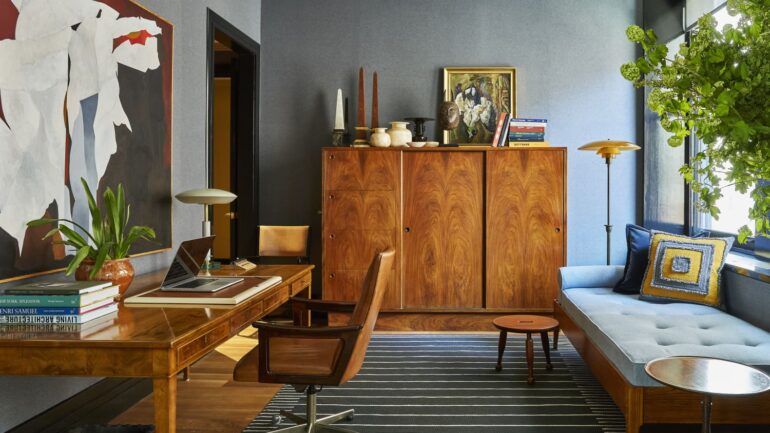
Obsolescence as a New Beginning: A Different Perspective on Personal Space
The aesthetic renewal of an interior no longer necessarily involves an obsessive search for the latest trendy catalog or the alignment of impeccably factory-produced lines. A paradox is taking hold in our homes: it is by looking back—by drawing on objects that have already lived a life—that we manage to infuse a space with a new kind of clarity. This rediscovered vitality does not stem from a lack of flaws, but precisely from the historical depth that period furniture brings to the domestic space. Incorporating pieces marked by time is no longer simply a collector’s pursuit, but an architectural strategy to break with the monotony of uniformity. The idea is simple in concept but radical in execution: using the past to breathe life into the present, from the bedroom to the most utilitarian corners of the bathroom.
This approach transforms the very perception of novelty. Usually, “fresh” is associated with smooth surfaces, white, and the absence of marks. Yet the introduction of a piece of antique furniture creates such a stark contrast with contemporary building standards that it acts as a visual cleanser. It restores a human scale, texture, and shadow where standardization had flattened everything. Vintage furniture then becomes the anchor of a home that is no longer content to be merely a setting, but becomes a place of resonance.
The Bedroom: From a Sleeping Area to a Sanctuary of Character
Within the bedroom, the stakes go beyond the simple functionality of rest. It is the space where intimacy is most absolute, and yet it is often the room most devoid of personality in modern architecture. By incorporating period furniture, you instantly alter the emotional atmosphere of the space. A storage piece with corners softened by the passage of decades, or a wooden structure whose grain tells the story of slow growth, brings a sense of stability that industrial furniture cannot replicate. This physical, almost organic presence redefines the room’s volume.
The effect of “freshness” here is psychological. In an environment saturated with technology and synthetic materials, visual contact with a material that has outlasted trends provides a sense of permanence. The air seems to circulate differently around an object imbued with historical depth. Whether it’s a massive dresser or an occasional chair with a confident patina, the vintage piece breaks the rigidity of the “total look.” It allows you to step out of the impersonal hotel room and into a space that expresses your personality. It is this contrast—this deliberate irregularity—that gives the entire home a less rigid, more lively, and therefore fundamentally fresher feel.
The bedroom thus becomes a laboratory of contrasts. The most contemporary bedding—made of natural fibers and featuring clean lines—finds a perfect counterpart in the complexity of aged wood. This dialogue between eras avoids the pitfall of a dusty museum; it is truly a harmonious coexistence where each element highlights the qualities of the other. The vintage elements do not weigh down the room; rather, they add depth to it, transforming a simple cube intended for sleep into a space for reflection and retreat.
The Bathroom: The Last Bastion of the Unexpected
Even more surprising is the incorporation of antique furniture into the bathroom. Long considered a purely functional space, governed by the demands of waterproofing and cold ceramic tiles, it is now opening up to the influence of the past. This is perhaps where the change in style is most dramatic. By repurposing a vintage piece of furniture—removing it from its original function—and integrating it into this world of tiles and chrome, we break the codes of sterile hygienism.
The introduction of wood, wrought metal, or speckled tin mirrors into a bathroom creates an immediate visual impact. It’s no longer just a bathroom—it’s a living space in its own right. This aesthetic shift alters our perception of cleanliness: freshness no longer comes from the clinical appearance of surfaces, but from the clarity of the decorative intent. An antique piece of furniture, adapted to hold a sink, brings a warmth that humanizes morning rituals. It transforms a space meant for a quick stop into a destination where you want to linger.
This transition from the bedroom to the bathroom creates a narrative continuity throughout the home. The house is no longer divided into distinct, compartmentalized sections—the modern for the kitchen, the practical for the bathroom, the comfortable for the living room—but is unified by the presence of the antique. This cross-cutting coherence is what gives the home its “new” feel: a strong, unique identity that seems to have been thoughtfully crafted rather than bought as a kit. The bathroom, once the neglected stepchild of interior design, becomes the highlight of this revival of the past.
The Overall Dynamics of Architectural Contrast
Ultimately, the use of vintage furniture is not a nostalgic retreat but a tool for staging the present. The result throughout the house is a sense of renewed vitality. The spaces seem larger, not in terms of square footage, but because of the richness of detail they offer the eye. A home that confidently blends eras gives the impression of being in motion, capable of absorbing the passage of time without ever going out of style.
The secret to this “fresh look” lies in balance. It’s not about cluttering every square meter with relics, but about choosing pieces whose silhouette or material will disrupt the linearity of contemporary furniture. It’s a lesson in visual economy: a single striking piece, placed just right, can be enough to redefine the atmosphere of an entire floor. This economy of means, combined with a high standard of aesthetics, defines modern luxury: space, light, and the object that has a story to tell.
As you move from the bedroom to the bathroom, you realize that a home is never more modern than when it embraces its roots. The much-sought-after freshness no longer lies in the brand-new, but in the intelligence of the design. The vintage object, through its endurance over time, paradoxically becomes the best ally of an interior lifestyle oriented toward the future, offering a setting that is both serene and bold. It is in this interplay between decades that the elegance of a home unlike any other takes shape today.