
Make Texture a preferred source on Google to support us
Add Texture to GoogleThe Measurement of Time as a Tipping Point
It all begins with time. Or more precisely, with the way we choose to shape it at the center of a dashboard. According to leaks from Wallpaper magazine, the spark that ignited one of the most radical collaborations between haute couture and precision engineering stemmed from a simple request. Singer, the California-based workshop renowned for its meticulous, almost clinical restoration of vintage Porsche 911s, wanted to integrate a clock into one of its interiors. The commission crossed the Atlantic to land on the workbenches at La Fabrique du Temps Louis Vuitton. The proposal took shape as a dial modeled after the design of the Tambour watch. This detail, which could have remained a discreet touch of flair from the car builder, acted as a catalyst. From this dial emerged a far-reaching concept, culminating in the design of two vehicles conceived not merely as sports cars, but as motorized travel trunks in which the driver’s entire ecosystem is orchestrated by the trunk maker.
Moving Beyond the Logo on the Bodywork
The luxury industry has long viewed the car’s body panels as nothing more than a mundane advertising space, content to simply affix logos to headrests or grilles. That era of lazy branding seems to be over. Today’s classic cars demand a more complex narrative—a depth of craftsmanship that the sheer power of an engine alone can no longer provide. The fusion of the garage and the runway has its recent roots in initiatives such as that of the brand Aimé Leon Dore, which unveiled a completely redesigned Porsche 911 Carrera 4 in New York in 2020. Here, Louis Vuitton takes this approach to its extreme. The challenge is to transpose its philosophy of the Art of Travel into the very heart of a sports car, blurring the lines between luggage, watchmaking, and engine assembly.
Saffron, cobalt, and solid wood beneath the roofline
The first car to emerge from this collaboration—dubbed the Porsche 911 Reimagined by Singer in its Classic configuration—is a true visual sensation. The workshop opted for a striking saffron finish, accented by flashes of yellow and cobalt blue. While the silhouette retains the aggressiveness of historic racetracks, the color palette instantly embraces the Parisian brand’s signature style. The cabin has undergone a radical transformation, upending the usual standards of automotive restoration. Industrial plastic has been ruthlessly hunted down and eradicated in favor of metal-machined controls, creating a new tactile experience under the driver’s fingertips.
For the seats, the craftsmanship shifts to pure leatherwork. Natural leather lines the interior, mimicking the light hues and suppleness of bag handles that develop a patina over the years. The diamond-patterned upholstery, crisscrossed with yellow topstitching, replicates to the millimeter the padded lining of vintage transatlantic trunks. The Monogram pattern, which often tends to dominate the visual space, takes a back seat here, making only fleeting appearances and appearing sparingly in the form of a few flowers on the interior trim. The car’s roof completes this utilitarian vision of escape: a custom-made roof rack dominates the bodywork. It allows for securing the equipment needed for an escape from the asphalt, accommodating everything from skis to an imposing wooden surfboard, stamped with contrasting markings for the occasion.
Nicolas Ghesquière’s Vision of a Rolling Pleasure Craft
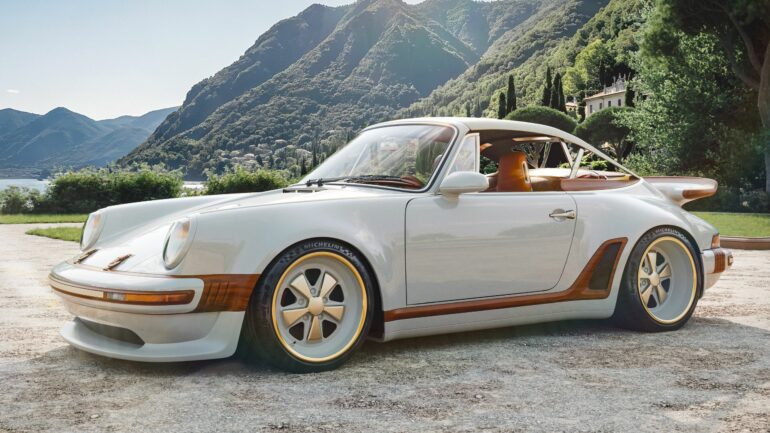
The contrast with the second creation is striking. Entrusted to Nicolas Ghesquière, artistic director of Louis Vuitton’s women’s collections, this Porsche 911 Reimagined by Singer—based on the Turbo model—exudes a completely different aura. Although the engine delivers 510 chevaux, the design emphasizes restraint and sophistication. The designer crafted its lines by turning his back on the asphalt and looking out toward the open sea. The convertible is clad in a particularly understated ivory hue, subtly enlivened by delicate gold accents. The inspiration draws directly from traditional sailing vessels, replacing the ruggedness of racing with the codes of nautical design.
The raw material tones down any showy flair. Ghesquière has employed wood in a sculptural manner, transforming the rear of the vehicle into a deck that immediately brings to mind the striated teak of pleasure yachts. The front compartment, traditionally reserved for luggage, is entirely clad in light wood paneling. The interior takes on the feel of a shipwright’s workshop or a coastal lounge. Ivory, warm-toned leather, and raw wood convey a level of sophistication intended solely for connoisseurs: the opulence lies in the texture of the materials, effortlessly setting aside glitz and ostentation.
A wardrobe tailored for the road
The fusion of these two worlds leaves no room for emptiness. The artisans have extended the concept far beyond the bodywork, encompassing the driver’s entire wardrobe. The founding principle of absolute coherence has given rise to a line of accessories modeled after the identity of each chassis. The automotive press highlights the scope of this array of gear, which transforms the car into a veritable mobile wardrobe. Custom-tailored bags conform to the asymmetry of the trunks. Driving jackets, matching shoes, pairs of gloves, and protective helmets perfectly replicate the shades and leathers of the interiors. Even the most mundane aspects of mobility are addressed: vehicle documents and the set of keys find a home in leather cases hand-carved to fit their exact shape.
This convergence crystallizes the new expectations of the high-end restoration market. Historically, luxury has always revolved around the automobile for its ability to harness speed and cultivate the cult of the rare object. But in an era of mass production, rarity alone loses its appeal. It demands a technical narrative. The surgical expertise of Singer’s workshops lends this dimension of absolute credibility. These two Porsches will never be sold commercially, nor will they have a list price. They exist as cultural prototypes, underscoring the fact that preserving and driving a classic car now requires a holistic approach to materials, craftsmanship, and movement.