
The Art of Concealment in Watchmaking
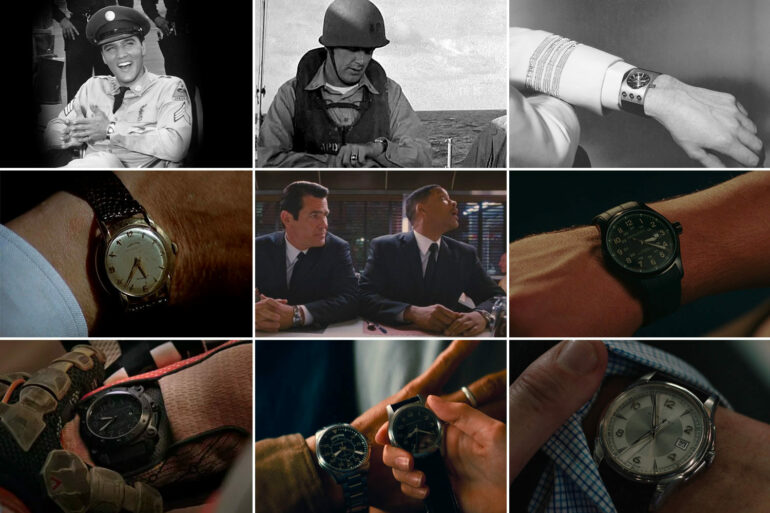
An actor’s wrist often reveals his character’s intentions even before he utters a single line. In the film *Disclosure Day*, the costume designer slipped a Khaki Field Mechanical onto Josh O’Connor’s wrist—a utilitarian, no-frills timepiece. Across from him, Colin Firth wears a Jazzmaster Open Heart, whose openwork dial offers a glimpse of the movement’s inner workings. The watch magazine Hodinkee noted this duality: on one hand, the spontaneity of a man of action; on the other, the rationality of an analytical mind fascinated by the mechanics of things. This choice of “material casting” epitomizes the Hamilton approach. For decades, the American brand has done more than simply place its logo in the camera’s frame. It has provided directors with clues to interpret the scenes.
With a catalog of appearances exceeding five hundred credits—ranging from independent films to blockbusters and television series—the watchmaker has infiltrated film sets with rare consistency. Hollywood eagerly embraces these objects because they add texture to the narrative. A watch never arrives on set as a blank slate: it carries the weight of its design, its era, and its function. And the strength of this brand lies precisely in its ability to provide props that seem to have existed long before the director yells “action.”
Class Deception and the Elegance of the Heist Artist
The integration of a timepiece into a fictional story works all the better when it avoids ostentation. Obvious product placement breaks the fourth wall. Conversely, subtle use reinforces the credibility of the world. George Clooney, stepping into the role of the sophisticated heist master in *Ocean’s Eleven*, needed to wear a timepiece that matched his worldly confidence without drawing the attention of the casino’s security cameras. The Linwood Viewmatic meets these requirements: a understated, refined elegance that adorns the wrist without overpowering the suit sleeve.
This psychological approach to the accessory finds another echo in *The Talented Mr. Ripley*. The main character’s usurped social rise is achieved through a series of skillfully orchestrated visual cues. The Ardmore watch chosen for the film contributes to the construction of this false identity. It accompanies this lie of class with the utmost discretion, proving that a luxury item can become a formidable tool for social manipulation on screen.
Christopher Nolan and the Mechanics of Time
If there is one filmmaker who has understood the narrative potential of a watch face, it is Christopher Nolan. The British director maintains an organic relationship with the measurement of time, and his collaborations with Hamilton go far beyond the mere provision of props. In *Oppenheimer*, the approach was strictly archival. Vintage timepieces were sourced to maintain historical accuracy for the 1940s, eliminating any hint of contemporary promotion in favor of meticulous precision.
But the high point of this partnership remains *Interstellar*. To embody the bond between a father and his daughter that transcends space and time, Nolan needed a physical object. The Khaki Field Murph was designed specifically for the film. It was merely a movie prop, a one-of-a-kind piece intended to capture the emotion of a pivotal scene. The watch’s emotional resonance, however, extended far beyond the big screen. Faced with public enthusiasm, the manufacturer eventually put it into mass production years later. It’s a unique journey: it is no longer reality that fuels fiction, but fiction that gives birth to a commercial product.
The utilitarian aspect of the brand’s watches is also taken to the extreme in hostile environments. The Khaki Navy BeLOWZERO established itself as a piece of survival gear in *The Martian*, before undergoing a conceptual redesign for *Tenet*. Nolan demanded a modification of this combat model to adapt it to the laws of time inversion that govern the film. The watchmaker complied, delving into the realms of physics and screenwriting rather than limiting himself to aesthetics.
From Pop Geometry to Virtual Worlds
A watch collection’s adaptability is measured by its ability to transcend genres. Long before interstellar travel, the Ventura’s radical asymmetry had captured the spirit of the rock ’n’ roll era. By wearing it on his wrist in *Blue Hawaii*, Elvis Presley etched that steel triangle into the collective unconscious. The model already possessed undeniable visual impact, but its appearance on camera definitively anchored it in pop culture, justifying its many reissues.
Today, the horizon extends beyond Earth’s archives. For *Dune: Part Two*, the creative process has reached a new milestone. Denis Villeneuve’s teams and the brand’s designers have jointly conceived a “Desert Watch.” It is no longer an object from the present projected into the future, but a purely fictional artifact, designed for the harshness of Arrakis, which subsequently gave rise to very real limited editions. The collaboration becomes an extension of the film’s universe.
This versatility naturally opens the door to new media. The brand’s appearance in *Death Stranding 2: On the Beach* illustrates an ongoing transformation. Video games, the new frontier of visual storytelling, incorporate the timepiece with the same symbolic significance as traditional cinema. Whether on a movie screen or a game console, the watch continues to shape the action and capture the viewer’s attention.
The story began amid the smoke of a train in 1932. Marlene Dietrich handled a timepiece in *Shanghai Express*, laying the groundwork for a long tradition. Nearly a century later, Hamilton’s enduring presence on film sets is rooted in iron discipline: designing timepieces with enough character to hold their own on screen, yet enough humility to take a back seat to the plot. A watchmaker’s greatest achievement in cinema is not to dominate the frame, but to set the tempo of the scene.