
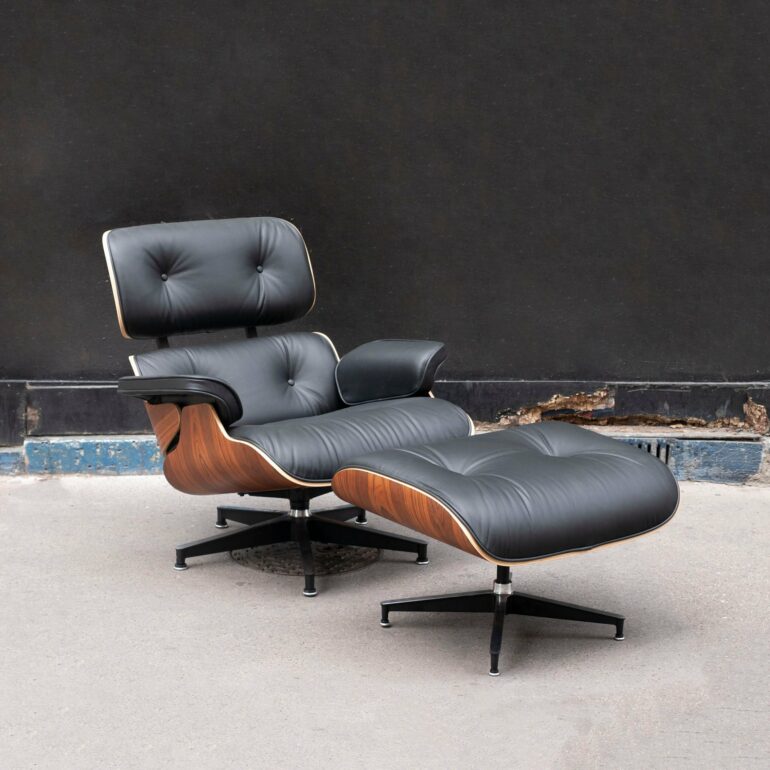
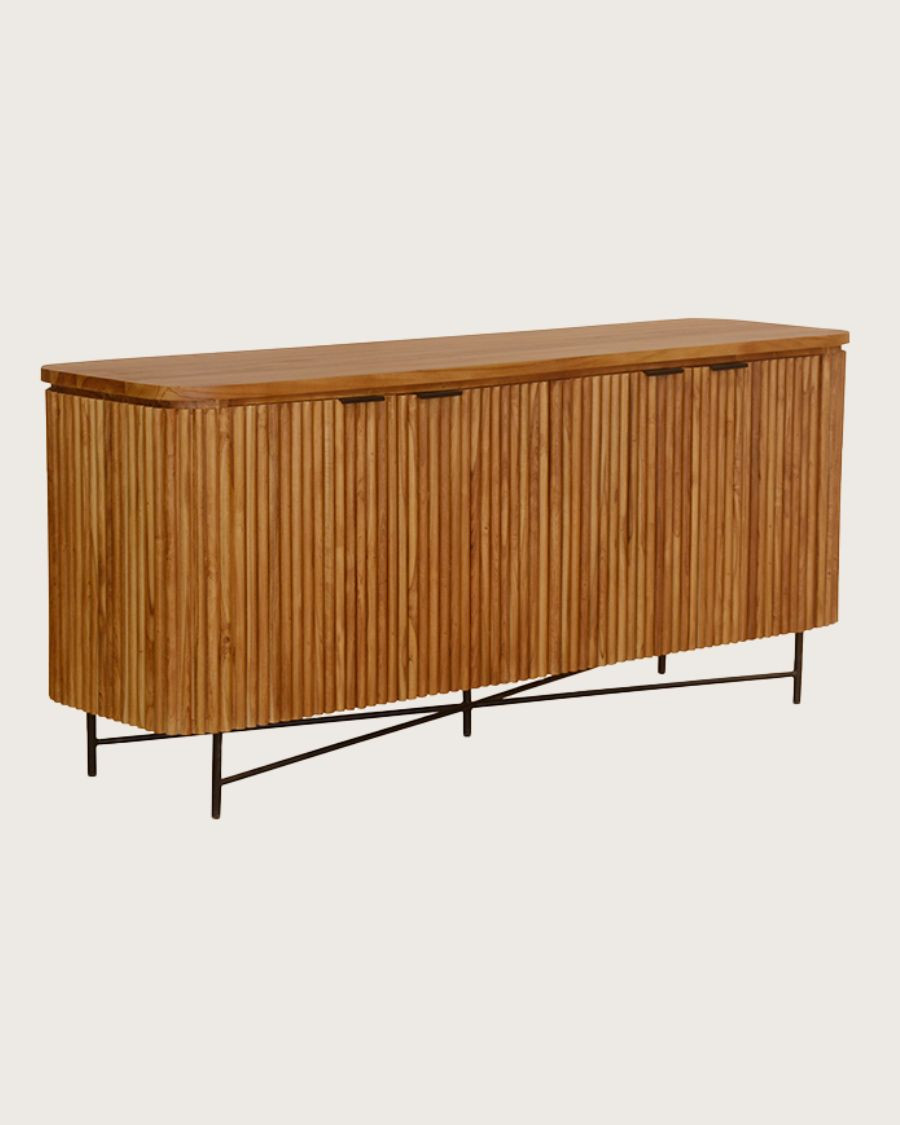
All you have to do is flip through the pages of interior design magazines or step inside an apartment recently redesigned by a leading Parisian or New York design firm. One constant stands out, almost as a rule. There, beneath a ceiling height that can sometimes feel restrictive, stands a walnut sideboard with elongated lines. Further along, an armchair whose fiberglass or molded plywood shell seems to defy gravity on a slender metal base. Furniture from the Mid-century modern movement has quietly taken over our contemporary living spaces. Far from fading with the decades, this aesthetic—born amid the turmoil of the postwar era—now exerts a fascination bordering on obsession among interior designers. To grasp the roots of this phenomenon, we must look beyond mere trends and dissect what fundamentally constitutes the most influential spatial grammar of the 20th century.
The Need for a New Domestic Equation
The very term “Mid-century modern,” later theorized by the American author Cara Greenberg in the 1980s, encompasses a creative period roughly spanning from 1945 to the late 1960s. Its origins, however, lie not in a quest for luxury, but in a social and economic urgency. In the aftermath of World War II, the need to rebuild and provide housing on a massive scale for a rapidly growing population forced architects and designers to rethink the home. Victorian interiors—dark, compartmentalized, and heavily ornamented—no longer met the aspirations of a society focused on the future, light, and functionality.
The shortage of traditional materials and technological advances made by the defense industry opened up new possibilities. Plywood—previously bent to make medical splints or the fuselages of light aircraft—made its way into the living room. Fiberglass, resin, synthetic foams, and tubular steel are replacing solid carved wood. In the United States, visionary manufacturers like Herman Miller and Knoll immediately grasped the challenge: to mass-produce rational, affordable furniture designed to fit the new open-plan layouts of modern homes.
The Cranbrook Melting Pot and European Influence
While the style flourished on American soil, its DNA is deeply hybrid. The rising dangers in Europe during the 1930s prompted leading figures of the Bauhaus, such as Walter Gropius and Ludwig Mies van der Rohe, to flee to the United States. They brought with them the functionalist dogma: ornament is a crime; form must follow function. This Germanic rigor found fertile ground across the Atlantic, particularly at the Cranbrook Academy of Art in Michigan.
It was in these studios that the figures who would define the coming decade crossed paths: Charles and Ray Eames, Eero Saarinen, Harry Bertoia, and Florence Knoll. Their work sought to humanize the geometric coldness of early modernism. They introduced organic curves and silhouettes dictated by the ergonomics of the human body. Saarinen’s Womb Chair and the Eames’ Lounge Chair are not merely seats; they are engineering manifestos that place physical comfort on the same level of importance as visual purity.
At the same time, Northern Europe was developing its own interpretation of this modernity. The Scandinavian branch of the movement, led by designers such as Hans Wegner, Arne Jacobsen, and Finn Juhl, countered American industrialization with a more artisanal approach. Metal was rarely used, supplanted by warm woods such as teak, rosewood, and oak. The lines are soft, almost sculptural. This duality between American industrial rationalism and Scandinavian organic warmth gives Mid-Century Modern a versatility that largely explains its longevity.
The mechanics of empty space and visual lightness
What obsesses today’s interior designers above all is the art of proportion. Contemporary homes, even in the high-end real estate market, often present spatial challenges. Open-plan rooms require furniture capable of structuring the space without overwhelming it. The Mid-Century design language precisely meets these requirements through a principle of elevation.
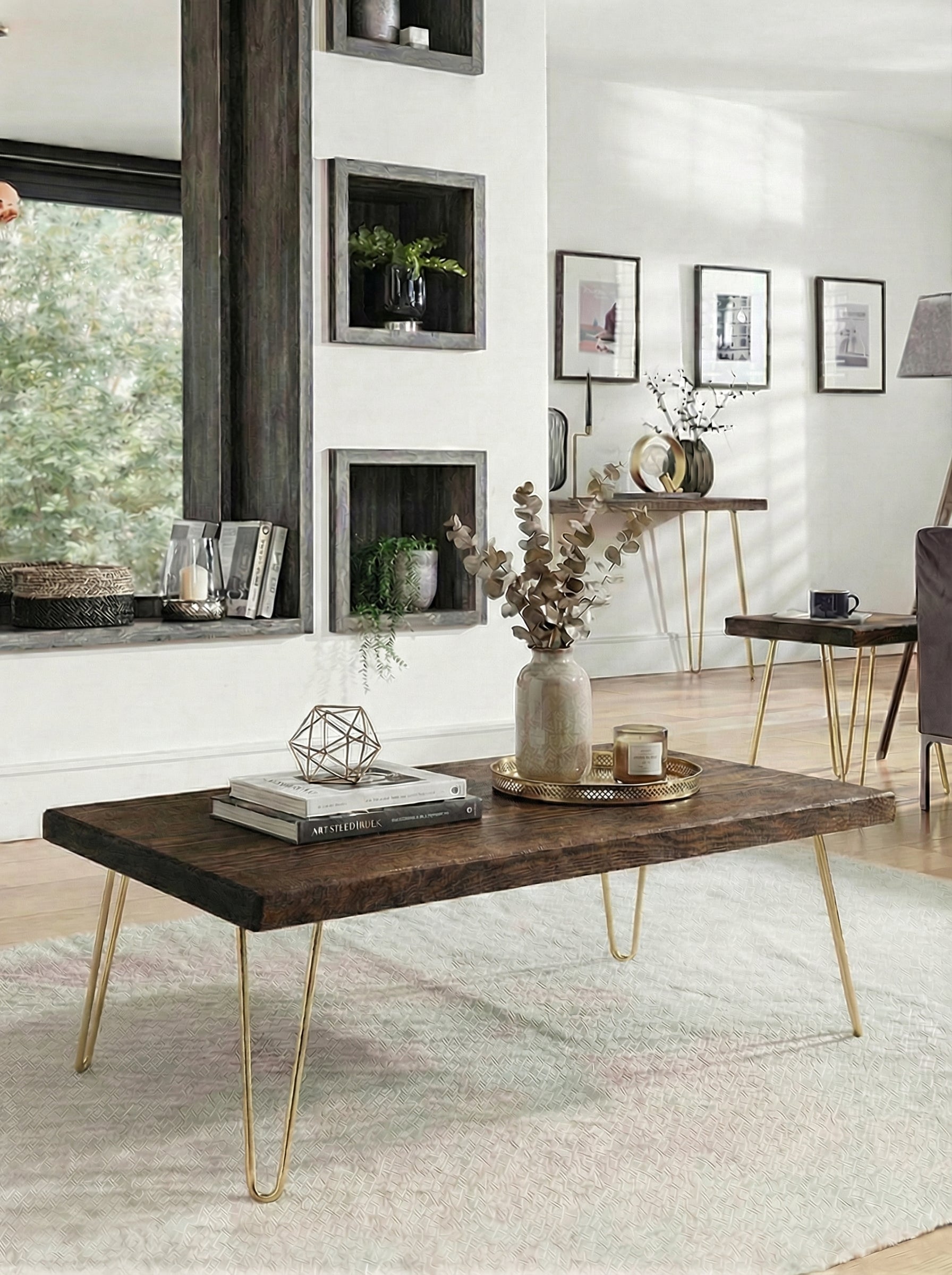
Sofas, sideboards, and armchairs are consistently raised off the floor, perched on tapered wooden legs or metal hairpin legs. This elevation allows light and the eye to circulate beneath the furniture, creating an illusion of space and lightness. A heavy piece of furniture placed directly on the floor anchors the space and makes the room feel smaller. In contrast, a design from this era seems to float. It occupies minimal physical space while offering maximum visual impact.
The absence of ornamentation and moldings also allows the materials to speak for themselves. A Carrara marble top on a Tulip table, the tight grain of a walnut veneer on a dresser, the raw weave of wool on an armchair: the material itself becomes the sole decoration. This material integrity resonates with our era, weary of synthetics and in search of tangibility.

Solving the Contemporary Equation
The widespread incorporation of these pieces into current projects isn’t a matter of blind nostalgia. Interior designers use Mid-century modern as a unifying element, a buffer zone between different time periods. Placed in a minimalist concrete cube with Brutalist architecture, an armchair with curved lines and weathered leather provides the necessary contrast to warm up the space. Conversely, in a Haussmann-style apartment saturated with moldings, cornices, and herringbone parquet floors, the clean lines of a coffee table designed by Isamu Noguchi act as a point of visual tension that balances the space and modernizes the overall look.
This furniture possesses the rare ability to never monopolize attention while still asserting a strong identity. It coexists naturally with contemporary art; galleries and collectors have long associated abstract paintings and Pop Art with these clean lines.
From Democratization to Speculation
There is, however, a profound paradox in this contemporary obsession. Pieces designed for mass production—intended for the American middle class or young European households of the 1950s—have undergone a radical transformation. The art market has seized upon this heritage. Original editions, bearing the hallmarks of their early years of production, now fetch stratospheric prices under the hammers of auction houses.
Collectors seek out the distinctive patina of vintage leather or the essence of a precious wood whose harvesting is now banned. Faced with this scarcity of historic pieces, contemporary manufacturers—such as Vitra and Carl Hansen & Søn—continue to produce certified models, sometimes subtly adapting the dimensions to modern body types or modifying the materials to meet the ecological standards of our century.
The survival of this aesthetic vocabulary does not stem from a passing trend—which is, by its very nature, fleeting—but from its technical and proportional accuracy. When you run your hand along the tapered armrest of a Chieftain chair or observe the invisible junction between metal and wood on a Florence Knoll sideboard, you are not looking at the past. You are observing a precise formal response to an ergonomic and spatial problem. A solution so exact, so stripped of the superfluous, that no decade has yet succeeded in rendering it obsolete.