
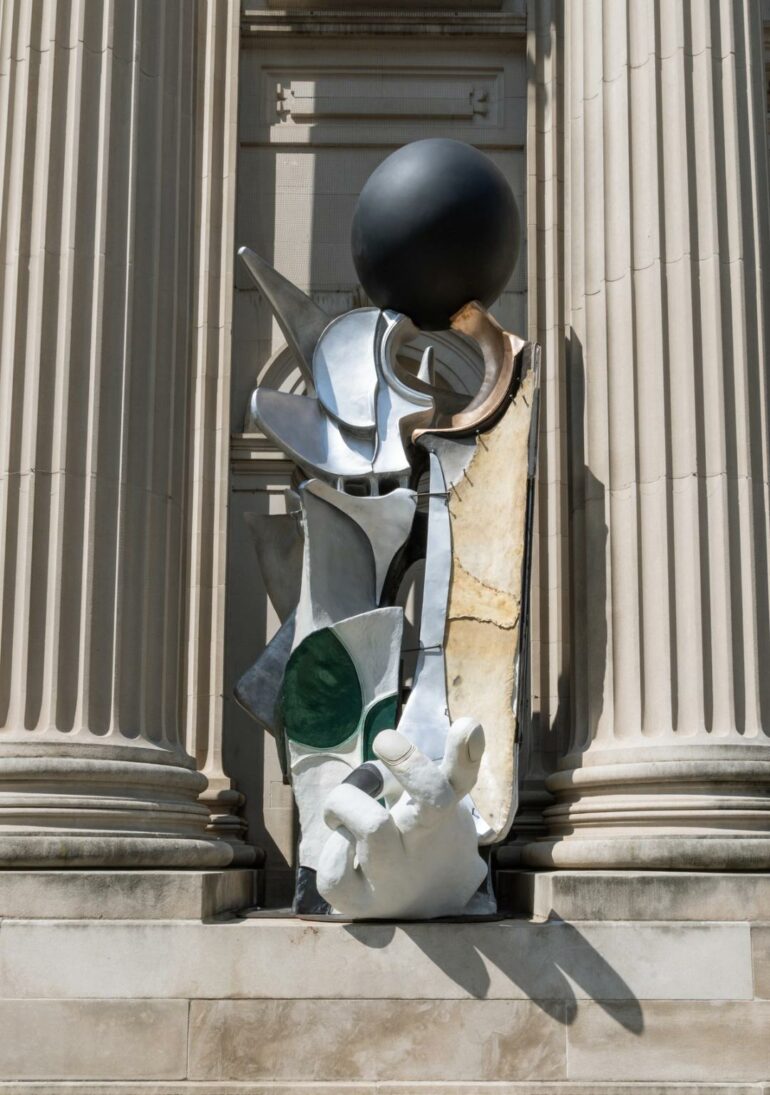
Since Thursday, September 17, 2026, the familiar skyline of Fifth Avenue has changed dramatically. In the niches of the Metropolitan Museum of Art’s Beaux-Arts façade—usually reserved for classical statuary or left empty—Liu Wei’s hybrid structures now take center stage. The Beijing-based artist, born in 1972, presents his first major institutional installation in the United States with a commission titled *The Genesis Facade Commission: Liu Wei, Speculation*. These four monumental sculptures, designed specifically for Richard Morris Hunt’s architecture, explore the notions of structure, failure, and reconstruction through a visual language that defies simple categorization.
An archaeology of the present in four acts
The installation is divided into four distinct pieces, bearing the cryptic titles Speculation / Λ, Speculation / G, Speculation / c, and Speculation / h. This choice of titling, blending Latin and Greek letters, seems to echo the complexity of the materials used. Liu Wei has assembled a motley collection: fiberglass composite, steel, bronze, aluminum alloy, and polyurethane paint. Even more surprising for an outdoor exhibition exposed to New York’s harsh weather, the artist has incorporated iron chains and rawhide, lending an organic and almost carnal dimension to these otherwise highly industrial structures.
Visually, the work is striking for its combination of biomorphic forms and modernist geometries. Smooth spheres sit alongside rigid metal frameworks, creating a contrast between the fluidity of living forms and the rigor of urban construction. A recurring motif catches the eye: that of the human hand. These monumental hands, positioned at the base of the main pieces, adopt poses reminiscent of mudras—the symbolic gestures derived from Asian spiritual traditions. This use of manual iconography anchors the sculptures in an anthropological dimension, reminding us that behind every architectural or archaeological transformation lies human gesture, tool, and intention.
The Poetics of Seam and Change
Working from Beijing, a metropolis marked by perpetual and ultra-rapid urban transformation, Liu Wei infuses this commission with a reflection on cycles of rupture. His works are not monolithic blocks, but assemblages that appear to have been broken and then repaired, or “sutured .” This theme of repair is central to his exploration of periods of civic instability and social change. The sculptures at the Met thus become metaphors for contemporary societies, forced to come to terms with the remnants of the past in order to erect new structures—often precarious or contradictory.
The choice of materials is integral to this narrative of organized chaos. Raw leather, subject to changes in the air, and bronze, an unchanging metal, engage in a dialogue about the longevity of civilizations. The artist uses these architectural and archaeological references not to celebrate history, but to examine how we inhabit the present amid ruins and construction sites. Curated by Lesley Ma, Curator (Ming Chu Hsu and Daniel Xu Curator) in the Met’s Department of Modern and Contemporary Art, the exhibition highlights Liu Wei’s ability to transform cold industrial materials into a sensitive reflection on the fragility of our social structures.
A Strategic Milestone for the Metropolitan Museum
This seventh edition of the facade commission holds particular historical significance for the institution. It is the first project of this scale entrusted to a China-based artist since 2006. The initiative is part of a commitment to diversification and international outreach, driven by the multi-year partnership with the Genesis automotive brand. Liu Wei thus follows in the footsteps of Lee Bul (2024) and Jeffrey Gibson (2025), marking the third collaboration under the auspices of this sponsorship.
Beyond its aesthetic appeal, this project foreshadows the museum’s architectural future. Liu Wei’s installation serves as a visual prologue to the programming of the future modern and contemporary art pavilion, the Tang Wing, which is officially scheduled to open in 2030. By extending onto the building’s exterior, the Met signals its transformation: contemporary art is no longer just a section within its walls but has become the primary interface with the city. Funding for this large-scale project relies on a strong network of supporters, including the Director’s Fund, East West Bank, the Hazen Polsky Foundation, as well as contributions from Zimo Zeng and Lehmann Maupin Gallery. Additional support has been provided by White Cube, Audrey Ou, Marietta Wu & Thomas Yamamoto, as well as Jerry Speyer & Katherine Farley.
An Accessible Work in the Heart of the City
One of the fundamental aspects of this commission is its accessibility. Unlike the indoor galleries, where entry is subject to the museum’s general admission policy, the sculptures on the facade are visible free of charge to all passersby on Fifth Avenue. This decision to place Liu Wei’s art directly within the flow of urban life reinforces the artist’s vision of the city as a space of constant confrontation and creation. The works will remain in place until June 8, 2027, giving New Yorkers and visitors a full year to observe how these structures respond to the changing seasons.
For those wishing to explore the artist’s approach in greater depth, an event titled “An Evening with Liu Wei” will be held on Tuesday, September 22, 2026, at 6:30 p.m. This public event, featuring Liu Wei and curator Lesley Ma, is free of charge by reservation. It will be an opportunity to explore the tensions at play in *Speculation*—between rigid steel and raw leather, and between the tradition of mudras and the boldness of industrial forms. While the institution has not yet announced what will become of the works after the exhibition closes in June 2027, their impact on the Met’s historic façade already marks a turning point in the way the museum engages with contemporary Chinese art.