
A central leg, a tabletop reduced to its most basic geometric form, and that defiant futility that defines it. Long relegated to the blind spots of our living rooms, the pedestal table watches the coming and going of massive sofas and armchairs with the detachment of those who have nothing to prove. It does not gather guests around a meal, nor does it conceal any personal belongings in deep drawers. Its primary function borders on the paradoxical: to provide a temporary resting place for a single object—a teacup, a book lying face-down on the table, a candelabra, a crystal glass. In the vocabulary of the decorative arts, this occasional piece acts as a punctuation mark. It opens up the space, breaks up the heaviness of an overly symmetrical layout, and reminds us that the elegance of an interior is often measured by its most superfluous elements.
Yet behind this delicate appearance and its status as the eternal supporting actor lies a complex history. The silhouette we recognize today—this floating table resting on a tripod or a single column—emerged only after a long semantic and formal evolution. Before it was cast in mahogany, marble, or brass, the object had a face, a body, and even a voice in the theaters of Paris.
From Theatrical Farce to the Marble Court
The etymology of the word reveals unexpected origins. In the early 17th century, court ballets and popular farces featured a recurring character: a Moorish servant named Guéridon. The success of this comic figure—often depicted holding a tray—quickly spread from the stage to the sculptors’ workshops. Artisans began carving figures of slaves or servants out of wood, richly painted and gilded, with a raised arm or head supporting a flat tablet. The piece of furniture took its name from its theatrical counterpart. At that time, its purpose was purely utilitarian and intended for nighttime use; in fact, it was commonly referred to as a “torch holder.”
The social rise of this sculpted figure took place under Louis XIV. In the Grand Apartments of the Palace of Versailles, light was a matter of power. Gilded wooden guéridons proliferated, but the Sun King went a step further by commissioning solid silver versions for the Hall of Mirrors. These monumental pieces of silverwork, cast in 1689 to finance the War of the League of Augsburg, marked the height of an ostentatious style. Deprived of its precious metal, furniture would have to reinvent itself, gradually abandoning its human form to embrace a more abstract architecture.
The Choreography of Intimate Salons
The Age of Enlightenment marked the end of rigidity. Under Louis XV, and later Louis XVI, etiquette became more flexible, and court society fragmented into smaller circles. Vast galleries gave way to boudoirs, private retreats, and small salons. This need for intimacy revolutionized furniture design: people now demanded lightweight pieces capable of keeping pace with conversations and being moved according to the mood of the moment. The guéridon became the mechanical companion to this new form of social interaction.
Haberdashers, the true artistic directors of the era, set new standards for proportions. The tabletop became rounded, framed by a gilded, openwork bronze rail to hold porcelain. The base definitively abandoned the human form, dividing into three slender, often arched legs, ending in delicate feet. Cabinetmakers displayed masterful craftsmanship on surfaces sometimes no more than thirty centimeters in diameter. Veneers of rosewood, amaranth, or lemonwood replaced uniform gilding. Secret mechanisms, retractable shelves, and even tiered compartments were sometimes incorporated. One no longer sits facing the piece of furniture; instead, one moves around it. It becomes the silent focal point of literary salons, the island where one sets aside the latest newspaper or the note one refuses to read aloud.
Ancient Rigor and Military Campaigns
The French Revolution severed heads and shattered curved lines. With the advent of the Directory, then the Empire, the side table underwent a radical overhaul. The excavations at Herculaneum and Pompeii infused Europe with a passion for antiquity, and the guéridon found historical justification for its tripod base in Greco-Roman furniture. Forms became stiffer, and Cuban mahogany established itself as the definitive material—dark, dense, and impenetrable.

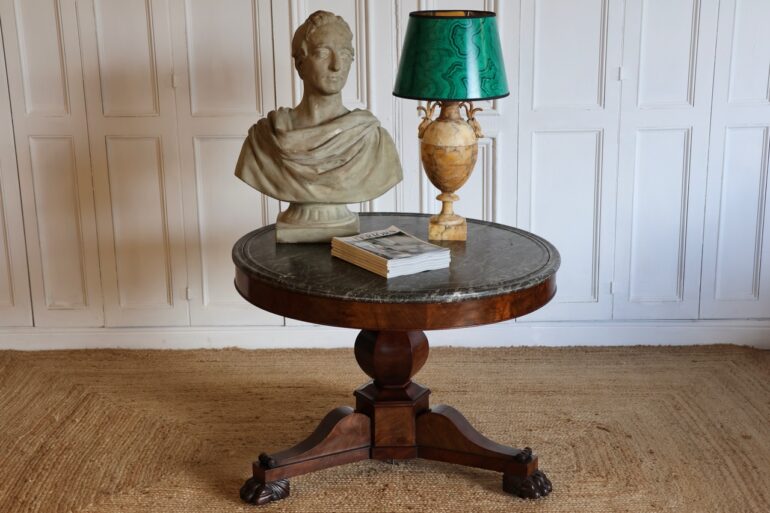
Under the influence of the architects Charles Percier and Pierre-François-Léonard Fontaine, this small piece of furniture took on the appearance of a miniature monument. The central shaft takes the form of a lictor’s fasces or a Doric column. The legs end in heavy lion’s claws made of bronze with a green or gold-plated patina, resting on a triangular base. The floral marquetry tabletop is replaced by a cold, heavy marble disc—porphyry, antique green, Sainte-Anne, or Italian griotte. Even on a smaller scale, the object must exude authority and conquest. The Egyptian campaigns brought with them a wealth of caryatids, sphinx heads, and palmettes that adorn the bands of these tables, now imbued with a martial spirit. At the Musée des Arts Décoratifs, the collections from this period reveal a fascinating paradox: how an object designed for lightness could so naturally assimilate the massive aesthetic of an empire at war.
The Subtraction of Material
The survival of this type of table into the 20th century was something of a challenge. The gradual disappearance of domestic life and the radical transformation of our living spaces could have relegated this small round table to antique dealers. Yet, paradoxically, the advent of modernism would breathe new life into it through subtraction.
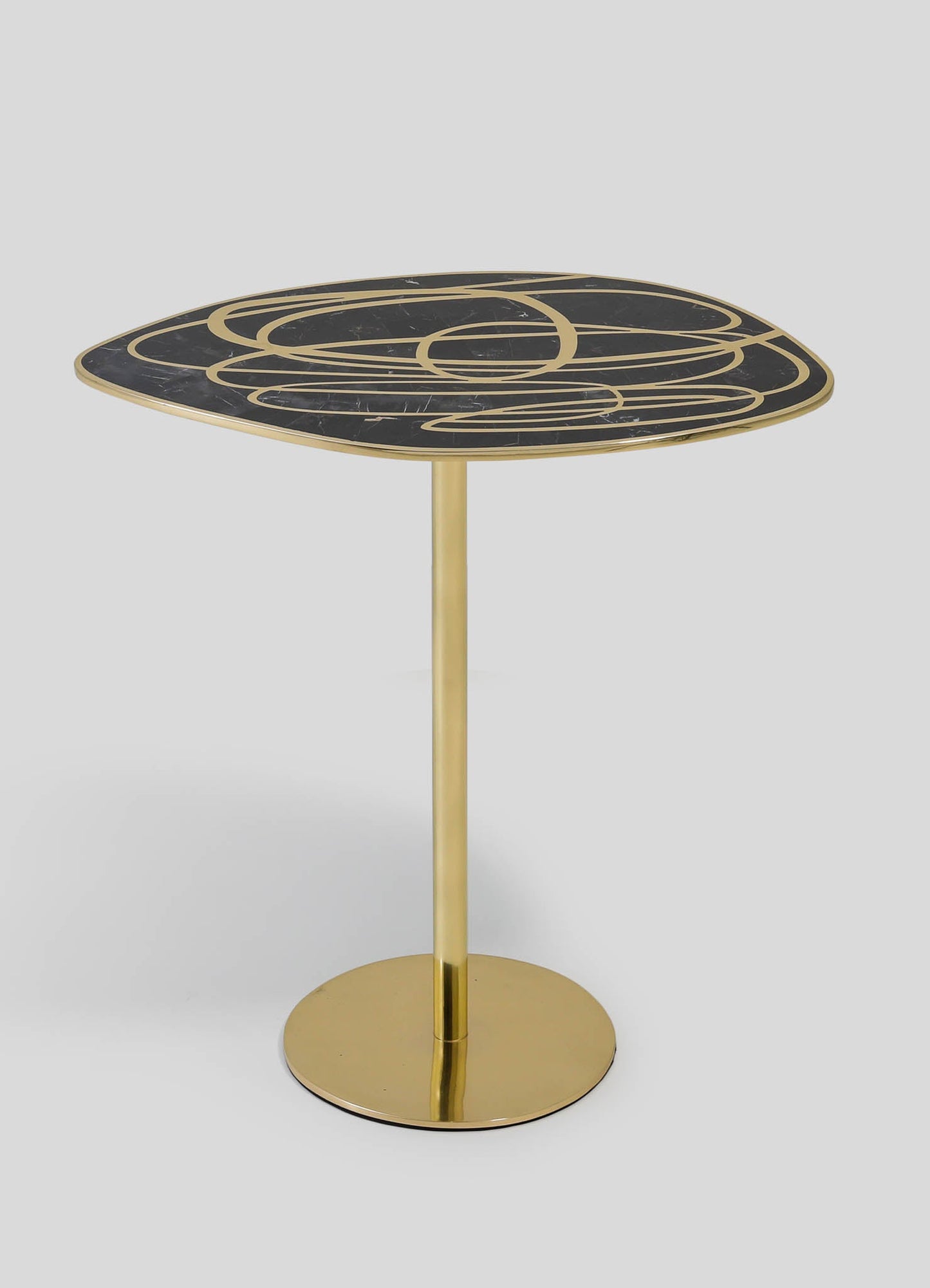
Interior designers of the Art Deco period stripped away ornamentation while preserving the nobility of the materials. Macassar ebony, stingray leather, and chrome-plated metal adorned lines that had become purely geometric. But it was truly the postwar era that established the definitive form of the contemporary side table. By replacing the multi-legged base with a single central leg that flares out toward the floor, designers solved the age-old problem of visual and physical clutter. The table no longer has “legs”; it springs from the floor.
Today, freed from any obligation to support a candelabra or display the coat of arms of a royal cabinetmaker, the object stands on its own as a pure sculptural composition. A simple disc of brushed aluminum, suspended on a steel rod and placed at the end of a modular sofa, is enough to structure the space. Far removed from the Moorish servant carved from oak who stammered his first lines during the Grand Siècle, the contemporary silhouette retains its original role: to keep a surface within reach, to discreetly defy gravity, and to impose its rigor on the chaos of a living room.